
Biological characteristics and symptoms of bacterial diseases of agricultural crops
19 min read
Regarding their nutrition, phytopathogenic bacteria (PPB) are heterotrophs and, therefore, capable of growing on nutrient media. On solid nutrient media, bacteria form colonies whose color, shape, and surface are typical for a given species or strain. PPB synthesize two types of pigments: water-insoluble, which do not enter the nutrient medium, and water-soluble, which diffuse into it. The former impart a characteristic color to bacterial colonies, for example, Xanthomonas colonies have a yellow coloration. Soluble pigments are typical for some species of the genus Pseudomonas: the greenish pigment they secrete fluoresces under ultraviolet light, which is why these species are called fluorescent pseudomonads.
The pathogenic properties of bacteria are associated with the activity of their enzymes and toxins. Most PPB possess enzymes that dissolve the middle lamellae of cellular tissue — pectinases, protopectinases, and polygalacturonases. Enzymes of rot pathogens are distinguished by particularly high activity. Toxins secreted by bacteria, by acting on the plant, disrupt its enzymatic systems and cause the death or wilting of the affected tissues and organs.
In PPB, asexual reproduction by dividing the mother cell in half prevails. The rate of bacterial reproduction is striking. Under favorable conditions, bacteria can divide every 20-50 minutes. Therefore, many bacterial diseases have a very short incubation period.
The main symptoms of bacterial diseases include necrosis, chlorosis, rot, tumors, and wilting.
Forms of necrosis can be varied. Thus, angular leaf spot of cucumber (pathogen — P. syringae pv. lachrymans) manifests as necrosis limited by fine veins. Necroses can also have circular and other shapes. Bacterial necrosis is characterized by the appearance of droplets of a cloudy oily liquid — exudate — on them under conditions of high humidity.
When bacteria affect succulent, carbohydrate-rich, parenchymal tissues — tubers, fruits, root crops — the disease manifests as wet rots. In this process, the intercellular substance is destroyed under the action of exoenzymes, as a result of which the affected tissue turns into a soft, mushy mass with a characteristic unpleasant odor. For example, such a symptom manifests in bacterial soft rot of cabbage (E. carotovora subsp. carotovora) or lettuce.
Chlorosis in bacterial infections often appears at early stages of the disease or arises around areas of necrosis.
The formation of tumors or galls as a result of a bacterial infection is observed due to the accelerated division of meristematic cells. This symptom is observed in crown gall, which is caused by Agrobacterium tumefaciens.
In wilting diseases caused by bacteria, the pathogen penetrates the vascular system, spreads through the conducting bundles and adjacent tissues. This disrupts the normal process of water intake in the plant, causing it to wilt. Another cause of wilting is poisoning by bacterial toxins. This type of disease includes vascular wilt of cabbage (Xanthomonas campestris pv. campestris) and bacterial wilt of tomato, caused by Clavibacter michiganensis subsp. michiganensis.
1-3.1. Systematics of phytopathogenic bacteria
Bacteria are divided into 35 systematic groups (Bergey's Manual of Systematic Bacteriology). PPB are found in three systematic groups: 1-3.1.1. Group of Gram-negative aerobic rods, Family Pseudomonadaceae.
Genera Pseudomonas and Xanthomonas. These are Gram-negative motile rods with polar flagella. They synthesize a fluorescent, water-soluble and/or water-insoluble pigment.
Genus Pseudomonas. Gram-negative rods; straight or slightly curved, but not helical, 0.5-1.0 x 1.5-5.0 µm in size. Cells move by means of one or several polar flagella; they are rarely non-motile. In some species, the formation of lateral flagella with a shorter wavelength is also possible. Resting stages are unknown. A characteristic feature of the representatives of the genus is the formation of a blue-green or yellow-green fluorescent pigment. Some colonies can be observed only under ultraviolet rays. In other species, the pigments diffuse into the medium, staining it the corresponding color. The formation of a specific pigment depends on the composition and pH of the medium. In many species, poly-beta-! Fig. 30. BACTERIAL GALL OF ROSE ROOTS | Pseudomonads are widespread in nature; some species are phytopathogens. However, the majority of species are saprotrophs capable of producing various antibiotics, which formed the basis for their use in the production of biological preparations. Pathogens of the most dangerous diseases of vegetable crops: P. corrugata — causes pith necrosis of tomato stems; P. syringae pv. lachrymans — angular leaf spot of cucumber. On MPA microorganisms of this genus form colonies of various shapes. Colonies can be flat or convex, mucoid or pasty, translucent, colorless, or pigmented (dirty white, blue, blue-green, red, yellow, brown, and black). + P. corrugata — bacteria have numerous polar flagella. They do not form a fluorescent pigment. They form a yellow-green diffusing non-fluorescent pigment. They accumulate poly-beta-hydroxybutyrate. Colonies are wrinkled, yellowish, sometimes with a green color. They grow at 37°, but not above 41°. They hydrolyze gelatin. Unlike P. savastanoi, they do not hydrolyze pectate, do not cause rot of onion slices, and do not use D-arabinose, cellobiose, adipate, mesotartrate, and citraconate. P. syringae — bacterial cells have more than one flagellum. It forms a fluorescent diffusing pigment. It does not grow at temperatures above 41°. It uses glucose and nitrates. P. (Ralstonia) solanacearum — has more than one flagellum. In culture, it accumulates poly-beta-hydroxybutyrate. It does not grow at 40°. It does not form pyoverdine and pyocyanin. Genus Xanthomonas. Gram-negative straight rods, 0.2-0.8 x 0.6-2.0 µm in size, predominantly single. They move by means of one polar flagellum. Resting stages are unknown. They do not form poly-beta-hydroxybutyrate inclusions. Fig. 31. AGAR MEDIUM Aerobes; respiration-type metabolism using oxygen as the final electron acceptor. Phytopathogenic species do not reduce nitrate. The optimum temperature is 25-30°. From many carbohydrates, they form acid in small quantities. They grow in a medium with calcium lactate, but not with glutamine. Triphenyltetrazolium chloride at a concentration of 0.1% (usually already 0.02%) inhibits growth. As a rule, they require growth factors, including methionine, glutamic acid, and nicotinic acid or their combination. Colonies are usually yellow, smooth, oily, or sticky. Cells form very specific yellow pigments: bromine-substituted aryl polyenes, or xanthomonadins (with the exception of X. maltophilia, which does not form xanthomonadins). Some species
X. campestris. Bacteria in culture weakly hydrolyze starch and gelatin, and utilize esculin well. They produce hydrogen sulfide from peptone. At temperatures above 35-39°, colony growth ceases. Maximum resistance to sodium chloride is 2-5%. Bacteria produce acid from arabinose, mannose, galactose, trehalose, and fructose. A plant pathogen, it causes parenchymatic, vascular, and systemic bacteriosis of cabbage, tomato, and other plants.
Bacteria inhabit the soil, infecting roots or underground plant parts, causing tissue overgrowth and the formation of tumors on affected organs. More than 1000 species of higher plants, comprising 60% of gymnosperm and dicot species, react to the action of this bacterium by forming tumors.
Fig 32. CULTURE OF X. campestris ON AGAR MEDIUM Genus Agrobacterium. Species of this genus are Gram-negative motile rods, 0.6-0.8 x 1.5-3.0 µm in size, single or in pairs. They do not form spores. They move by means of peritrichous flagella, the number of which varies from 1 to 6. Optimal temperature 25-28°. Colonies are usually convex, round, and smooth. They may be without pigments or of light beige shades.
Growth on media with carbohydrates is usually accompanied by abundant formation of extracellular polysaccharide slime. Bacteria do not assimilate starch, agar-agar, or chitin. For strains of some species and biovars, ammonium salts and nitrates can serve as nitrogen sources, while others require amino acids and additional growth factors.
Oncogenic strains are found mainly in soils where affected plant material has previously been present. Specificity towards hosts is weakly expressed.
A. tumefaciens is the causal agent of crown gall in fruit crops, grapes, chrysanthemum, rose, tomato, and other plant species. The harmfulness of the pathogen is related not so much to the multiplication of bacteria in plant cells as to toxicosis.
Agrobacterium rhizogenes — bacteria acidify the medium (reaction to litmus milk) and cause the formation of tumors on affected stems. 1.3.1.2. Group of Gram-negative facultative-aerobic rods Family Enterobacteriaceae
They cause necrosis and soft rots of various plants. The most well-known pathogens are grouped in the genus Erwinia.
Gram-negative straight rods, 0.5-1.0 x 1.0-3.0 µm, single, in pairs, and sometimes in short chains. These are motile bacteria with peritrichous flagella. They are associated with plants as pathogenic organisms, saprotrophs, or components of epiphytic flora.
Enterobacteria and vascular pathogens: how to recognize a threat in the field
Bacterial plant diseases can cause serious damage to the harvest both in open soil and in greenhouses. Most phytopathogenic bacteria are facultative anaerobes and chemoorganotrophs possessing respiratory and fermentative types of metabolism. Their active development requires elevated temperatures, and the range of affected crops is extremely wide.
In the process of their life activity, these bacteria ferment galactose, β-methylglucoside, sucrose, fructose, D-mannitol, D-mannose, ribose, and D-sorbitol. At the same time, they are rarely able to break down adonitol, dextrin, dulcitol, and melezitose. As sources of carbon and energy, the pathogens use acetate, gluconate, malate, succinate, and fumarate, but are unable to assimilate benzoate, oxalate, or propionate. Most species also do not reduce nitrates.
Among enterobacteria, in practice, one most often has to deal with the following pathogens:
- E. carotovora ssp. carotovora — causes soft stem rot of tomato and bacterial soft rot of cabbage. In culture, the bacteria do not form indole but are capable of releasing hydrogen sulfide and hydrolyzing gelatin.
- E. toxicus — provokes dangerous vascular bacteriosis of cucumber.
- Erwinia chrysanthemi — causes bacteriosis of chrysanthemum. In terms of its metabolism in culture, this pathogen is similar to E. carotovora.
A separate place is occupied by representatives of the genus Clavibacter. Unlike most other bacteria, they are Gram-positive and non-motile. These pathogens cause mainly vascular bacteriosis — wilt diseases — in plants. The most well-known representative of this group is C. michiganensis subsp. michiganensis, which causes bacterial wilt of tomato.
- Optimal temperature for the growth of enterobacteria — 27–30 °C
- Cell size of C. michiganensis subsp. michiganensis — 0.35–0.40 x 0.8–1 µm
Actinomycetes and phytoplasmas: hidden threats in soil and plant tissues
Actinomycetes (according to Bergey's taxonomy) represent a special group of bacteria. Their vegetative body consists of very thin, branching hyphae that radiate in all directions and form a mycelium similar to that of fungi. They reproduce by spores on special organs — sporophores — or by sections of mycelium, forming small colonies of leathery or oily consistency about 10 mm in diameter in culture. Spores germinate with a sprout, just like fungal conidia.
Many actinomycetes produce natural antibiotics that suppress the growth of fungi and other microorganisms. Based on these properties, biological plant protection products have been developed, such as Fungistop, Figolavin-300, and Alirin-S.
Plant diseases are caused by members of the genus Streptomyces. These are Gram-positive microorganisms with an extensively branched mycelium (hyphal diameter 0.5–2.0 µm), which rarely breaks into fragments. Aerial mycelium bears chains of three or more non-motile spores. Some species can form sclerotium-, pycnidium-, and sporangium-like structures. Actinomycete colonies are discrete, lichen-like, leathery, or oily, and their color depends on the pigments produced, which can diffuse into the environment.
The greatest damage to crop production is caused by S. scabies, the pathogen of common scab in potatoes, radish, and other root crops. The disease manifests as small warts, ulcers, and corking of tissues. In severe cases, the ulcers merge, covering the tuber or root crop with a solid crust.
Actinomycetes causing common scab (S. scabies) have high survival rates. They are capable of accumulating in the soil and persisting on affected plant organs.
Phytoplasmas (formerly known as mycoplasmas) occupy an intermediate position between bacteria and viruses. These are pleomorphic (variable in shape) organisms with a diameter of 0.3–0.8 µm, which can appear as spheres, pears, or branched helical filaments. Unlike viruses, they contain two types of nucleic acids (DNA and RNA) and ribosomes, which are similar in size to bacterial ones. Phytoplasmas reproduce by budding or binary fission.
Phytoplasmas lack a rigid cell wall — they are surrounded only by a three-layered elementary membrane. Because of this, they are resistant to penicillin and its analogs but are extremely sensitive to osmotic shock, alcohols, and detergents. Most species are non-motile, however, some spiral forms are capable of rotating, bending, or performing translational and gliding movements on moist surfaces. Phytoplasmas have no resting stages.
- Temperature range for Streptomyces growth — 25–35 °C
- Optimal environmental acidity (pH) — 6.5–8.0
- Cell diameter of phytoplasmas — 0.3–0.8 µm
Species described to date can grow on synthetic cell-free media of varying complexity. Most species require sterols and fatty acids for growth. However, some strains grow poorly on artificial media, and it is easier to isolate them using cell culture. Most species are facultative anaerobes, but some organisms are obligate anaerobes that die in the presence of even minimal amounts of oxygen. Colonies on solid media are very small, usually with a diameter much less than 1 mm. These organisms often penetrate deep into the medium, growing into the agar.
Phytoplasmas are capable of causing significant damage; affected plants often fail to produce a harvest at all, or the yield is sharply reduced. This is explained by the fact that phytoplasmoses disrupt plant growth and development, with stunting being observed. Other characteristic manifestations of phytoplasma diseases are pathological changes in generative organs and increased shoot formation.
Symptoms of phytoplasmoses can include:
- yellowing of leaves (aster yellows);
- formation of a large number of shortened shoots;
- development of leaf-like structures in flowers instead of petals (clover phyllody, or green petals).
On a single plant, general chlorosis, anthocyanosis, growth inhibition, organ deformation, and wilting can be observed simultaneously or sequentially. Phytoplasmas primarily colonize the phloem and spread systematically throughout the plant.
Many species have a broad host range; for example, the aster yellows pathogen also infects carrots, celery, strawberries, and many other plants. Potato stolbur affects plants of the Solanaceae family, as well as weeds of other families, such as bindweed, spurge, thistle, etc.
Vectors of phytoplasmas are mainly leafhoppers, psyllids, thrips, and mites. A number of parasites multiply in the body of the insect vector. Such an insect does not acquire the ability to transmit the infection immediately after feeding on a diseased plant, but only after a certain period during which the phytoplasma multiplies in the vector's body. In plants, phytoplasmas can persist only in living tissues: in tubers, root crops, bulbs, roots, and rhizomes.
Modes of spread and sources of primary infection in bacterioses
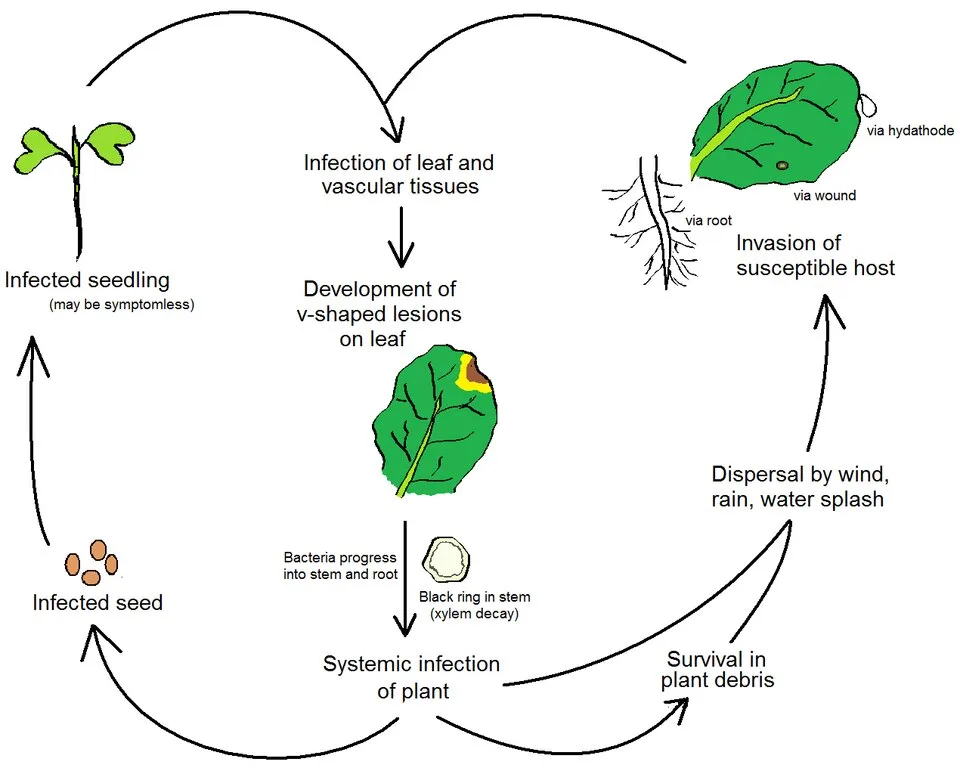
Bacteria are not capable of penetrating directly through the plant's covering tissue. The main route of penetration is through mechanical damage or through natural openings:
- stomata;
- hydathodes (water pores);
- lenticels;
- flowers.
Air humidity is of particular importance for the penetration of bacteria into plants: high air humidity or water droplets on the plant surface facilitate infection. The optimal temperature for the reproduction of most phytopathogenic bacteria (PPB) is 25-30°, so the combination of high air humidity with the optimal temperature favors the penetration of bacteria into the plant and subsequent disease development. The duration of the incubation period for bacterioses also depends to a significant extent on environmental conditions and varies from several days to several months.
Due to their small size, bacteria can move through the vascular system, which ensures rapid colonization of the host by the pathogen, including penetration into seeds. In humid weather, exudates containing a huge number of bacteria often appear in the necrotic zones; these can be carried to neighboring plants by raindrops, wind, insects, and mechanical contact between plants. The spread of phytopathogenic bacteria (PPB) also occurs via tools (machinery components, pruning knives, secateurs, containers). PPB persist in infected seeds, planting material, in plant residues, and more rarely in the soil.
In post-harvest plant residues, PPB can persist until they are completely mineralized. The slower the decomposition process of plant residues, the longer the bacteria remain viable. After the decomposition of plant residues in the soil, PPB quickly die off, as they are suppressed by antagonists — soil microorganisms. The only exceptions are the causative agent of crown gall, Agrobacterium tumefaciens, the causative agent of brown bacterial wilt of potato and tomato, Pseudomonas solanacearum, and some other bacterial species capable of persisting in the soil for several years without association with plant residues. Some PPB species are able to persist for some time on the surface of plants or latently in their tissues.
Based on the effect of bacteria on plants and the degree of tissue damage, two types of diseases are distinguished: diffuse, or systemic, and local.
In diffuse bacterioses, the pathogen penetrates the vascular system and spreads through the conducting bundles and adjacent tissues. This disrupts the normal process of water intake by the plant, causing it to wilt. Sometimes the cause of wilting is poisoning by bacterial toxins. This type of disease includes bacterial canker of tomato (Clavibacter michiganensis subsp. michiganensis) and vascular bacteriosis of cucumber (E. tracheiphila).
Local bacterioses manifest as damage to the parenchymal tissues of individual plant organs — leaves, fruits, shoots, etc. Their main symptoms are:
- necrosis;
- chlorosis;
- rot;
- tumor;
- scab.
When bacteria infect succulent, carbohydrate-rich parenchymal tissues — tubers, fruits, root crops — the disease manifests as soft rots. Under the action of exoenzyme pectinases, the intercellular substance is destroyed, causing the affected tissue to soften, which is observed, for example, in the soft rot of tomato caused by Erwinia carotovora subsp. carotovora.
Chlorosis in bacterial infections is often observed at the early stages of the disease or forms around necrotic areas, as can be seen in tomato plants with bacterial spot. The formation of tumors and galls as a result of a bacterial infection is observed due to the accelerated division of meristematic cells, as, for example, in crown gall caused by Agrobacterium tumefaciens.
Methods of diagnosing bacterial diseases
Visual analysis of symptoms. It is possible to accurately identify a disease based on symptoms only in rare cases when the symptoms are of a specific nature. The bacterial nature of necrosis is often indicated by
Microscopic analysis using staining. A microscopic preparation is made from the affected plant tissue, using the boundary areas between the affected and healthy tissue.
Staining (e.g., Gram staining) facilitates the recognition of bacterial cells in the host plant tissue.
Microbiological method. This consists of isolating the pathogen from the affected tissues onto artificial culture media. It is necessary to establish the pathogenicity of the bacterial isolates, i.e., their ability to cause the same symptoms on artificially infected plants as those observed on the test plant during natural infection. This is done in accordance with Robert Koch's rules, known as Koch's postulates. The method includes three main stages: isolation of the pathogen, infection of the plant, and re-isolation of the pathogen.
Serological method. The essence of this method is the same as in the diagnosis of viruses. The difference between the serological diagnosis of bacteria and that of viruses, and the complexity of the analysis, lies in the fact that a bacterial cell has not only species-specific proteins but also proteins common to the genus and family of bacteria. Therefore, to obtain a specific antiserum, only species-specific proteins (antigens) are used. The most frequently used serological methods are enzyme-linked immunosorbent assay (ELISA) and immunofluorescence reaction. Currently, commercial diagnostic kits for detection are available.
Molecular method. Among several diagnostic methods that use the polymorphism of bacterial DNA molecules, the most common is the amplification (multiplication) of species-specific DNA sequences during the polymerase chain reaction (PCR). During this reaction, individual DNA fragments, characteristic of only one bacterial species, are selectively synthesized by the polymerase enzyme to an amount thousands or millions of times greater than the initial number of copies of the selected DNA fragment. Next, the fragment is detected using agarose gel electrophoresis or by the fluorescence of the initial solution. The method is characterized by high sensitivity (10^-12 g of bacterial DNA is sufficient), speed (up to 2-3 hours), and high reliability. The disadvantages include the high cost of equipment for performing PCR and reagents, as well as the need for preliminary study of the DNA diversity of PPB.
General methods for plant protection against bacterioses. In greenhouses and orangeries, favorable conditions (temperature, high air and substrate humidity) are created for the multiplication of bacteria, however, crops in protected ground are affected by a relatively small number of pathogens. This is because sterilization of the soil is regularly carried out in greenhouses, plant residues are removed, seed treatment is performed, artificial substrates are used, and the soil is enriched with antagonistic microorganisms that prevent the mass development of phytopathogenic bacteria.
Seed is the primary source of initial infection. Growing healthy seed material is the foundation of measures to combat bacterioses, which should be implemented especially strictly in seed-producing companies. Disinfection of seed material using thermal treatment, seed treatment with Phytolavin-300, Planriz, TMTD (thiram), etc., can be carried out both by the seed producer and on commercial farms. For example, the Dutch seed company De Ruiter Seeds thermally disinfects all batches of tomato seeds, and S&G, in addition to this, practices seed treatment with thiram using a film-forming agent.
Most phytopathogenic bacteria can persist in the soil or in the greenhouse substrate. To suppress infection in the soil, its disinfection is carried out. For this purpose, it is steamed or sterilized with preparations such as methyl bromide, dazomet, or Vydate.
During vegetative propagation, measures are taken to obtain healthy mother plants. Healthy planting material from mother plants infected with bacteriosis is obtained using meristem tissue culture. When propagating planting material, culling of affected plants is applied, using visual and other diagnostic methods.
The spread of bacterial infection can be significantly reduced by implementing control measures against vectors, using insecticides and fungicides for this purpose.
The importance of the chemical method in combating bacterioses is limited. For plant treatment, antibiotics such as Phytolavin-300 and biological preparations based on antagonistic bacterial strains (Planriz, Baktofit, Gamair, etc.) or bacteriophages (Pentaphag) are used.
Methods of genetic engineering allow for the introduction of plant resistance genes to bacterial infections. Specific resistance genes to bacterioses are poorly understood; therefore, works devoted to the development of induced non-specific immunity in plants are of great interest. In plants, in response to a pathogen attack, a complex of defense mechanisms is activated. It includes the synthesis of compounds commonly referred to as pathogenesis-related proteins, or PR-proteins.
Read next
Plant protection For agronomists
Diagnosis and plant protection of peppers from viral and bacterial diseases
Plant protection For agronomists
Application of biological preparations based on bacteria and actinomycetes for plant protection
Plant protection For agronomists