
Diagnosis and plant protection of peppers from viral and bacterial diseases
5 min read
Viral diseases of pepper: diagnosis and control measures for CMV and Tomato spotted wilt
Cucumber mosaic virus (CMV) is practically not transmitted through pepper seeds; however, it is capable of spreading rapidly through crops. The main danger is posed by aphid vectors, among which the most important are the species Ar#b d055ury and Mygo4ezperhgsae. Mechanical transmission of the virus during plant care is possible but is not characteristic of it. For accurate diagnosis of the disease, mechanical inoculation of indicator plants (Cucumis sativus) or serological methods (ELISA) are used.
Pepper protection against CMV is based on prevention and timely elimination of infection sources. Agronomists need to rogue out diseased plants and choose tolerant and resistant cultivars for planting. It is important to carry out systematic control of weeds in greenhouses and on the surrounding territory both during the growing season and in the off-season.
To prevent the mass spread of CMV, it is necessary to constantly monitor the population of aphid vectors. Use insecticides such as Actellic, Aktara, or Confidor for treatments.
Tomato spotted wilt virus (Tomato spotted wilt orthotospovirus / TSWV) manifests itself with specific symptoms. On the tops and lateral shoots of pepper, young leaves acquire a bronze or muddy-purple hue, after which brown necrotic rings, stripes, and zigzags form along the main vein. Similar lesions appear on petioles and shoots, often leading to the death of the top. Brown, green, and pale yellow rings form on green fruits, and brown stripes appear near the peduncle; upon ripening, the fruits become mottled.
When performing maintenance work on pepper crops, regularly moisten your hands and tools with a solution of potassium permanganate or skimmed milk. This will prevent the mechanical transmission of viruses from plant to plant.
Bacterial leaf spot: symptoms and crop protection
The causal agent of black bacterial leaf spot of pepper is the bacterium Xanthomonas campestris pv. vesicatoria (also referred to as Xanthomonas campestris pv. vesicatoria). The disease is most damaging in wet years. In greenhouses on new or steamed substrate, the pathogen manifests itself weakly, but in the spring-summer period, it can still affect young leaves and part of the fruits. Infected seedlings often lose their lower leaves, which makes it easy to distinguish bacteriosis from stolbur.
Symptoms of the disease begin with small watery spots on leaves, cotyledons, petioles, stems, and fruits. Over time, they turn black, acquire a round or irregular-angular shape with a size of up to 1–2 mm, and are surrounded by a yellow halo. On the leaves, the spots spread along the veins, acquiring angular outlines with light yellow necrosis in the center. Black elongated spots appear on the stems, which merge and cause the death of the plant.
On the fruits, convex black dots with a watery border first form, which then grow into ulcers up to 6–8 mm in size. The tissue underneath them rots, and the border is replaced by a greenish zone. At an early stage, these symptoms resemble the "bird's eye" characteristic of Clavibacter michiganensis infection, but differ in their convex shape.
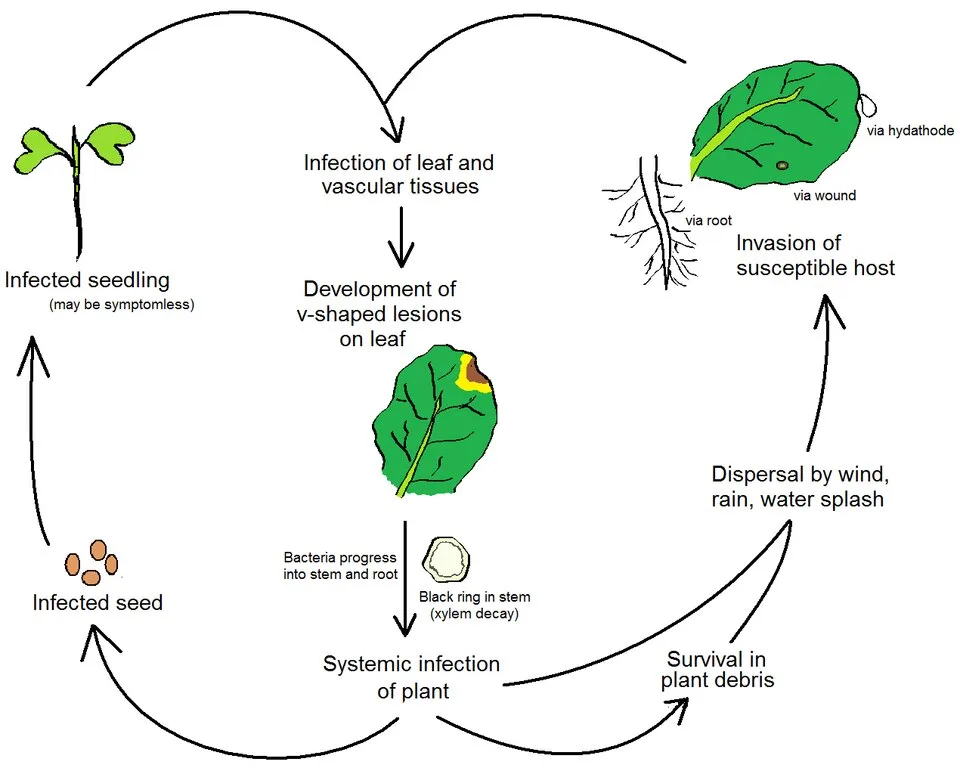
Bacteria penetrate plant tissues through natural stomata and multiply in the intercellular spaces of the parenchyma. They enter young fruits through micro-injuries of hairs, and at later stages through wounds. The development of the disease is promoted by high air humidity and overhead irrigation. The source of infection is infected seed and crop residues, on which bacteria successfully survive due to their resistance to drying and low temperatures.
- Bacterial cell size — 0.6–0.7 x 1.0–1.5 µm
- Optimal development temperature — 25–30 °C
- Bacterial death temperature — above 56 °C
- Disease incubation period — 3–6 days
- Fruit diameter for penetration through hairs — up to 2.5 cm
- Maximum ulcer size on fruits — 6–8 mm
To combat black bacterial leaf spot, a comprehensive approach is required. Build your crop protection sequentially:
- Use only healthy seed, completely free from the pathogen, for sowing.
- Strictly observe crop rotation rules in production areas.
- Choose resistant cultivars and hybrids. The introduction of the Bs gene will soon make it possible to obtain forms resistant to most bacterial strains.
- Timely apply chemical and biological plant protection products.
Read next
Plant protection For agronomists
Diagnostics and prevention of diseases in tomatoes and eggplants
Plant protection For agronomists
Biological characteristics and symptoms of bacterial diseases of agricultural crops
Plant protection For agronomists