
Organization of light and temperature regimes for growing transplants
12 min read
Light and temperature conditions for growing seedlings
High-quality seedlings, grown in an urban apartment, are in no way inferior to plants from professional greenhouses and hotbeds in their characteristics. The main limiting factor in the winter period and the first half of March is the light level. Without creating an optimal light regime, the seedlings quickly become spindly and weak.
- Reduction in light on a windowsill in winter — 100-fold
- Daily supplemental lighting duration — 14–16 hours
- Gap between the lamp and the tops of the plants — 1–1.5 cm
For artificial supplemental lighting, fluorescent lamps are used, which are mounted above the plants at the minimum height. Continuous round-the-clock lighting is unacceptable, as it disrupts the natural physiological rhythms of the crops; the devices must be switched off at night. Installing a directional light-reflecting screen made of foil or white paper on the room side helps to significantly increase the efficiency of lighting.
Additionally, illumination is regulated by the density of plant placement per unit area. To lower night temperatures and prevent the seedlings from becoming spindly, one can set up a room greenhouse, isolating the windowsill from the room's warm air with polyethylene film, or temporarily move the containers to a cooler place.
| Seedling age from emergence, days | Nutrient area, cm² | Seed sowing time | Seedling planting time |
|---|---|---|---|
| 35–40 | 6х6 | March 20–30 | April 20–30 |
| 40–45 | 6х6 | April 10–20 | May 25–31 |
| 45–50 | — | February 5–10 | April 5–10 |
| 60–65 | 10х10 | February 1–5 | April 15–20 |
| 35–40 | — | April 1–10 | May 15–20 |
| 70–75 | — | February 15–20 | May 20–25 |
| 45–50 | — | March 20–25 | May 20–25 |
| 70–75 | — | February 15–20 | May 20–25 |
| 45–50 | — | March 20–25 | May 20–25 |
| 65–70 | — | January 20–25 | April 15–25 |
Substrate preparation and mineral nutrition
The growth of the root system and the overall quality of the seedlings directly depend on the structure and nutrient content of the soil mixture. It is recommended to check the safety and suitability of the finished soil using a biotest: pre-sow a fast-growing crop (e.g., radish). Delayed development, unnatural leaf color, or deformation of the seedlings indicate an excess of salts, which is often encountered when using low-quality humus.
It is preferable to prepare soil for seedlings in areas with known good plant growth. Store-bought peat-based soils require caution due to potential increased acidity and the risk of the presence of toxic ammonium and iron salts.
Mixing the components and the application of mineral fertilizers are performed strictly according to the plan. This allows for balancing the nutrients and preventing chemical burns on young roots.
- Prepare the base: mix 2–3 parts of high-quality decomposed humus and 1 part of soil (add sand when growing seedlings).
- Add vermicompost in a volume not exceeding 1/6 of the total mixture mass.
- Add a scant teaspoon of crushed nitroammophoska to every 1 kg of mixture and mix thoroughly.
- Let the substrate sit for 24 hours, then add a scant tablespoon of wood ash.
Simultaneous application of nitroammophoska and ash is prohibited, as this leads to nitrogen loss through volatilization. To prevent damping-off, which is triggered by drafts, temperature fluctuations, and waterlogging, the substrate is watered once a week with a weak solution of potassium permanganate.
Mineral top dressing is carried out in accordance with the growth stages of the crops. Fruit-bearing vegetable plants (tomato, pepper, eggplant) require phosphorus nutrition at early stages to accelerate flowering and fruit set. Nitrogen excess, especially under low temperatures, weakens the seedlings' immunity and delays ripening. Potash fertilizers optimize the water regime and increase the osmotic pressure of cell sap, which is necessary for the successful hardening of seedlings before transplanting into open ground.
Sowing dates and features of growing pepper seedlings
In experiments with pepper cultivars Druzhok and Pioner, sowing in unheated polyethylene greenhouses was carried out on March 25–30, as soon as the soil reached a workable state. By the time of transplanting into open ground in the third ten-day period of May, the seedling age was 45–50 days. The plants reached a height of 20–25 cm and had 8–9 true leaves. Harvesting with such a simple cultivation method began in mid-July.
To obtain an early harvest or when growing late-maturing cultivars in apartment conditions, sowing is moved to February. Indoors, seedlings develop more slowly, but by the end of May, the seedlings have time to flower and form fruit set. This allows picking the first green fruits as early as mid-June. Accelerated fruiting is provided by a substantial seedling age — 80–90 days.
Growing older pepper seedlings is easier than tomatoes due to lower requirements for nutrient area. For 80–90-day-old pepper, an 8х8 cm container is sufficient. Tomatoes, on the other hand, at 60–65 days of age require pots of at least 10х10 cm, and by 90–100 days they must be transplanted into liter containers. If the area on the windowsill under lamps is limited, pepper can be placed more densely, as it handles temporary crowding well.
- Development delay during pricking out — 5–7 days
- Pot size for pepper (80–90 days) — 8x8 cm
- Pot size for tomatoes (60–65 days) — 10x10 cm
- Daytime temperature for pepper seedlings — 25–27 °С
- Nighttime temperature for pepper seedlings — 11–13 °С
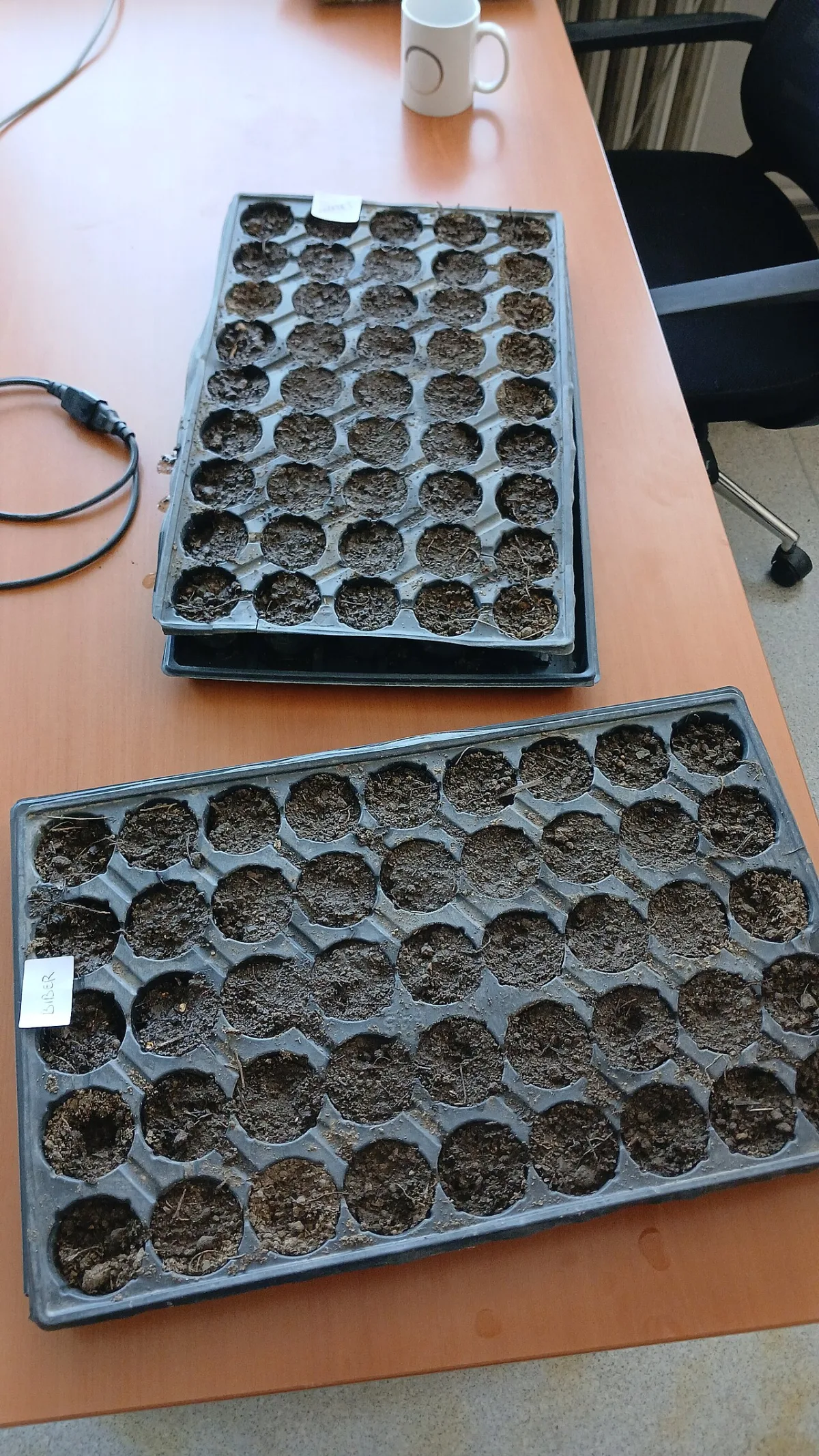
To germinate, pepper seed is placed in Petri dishes or on a damp cloth between saucers and put on a radiator. Once the seed has sprouted, it is transferred with tweezers to a seed tray and later pricked out into plastic cups. It is worth considering that pricking out damages roots and delays plant development by 5–7 days. If there is enough space, it is better to sow sprouted seed directly into individual cups with drainage holes.
For pot-free seedling cultivation in boxes, a technique is used to accelerate emergence. The sown box is covered with plastic film and light-permeable material, then placed on a heating radiator. As soon as the first seedlings appear, the cover is removed. The pot method is preferable to the pot-free method, as it better preserves the root system during transplanting.
Temperature regime, irrigation, and disease prevention
Pepper is demanding of heat and good lighting. The temperature during its cultivation is maintained 4–5 °С higher than for tomatoes. On clear days, the optimal values are 25–27 °С, and at night, they are reduced to 11–13 °С. A lack of heat and light leads to stretching and weakening of the plants.
Special attention is paid to the humidity of the substrate. Dry soil slows down the growth of seedlings and reduces the future yield of plants in the field. Excessive irrigation provokes the development of diseases, especially damping-off. Most often, this rot affects young seedlings when high humidity is combined with temperature fluctuations, drafts, and an acidic soil reaction.
To prevent damping-off, wood ash is added to the soil mixture before sowing. Once a week, the seedlings are watered with a weak solution of potassium permanganate. All irrigation is carried out exclusively with warm water in the morning hours, after which the room must be ventilated. The substrate of older seedlings is moistened especially thoroughly, using the multiple irrigation method.
When growing seedlings in plastic cups, the substrate dries out 2–3 times faster than in boxes or on beds. Such plants must be watered abundantly but rarely, always in the morning hours, followed by ventilation.
Top dressing is carried out strictly according to the schedule to ensure balanced nutrition at different stages of development. The first fertilizer application is planned after the appearance of the first true leaf. The second top dressing is carried out 10–15 days after the first, repeating it twice if necessary. The final hardening top dressing is performed 1–2 days before transplanting the plants to their permanent location.
- First top dressing — after the appearance of the first true leaf.
- Second top dressing — 10–15 days after the first (if necessary, the treatment is repeated twice).
- Third (hardening) top dressing — 1–2 days before transplanting seedlings into the soil.
If you have little experience, stick to the principle of "do no harm." It is safer not to add fertilizer to the seedling mixture at all, but rather to regulate plant nutrition exclusively through liquid top dressing during growth.
Pepper is a light-loving crop, so when growing seedlings in February — the first half of March, it is supplemented with light from fluorescent lamps for 12 hours. Pepper is a short-day crop, and for normal growth, the light day must be limited to the specified period. There are recommendations to cover pepper seedlings with an opaque cover from 7—8 PM to 8—9 AM. But this is advisable only up to the age of 25—30 days, as later the plant loses photoperiodic sensitivity. It has been noted that seedlings grown under a short day are more resistant to low temperatures and enter the budding phase significantly earlier. To increase the efficiency of using light from the lamp, a reflective screen made of foil or white paper is installed behind the windowsill.
The top dressing schedule is indicated in Table 4.
The last top dressing is a hardening one, 1—2 days before transplanting. In this case, against the background of 1 g of ammonium nitrate and 4 g of superphosphate, increased doses of potassium fertilizers are added — 6—8 g per 1 l of water — to increase osmotic pressure, which enhances the suction power of the roots. Top dressing is carried out after thorough irrigation. After each top dressing, it is mandatory to wash the fertilizer off the leaves.
Hardening of seedlings is a special period in their cultivation, which ensures the preservation of the progress achieved in the growth and development of the plant during transplanting into open ground. To do this, for 10—12 days before transplanting, the seedling cultivation regime must be brought as close as possible to open-ground conditions. For this, seedlings are exposed to direct sunlight, aired, and irrigation is reduced. This is done gradually. If the seedlings are growing in an apartment, they are taken out to an open balcony, first for a few hours (preferably in cloudy weather), then around the clock, excluding periods with frost and sustained temperature drops to 13 °С — the biological zero for pepper.
When growing pepper transplants in a hotbed, the film over the plants is gradually removed 10–12 days before planting. Light hardening with direct sunlight is mandatory for growing any transplants. The fact is that not only under glass, but also under film, plants do not receive the full spectrum of sunlight, especially in the ultraviolet range.
And this leads to ultraviolet leaf burns. And pepper
Early transplants should be flowering, and extra-early ones should have fruit set. If the specified growing regimes are observed, the fruit set is preserved during planting and ensures the harvest of the first fruits at the stage of technical maturity as early as mid-June. Among solanaceous crops, pepper can provide the earliest harvest. It is advisable to keep the fruit set on a few transplants, but it is better to remove it from the rest to ensure the growth of the whole plant. There is such a general biological law: a living organism directs all its strength to offspring, especially if it finds itself in unfavorable conditions.
Thus, overgrown transplants direct all nutrients to fruit growth, which sharply inhibits the increase of the assimilation surface and the overall productivity of the plants.
Read next
Greenhouses and covers For gardeners
Sowing and growing technology of tomato transplants for greenhouses
Greenhouses and covers For agronomists
Specifics of growing transplants in hotbeds and film greenhouses
Greenhouses and covers For gardeners