
Cultivating early greens and radishes in hotbeds and greenhouses
11 min read
Growing greens and radish in hotbeds
Producing early greens and radish in protected soil is a reliable way to start the season with high profitability. The success of cultivation depends on the proper substrate preparation, adherence to temperature parameters, and planting density for each crop.
- Temperature for lettuce — 15–20 °C
- Temperature for spinach — from 14 °C
- Temperature for radish — 10–12 °C
- Sowing rate of spinach under a frame — 40–50 g
- Soil layer for dill — 12–15 cm
For growing lettuce in the first rotation, propagator greenhouses or hotbeds on hot manure with a soil layer of 5–7 cm are used. Seedlings are pricked out into boxes with light soil mixed with sand. Upon the appearance of 3–4 true leaves, the transplants are moved to the hotbed soil following a 6x6 cm pattern, planting 400–500 plants under one frame. For later dates, lettuce is sown with seed directly into the soil followed by the thinning of emergence. Lettuce is also well-suited for intercropping with cucumbers.
Sowing lettuce at different times allows for the organization of a continuous conveyor for obtaining fresh greens over a long period.
Water and top dress lettuce with nitrogen strictly in the row spacings using a watering can without a rose. Water contact with the leaves causes rapid rotting. In cold weather and during early sowing periods, be sure to cover hotbeds at night with mats in 1–2 layers.
Spinach is demanding of the soil: a mixture of humus and old hotbed soil with a layer of 12–15 cm is prepared for it. Sowing is carried out with soaked seed in rows with a spacing of 6 cm. The growing season of spinach is 35–40 days. The crop is not as demanding of heat as lettuce but tolerates high temperatures well.
Dill seed is slow to germinate, so they must be specially prepared before sowing:
- Soak the seed in water for 2–3 days.
- Change the water to fresh daily.
- Slightly dry the seed before sowing until they are free-flowing.
Dill is grown on a soil layer of 12–15 cm at a temperature of 15–20 °C. To avoid the plants becoming leggy, hotbeds must be ventilated intensively. The greens are harvested upon reaching a height of 15–20 cm.
Radish is grown on light soils with the addition of humus or old hotbed soil. The seed is sown in rows and covered with a thin layer of humus or sand. The plant density is regulated by thinning the emergence.
| Radish root type | Recommended soil layer, cm | Number of plants under a frame after thinning, pcs. |
|---|---|---|
| Round cultivars | 12–15 | 250–400 |
| Long cultivars | 18–22 | 150–200 |
Excessive heat and high humidity are dangerous for radish. Under such conditions, plants produce excessive foliage, and the root may not form at all. Provide the crop with increased ventilation.
Agrotechnics and temperature regime for cucumbers
Growing cucumbers in protected soil is a technologically complex process requiring strict microclimate control. They are sown either as the first crop in early hotbeds or as the second — after forcing greens or growing transplants. The transplant method is the most preferred, as it guarantees an earlier and higher yield.
- Sowing rate of seed under a frame — 6–8 g
- Yield of transplants from one frame — 200–250 plants
- Air humidity for transplants — 90–95%
- Temperature of irrigation water — 20–25 °C
The best cultivars for hotbeds are recognized as Nerosimye and Vyaznikovskie. Klinskie and Muromskie cucumbers can also be used (the latter start fruiting faster, although they are inferior in total yield). To obtain transplants, the seed is pre-soaked and germinated for 1–2 days. When sowing directly into the hotbed soil, it is also better to use germinated material: dry seed emerges later, which delays the start of fruiting.
| Development phase of cucumber transplants | Optimal temperature regime, °C | Effect of temperature on plants |
|---|---|---|
| Before the emergence of seedlings | 28–30 | Increases germination energy and accelerates emergence |
| After emergence (until the 1st true leaf) | 18 | Promotes better root establishment of plants |
| After the appearance of the first true leaf | 22–25 | Stimulates active growth under high light |
In the process of growing seedlings, as they grow, turf soil is added to the boxes or pots. For irrigation, only warm water is used. Special attention is paid to the preparation of soil mixtures and hotbeds for the second rotation.
When using hotbeds in the second rotation, early hotbeds must be reworked after harvesting the first crop:
- Unload the old soil onto the free path of the hotbed.
- Rework the manure with a pitchfork, adding fresh manure to it.
- Return the prepared soil to its place.
In medium hotbeds with later sowing dates, it is not necessary to rework the manure.
The quality of the substrate directly affects the cucumber yield. The best soil is clean sod soil. If it is scarce or absent, special soil mixtures are prepared:
- In case of a partial deficit, mix 1 part sod soil and 1 part peat soil.
- In the complete absence of sod soil, use fertile loamy garden soil mixed with well-decomposed lowland peat.
Soil preparation, planting of transplants and plant care
- Air humidity in the hotbed — 85–95%
- Thickness of the manure mulch layer — 3–4 cm
- Ventilation time on warm days — 6–8 hours
- Seed warming period before sowing — 2–8 years
Before spreading the soil, a groove 25–80 cm wide and 15 cm deep is made in the center of the hotbed over the manure. Fresh sod soil is poured into it in a layer of 18–20 cm. On the remaining area of the hotbed, on the sides of the groove, old hotbed soil is laid. The thickness of this layer is 10–12 cm on the north side and 7–10 cm on the south side. The soil is leveled with a rake and lightly rolled before sowing or planting.
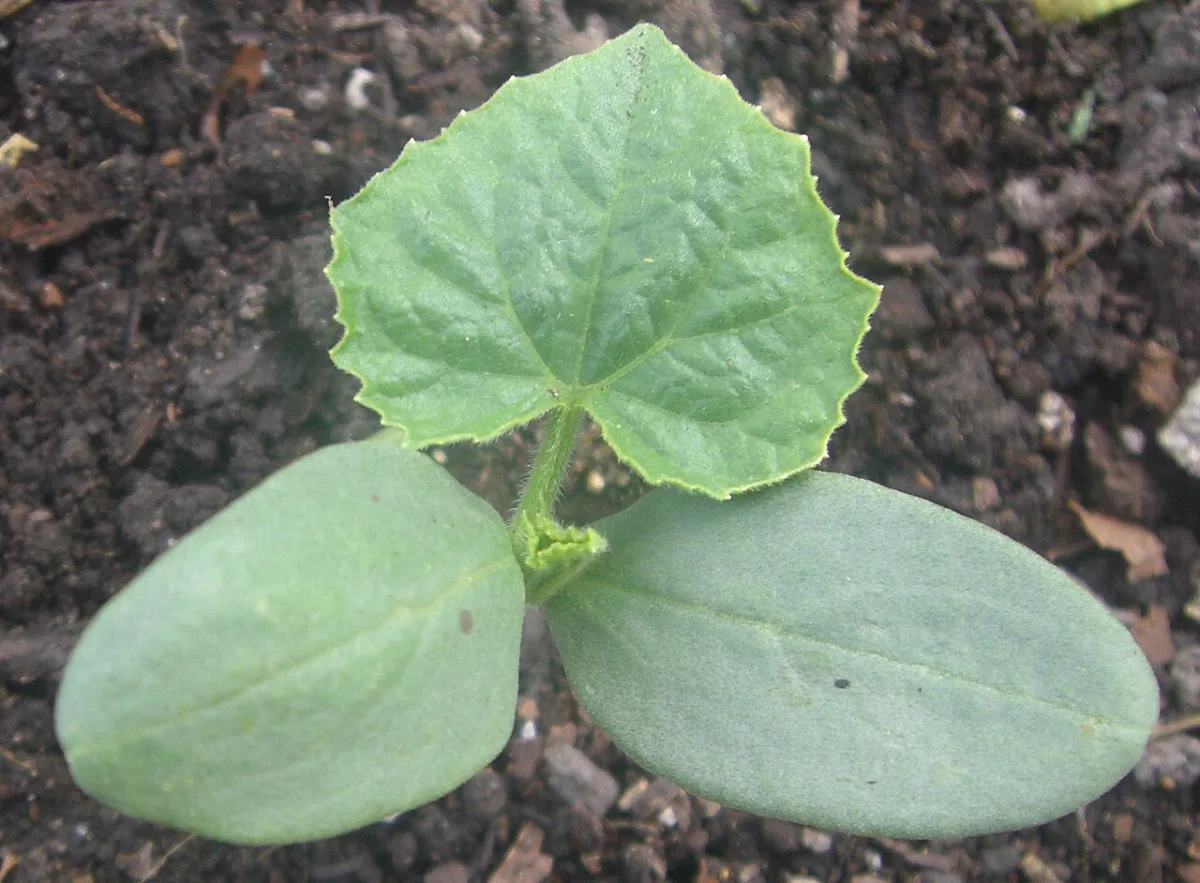
Planting cucumber transplants into the hotbed requires at least 2 true leaves. When growing in pots, it is more effective to use more mature transplants with 4–5 leaves. Planting is carried out on warm days, placing 2 plants in each hole and burying them up to the cotyledonary leaves. Immediately after planting, the hotbeds are covered with frames and shaded with mats for 2–3 days to protect them from sunburn.
| Cucumber cultivar | Number of plants per frame, units |
|---|---|
| Nerosimye, Vyaznikovskie | 6–8 (more is allowed with high-level agricultural practices) |
| Muromskie | 8–10 (more is allowed with high-level agricultural practices) |
Planting of transplants in the flowering phase during pot culture accelerates the start of fruiting by 15 days compared to younger age groups.
While the transplants are rooting, a stable temperature is maintained in the hotbed within 25–28 °C without sharp daily fluctuations. Irrigation during this period is carried out every 2–3 days with warm water at a rate of up to 11% of a watering can per frame. After rooting, the rate is reduced to half a watering can per frame, and the interval is increased to 3–4 days. In this mode, irrigation continues until the beginning of flowering.
Do not allow waterlogging of the soil in the hotbed. In the first days of cucumber flowering, irrigation is completely stopped and resumed only when fruits appear.
High air humidity in the range of 85–95% is ensured by the high combustion temperature of the biofuel and abundant irrigation. Ventilation of the hotbeds is carried out cautiously and for a short time. In the fruiting period, frames are opened for 6–8 hours on warm days. On sunny days, the temperature is maintained at 25–30 °C, on cloudy days at 22–23 °C, and at night at 17–19 °C. In cold weather, hotbeds are covered with mats for the night.
Bush formation directly affects the cucumber yield in protected ground. Primarily male flowers form on the main shoot, of which up to 200–250 appear per plant per season. Female flowers, in quantities of 3–4 per node, are set mainly on shoots of the 2nd and 3rd order, whereas there can be up to 15 male flowers in a node. To stimulate the growth of side shoots, the terminal buds are pinched above the 4th–5th leaf. An exception is the Muromskie cultivar, which has short vines and sets fruit early, therefore it does not require pinching.
Among other mandatory maintenance tasks are loosening the soil, weeding, and straightening the vines. The vines are carefully distributed and pinned to the ground with twig hooks near the petiole of the second leaf. The pinning site is covered with sod soil to form an additional root system. Mulching of the soil surface with horse manure in a layer of 3–4 cm is also carried out. Cucumber pollination in protected ground is performed with the help of bees or manually, by transferring pollen from male flowers to the pistils of female flowers using a brush or a plucked flower without petals.
Preparation and disinfection of seeds before sowing
For growing cucumbers in protected ground, varietal seeds obtained in the greenhouses of one's own farm are best suited. Seeds kept for 2–8 years in a dry and warm room are considered the most valuable. Before sowing, the seed material must be disinfected using one of two chemical seed treatment methods.
A formalin solution can be used to disinfect the seed material. This method allows for the effective destruction of surface infection on seeds. Treatment is carried out according to a strictly defined scheme.
- Dilute 1 cubic cm of 40-percent formalin in 3 liters of water.
- Spread the seeds in a thin layer in a warm room and moisten them with the prepared solution.
- Cover the seeds tightly with bags for 3–4 hours.
- Thoroughly dry the seed material before sowing.
A more effective method of disinfection is considered to be treatment with a mercury(II) chloride solution. This method requires care and precise adherence to time intervals. The seed treatment process consists of the following stages.
- Dissolve 1 g of mercury(II) chloride in 1 liter of water.
- Place the seed in bags into the prepared solution for 4–5 minutes.
- Remove the bags and rinse the seed in clean water 5–6 times.
- Dry the seed before planting.
Regarding top dressing of cucumbers in protected soil, there is still no definitive data. Research organizations have not yet fully developed this issue, and the practice of Stakhanovite vegetable growers yields varied results. Stakhanovites Klyuchnikova and Lobanova from the 10th Anniversary of October state farm in the Moscow region obtained cucumber harvests in hotbeds without any top dressing, maintaining a generally high level of agricultural technology, with 30–36 kg per frame. Stakhanovites D. V. Vasilyeva from the "Vyborgsky" state farm and Voronina from the "Kikerino" state farm in the Leningrad region systematically applied top dressing to cucumbers with mineral fertilizers and also obtained good harvests. However, some Stakhanovites did not receive increased harvests from the use of top dressing. This issue still requires verification.
It seems to us that the practice of top dressing is closely linked to the overall level of agricultural background. On less fertile soil, with lower fertilizing quality of biofuel and other reduced agricultural backgrounds, the application of top dressing has a greater effect than on a high, comprehensive agricultural background. Consequently, with a low general level of agricultural technology, it is necessary to systematically apply top dressing to cucumbers, which yields positive results in increasing yields. This should be especially emphasized for the Leningrad region, where even in advanced state farms and collective farms, the general level of agricultural technology in protected soil is still far from high. Moreover, a high agricultural background is not guaranteed in newly organized auxiliary farms, which acutely feel the shortage of high-quality biofuel, lack of good composition of earthy soils, etc. The application of top dressing to cucumbers during the growth and fruiting period can significantly compensate for these shortcomings and help obtain high yields.
It is recommended to carry out top dressing of cucumbers with a solution of cow manure with the addition of a mineral fertilizer solution. For 1 bucket of water, take 12 g of ammonium sulfate, 3 g of superphosphate, and 10 g of potassium salt. This solution is mixed with the cow manure solution. Before fertilizing irrigation, a watering with clean water is carried out. Before harvesting cucumbers, top dressing is performed using only mineral fertilizers.
Stakhanovite vegetable growers have introduced a number of other new methods into the agricultural technology of cucumber cultivation.
For instance, it is not always possible to obtain 3-year-old seed. In this case, to improve the quality of one-year-old seed, Stakhanovites dried the seed before sowing at a temperature of 30–35° and sorted it, selecting fuller, heavier ones. Stakhanovites performed seed sorting by immersing them in water. Lighter seed floated and was removed, and the heavier seed that remained in the water was used for sowing after drying.
To extend the fruiting period and increase the cucumber harvest, Stakhanovite vegetable growers dried out the soil in the hotbed. They did this when the leaves and vines of the cucumbers grew and occupied the entire space under the frame. During this period, until the beginning of noticeable wilting of the leaves, no watering was performed. After the leaves began to noticeably wilt, watering was resumed.
They performed so-called "steam baths." At a high temperature in the hotbed (28–38°), the ground was abundantly watered and the hotbed was covered with frames for 2–3 hours. A high saturation of warm humidity (90–95%) was created in the hotbed.
They also produce "rejuvenation" of plants. When fruiting ends and the leaves begin to turn yellow, the stem is deepened into the ground at a distance of 1/3 from the root by pinning, then covered with fresh sod soil, given abundant watering, and the hotbeds are covered with frames. New roots form on the stem, the plant resumes growth and continues fruiting.
By a number of other methods, advanced vegetable growers achieve high cucumber yields in protected soil.
Read next
Greenhouses and covers For gardeners
Growing cucumber and various onion species transplants in hotbeds
Greenhouses and covers For gardeners
Specifics of growing transplants of celery, cauliflower, swede, and beet
Greenhouses and covers For gardeners