
Organization of production areas and cultivation regimes for flower crops
18 min read
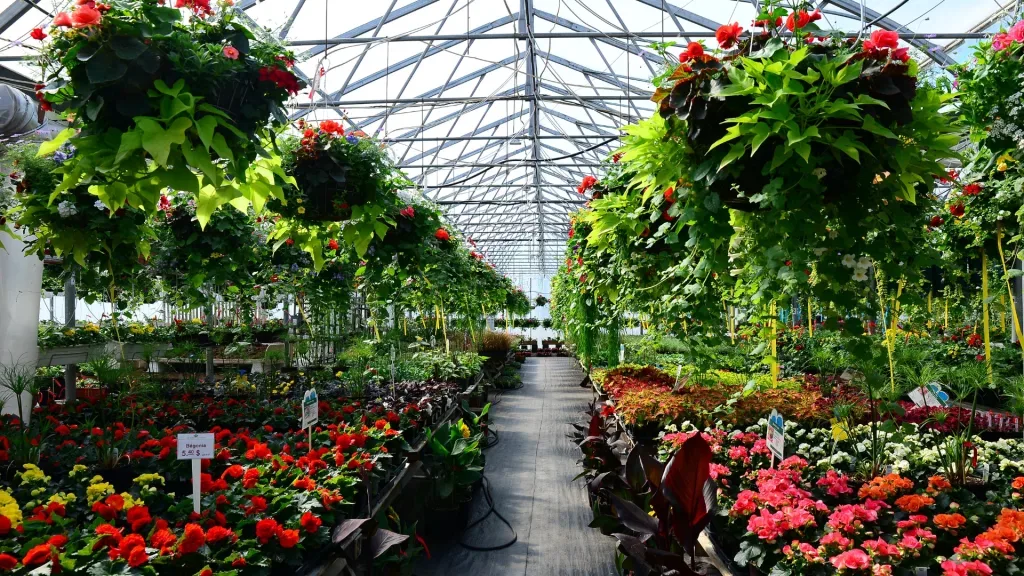
The efficiency of a floriculture enterprise depends directly on how the production areas are interconnected: open soil, greenhouses, hotbeds, storage facilities, and utility rooms. Proper organization of these areas helps to use machinery rationally, reduce the cost price of flowers, and increase overall profitability. The ratio of different soil types is selected for a specific technology, taking into account the plant feeding area, the duration of their cultivation in one place, and their climate requirements.
Greenhouse types and temperature regimes
Greenhouses are large protected soil structures where heat, humidity, and the gas composition of the air can be fully controlled. They are used for growing seasonal flowering crops (carnation, hydrangea, rose, chrysanthemum, cyclamen), heat-loving evergreen herbaceous plants (dieffenbachia, saintpaulia, spathiphyllum), and woody plants (araucaria, palms, citrus, ficus). They are also used for forcing narcissus, lilac, and tulips, and for propagating nursery plant.
According to their purpose, greenhouses are divided into three groups:
- Propagation greenhouses — warm structures with shelves and misting systems for sowing, taking cuttings, winter grafting, and growing transplants.
- Forcing greenhouses — shelf or soil-based greenhouses for the rapid production of cut flowers and potted flowers.
- Cultivation greenhouses — greenhouses for long-term maintenance of tropical and subtropical plants, succulents, and mother plants.
In winter, it is important to strictly maintain the temperature in greenhouses depending on the biological requirements of a specific crop. Errors in the temperature regime can destroy nursery plant or disrupt the forcing schedule. All structures are divided into three main types based on temperature regimes.
- Winter temperature in warm greenhouses — 14–18°C and higher
- Winter temperature in moderately warm greenhouses — 8–14°C
- Winter temperature in cold greenhouses — 3–8°C
Each regime corresponds to its own set of crops. Tropical species, forcing crops, and seasonal flowers are kept in warm facilities. Subtropical plants and mother plants, such as coleus and iresine, overwinter in moderate greenhouses. Bulbs and roses are stored in cold greenhouses before forcing, along with mother plants of fuchsia and pelargonium, and bay leaf and camellia are also grown there.
Lighting, covering materials, and structures
Modern greenhouses are built with both top and side lighting, which is significantly superior to older designs with only overhead lighting. The level of photosynthesis and the final yield of plants depend directly on the choice of light-transmitting material. Uviol glass, which transmits ultraviolet rays, shows the best results. When using synthetic films, pay attention to their service life and physical properties.
- Polyvinyl chloride film lasts from 3 to 5 years.
- Polycarbonate film retains its properties for 6–8 years.
- Ethyl vinyl acetate film lasts 3–4 years, maintaining light permeability of up to 85% and remaining elastic even at temperatures of –60°C.
The roof pitch in gable greenhouses should be within 24–28°. This is the optimal range, which reliably protects plants from solar overheating.
In terms of design, greenhouses are divided into gable, multi-span (block), and hangar types. Gable structures are oriented from south to north, and their slopes are directed to the east and west. In large farms, such greenhouses are connected by a glazed corridor that runs from west to east and is used as a utility room.
| Greenhouse type | Ridge height, m | Width, m | Length, m |
|---|---|---|---|
| Gable | 6 | 18 | 50 |
Block greenhouses combine several gable spans, where internal side walls are replaced by support columns. By reducing the surface area of the outer walls, such a design significantly reduces heat losses in the winter period. The slopes in the blocks are also directed to the east and west, and drainage gutters are installed at the roof joints to divert precipitation.
Choosing a design and planning crop rotation
Block greenhouses are divided into seasonal and permanent. Seasonal ones are assembled on lightweight metal, wood, or plastic frames and covered with film. Permanent ones are built with glass covering and automation for climate control. Plants in them are grown primarily in the soil, with shelves used less frequently.
Hangar greenhouses are suitable for large tropical crops, vines, and roses. It is convenient for machinery to operate in them, but they are difficult to heat in winter, which is why such structures are most often built in southern regions.
| Hangar greenhouse parameter | Value |
|---|---|
| Height | 5–7 m |
| Width | 18–20 m |
| Length | 49 m |
Optimal light and temperature regime without sharp fluctuations during ventilation are provided by greenhouses with a ridge height of 6 m and side wall height of 2.2–2.5 m.
To ensure that production is profitable year-round and areas do not remain empty, a crop rotation plan is developed. This is a schedule of sequential crop rotation, which is calculated taking into account high costs for heating, lighting, and water supply.
The crop rotation plan is developed according to the following stages:
- Selecting leading floral crops that will ensure the main volume of sales.
- Developing cultivation technology taking into account the biological characteristics of plants and planned marketing schedules.
- Selecting additional crops to fill available space during the off-season and rationally utilize farm resources.
From spring to autumn, the useful area of the greenhouse can be overloaded by up to 10% through the use of aisles and hanging shelves. The main thing is to ensure that this does not impair the quality of the finished products. In summer, be sure to include time for repairs and disinfection of premises in the schedule.
The operational efficiency of a greenhouse is evaluated according to three key indicators. An agronomist needs to track the output of finished products per 1 m² in units, profit per 1 m² in monetary terms, and total production profitability in percent.
Equipping useful area and soil preparation
Flowers can be grown on racks or directly in the soil. Racks are made in the form of bench-tables with edges. Wall-mounted shelves are installed with a width of 0.8–1.2 m, and those doubled in the center of the hall — with a width of 2–2.25 m. Table height is kept at the 0.8–1 m level. Side aisles are left with a width of 0.7–0.8 m, central ones — 0.8–1 m.
Wooden racks are well-suited for heat-loving crops but last only 2–3 years. Concrete ones are more durable but require a layer of 2–4 cm of sand or expanded clay for insulation of roots from the concrete. Plants on tables are placed in pots, crates, or planted directly into the bulk soil. For transplants and cyclamens in spring, hanging shelves made of durable reinforced glass are installed, which do not shade the lower tiers.
For roses, gerberas, callas, and early sweet peas, a rack-less method of cultivation is used. To do this, a pit 50–70 cm deep is constructed in the greenhouse with a slope for drainage of excess water.
The technology of preparing a soil bed consists of the following steps:
- Laying a clay layer on the bottom of the pit.
- Arranging a drainage layer of sand and fine gravel.
- Filling with a nutrient substrate.
To protect floral crops from soil-borne pathogens and pests, isolate the substrate from the underlying soil with polyethylene film or use concrete boxes.
Natural ventilation for regulating temperature and humidity is organized through transoms with automatic opening. Additionally, forced air exchange is used with the help of fans.
- Service life of wooden racks — 2–3 years
- Area increase from sliding racks — 20–25%
- Soil pit depth — 50–70 cm
- Roof vent area — no less than 30%
- Side wall vent area — no less than 50%
Heating, ventilation, and microclimate in greenhouses
Maintaining optimal temperature and air conditions directly affects the marketability and health of floral crops. Ventilation must ensure a constant influx of fresh air without creating dangerous drafts in the zone of plant growth. To control the air environment in working zones, use the following technological parameters as a guide:
- Air exchange rate — 5–20 times per hour
- Air speed above plants — 5–10 m/s
- Air speed in the plant zone — up to 3 m/s
Hot water is used for heating greenhouses. Heating pipes are mounted along side walls, under racks, and under the roof. In block greenhouses, load-bearing metal structures are often combined with the heating system — this allows for heating the premises and simultaneously melting snow on the glass roof. During peak frosts for additional heating, and in summer for active ventilation, electric heaters are utilized.
Do not use steam to heat flower greenhouses. Steam heating severely overdries the air, which leads to plant stunting, bud drop, and loss of commercial quality of the flowers.
For sub-soil heating of the ground and supply of carbon dioxide, a system of plastic pipes is used. Automatic heating of the substrate on racks is necessary for rooting cuttings of demanding crops, such as azalea and gerbera. Irrigation and the operation of technological equipment are provided by a centralized water supply system, feeding sprinkler installations, hoses, and trays on racks.
Any greenhouse structure on a farm must meet four basic requirements:
- minimal heat loss from every square meter of useful area;
- maximum capture of natural sunlight and heat;
- possibility of full automation of the microclimate and mechanization of manual labor;
- high return on investment with minimal operating costs.
Hotbeds: classification, dimensions, and seasonal use
Hotbeds serve as auxiliary structures for growing transplants of annuals and biennials, rooting cuttings, storing mother plants, and hardening off heat-loving crops before planting in open ground. They are placed on the south side of the main greenhouses. The cost price of plants grown in hotbeds is significantly lower due to the efficient accumulation of solar heat.
Structurally, hotbeds are divided into sunken (pit) and surface types. Sunken hotbeds retain heat better, so they are built in northern and middle latitudes. Surface hotbeds are cooler but easier to maintain; they are suitable for southern regions and can be portable. In terms of roof shape, hotbeds can be single-sloped or double-sloped.
Wood has low thermal conductivity and holds heat in the pit excellently, but it rots quickly in a humid environment. To extend the service life of a hotbed, construct the pit frame using concrete, cinder block, or stone.
The start dates for operations and the purpose of a hotbed depend directly on the depth of its pit:
| Hotbed type | Pit depth, cm | Start of operations | Purpose |
|---|---|---|---|
| Warm (early) | 80 | March | Sowing seed and pricking out seedlings |
| Semi-warm (medium) | 60 | April | Growing transplants and rooting cuttings |
| Cold (late) | 40 | May | Maintaining and hardening off plants before planting out, storage of mother plants |
The most common is the single-sloped sunken hotbed. It is oriented from west to east, with the slope facing south. The northern wall of the frame is made 8–12 cm higher than the southern one. A standard pine hotbed frame has dimensions of 160×106 cm and glazing with a thickness of 2.5 mm, providing light transmission of 70–90%. The width of such a hotbed is always 160 cm, and the optimal length for 20 frames is 21.2 m. The angle of inclination of the frames depends on the geographic zone: 20° in the north, 15° in the middle latitudes, and 12° in the south.
Double-sloped hotbeds are oriented from north to south, with their frames facing east and west. This design is optimal for growing tall, heat-loving crops (dahlia, canna) and evergreen plants like dracaenas or small palms. Two-sided ventilation in double-sloped hotbeds ensures uniform decomposition of organic fertilizers in the soil.
How to allocate space: portable hotbeds and frame rotation
To optimize workspace, farms use portable structures and light covers. A portable surface hotbed is a frame without a bottom, which is placed on a manure bed. Such structures are mobile, can have side lighting, and modern industry produces them in various sizes from plastic and metal. They are indispensable when it is necessary to quickly deploy temporary space for transplants or rooting cuttings.
- Height of the portable frame — 20–25 cm
- Thickness of the topsoil layer — 10–20 cm
- Number of frames per hotbed — 4–6 units
- Acceleration of bulbous flower harvesting — by 10–16 days
Small-sized film covers on simple frames made of wooden slats, pipes, angles, or thick wire help to effectively manage production schedules. They create a favorable microclimate for growing seedlings of annuals with a short development period, such as alyssum or ornamental cabbage. Also, these covers protect crops from frost and allow for the harvesting of tulips and other bulbous plants significantly earlier than in open soil.
To ensure protected soil does not sit idle, agronomists create a frame rotation schedule — a calendar for the efficient use of hotbeds. In the spring, they are used to grow seedlings of annuals, such as elegant zinnia and Drummond's phlox, for subsequent planting in flower beds in May to early June. In the summer, the vacated space is occupied by potted crops like hydrangeas and cyclamens, seedlings of biennials (Viola wittrockiana, Canterbury bells), or cuttings of cultivar roses and garden phlox. In the autumn-winter period, the hotbeds are designated for maintaining crops for subsequent forcing, including lily of the valley and primrose.
Heating systems and biofuel preparation
Heating for hotbeds is divided into solar, technical, and biological. Solar heating determines the temperature in cold hotbeds and allows for energy savings on clear days. Technical heating can be electric (using cable heaters in the soil and air in the south) or water-based. Water heating is considered the most advanced, as it allows for flexible adjustment of the temperature according to plant requirements, using heat from private boiler rooms, thermal power plants, or industrial facilities.
Biological heating works by utilizing the heat generated from the decomposition of organic raw materials — biofuel. Manure from various types of livestock animals, refuse, waste from cotton ginning plants (hulls), or flax production (flax shives) is used for this purpose. Waste from the leather industry (tannin-extracted bark), wool factories (wool waste), flour milling, brewing, and hemp production, as well as peat, leaves, and sawdust, are also suitable.
| Biofuel type | Burning period (days) | Temperature (°С) |
|---|---|---|
| Horse manure | 50–60 | 70 |
| Manure of other animals | 35–40 | 45 |
Urban refuse must be thoroughly cleaned of glass, stones, metal pieces, and construction materials before being used as biofuel.
The intensity of manure combustion can be adjusted using additives. An admixture of sawdust or wood shavings increases the combustion temperature but shortens its duration. Adding peat has the opposite effect: it lowers the temperature and extends the process. If other organic waste is used as a base, it should be mixed with 20% to 50% manure of the total volume.
Spent biofuel can be reused. To do this, add 50% fresh horse manure to it.
Intensive organic combustion begins only when the material is loose, has access to oxygen, humidity of about 70%, and a positive temperature. For the process to start correctly, it is essential to strictly follow the technology. The preparation and application of the substrate include several sequential steps.
- 5–8 days before filling with soil, fill the hotbed with prepared biofuel at a rate of 0.4–1 ton per hotbed frame.
- Loosen the mass using an excavator with a fork instead of a bucket to saturate the organic matter with oxygen and activate the bacteria.
- Allow time for the biofuel to heat up, depending on the type of hotbed.
- After heating, scatter quicklime over the surface for disinfection.
- Apply a 5–6 cm layer of nutrient substrate on top for seed sowing or 10–20 cm for planting transplants and cuttings.
| Type of hotbeds | Heating period |
|---|---|
| Early | 1.5–2 weeks |
| Mid-season | 1 week |
| Late | natural heating |
Open ground is an unprotected area of the farm used for seasonal or perennial cultivation of ornamental plants. Here, cut flowers, seed, cuttings, bulbs, and corms are obtained, perennials are propagated vegetatively, and rootstocks for grafting are grown. These areas are also used for plant acclimatization work. Several specialized departments are distinguished in the open ground of floriculture farms.
How to zone a farm and prepare open ground
To use the flower farm area efficiently, clearly divide it into technological zones. First, organize three main departments: propagation, nursery, and mother plantations/cutting production. In the propagation department, sow seed and root cuttings on shaded beds. In the nursery department, grow seedlings, bulbs, tubers, and grafted plants to standard sizes, and in the mother plantation department, harvest seed and cuttings, as well as flowers for cutting. In large farms, a breeding department is additionally created for developing new cultivars, along with collection and experimental plots, and a side-industry department, for example, for growing lawn grasses.
Place the open ground near the greenhouse/hotbed complex to simplify logistics and plant care. For layout, choose a level square or rectangular plot with fertile, moisture-retentive, and aerated soil. From the north and northeast, be sure to plant shelterbelts of deciduous trees to protect the plantings from cold winds. Plant the crops themselves in rows from north to south to protect them from one-sided sun exposure and facilitate the use of machinery.
Do not plant perennial flowering crops on heavy clayey soils with a groundwater level closer than 1 meter from the surface. In such conditions, the root system rots, and most perennials freeze out in winter.
Divide the territory into rectangular blocks, orienting them perpendicular to the main road. Within the blocks, observe tiering: plant the tallest and most stable cultivars near the northern and northeastern borders so they can shade less hardy crops. All areas of the farm should be connected by a convenient road network for the passage of machinery and manual equipment.
| Layout element | Standard size |
|---|---|
| Typical block size (option 1) | 10 × 15 m |
| Typical block size (option 2) | 25 × 54 m |
| Width of central and perimeter roads | 10 m |
| Width of inter-block roads | 1–3 m |
Crop rotation rules and auxiliary facility arrangement
Long-term cultivation of one plant species in the same spot leads to the accumulation of specific pests, weeds, and disease pathogens in the soil. To avoid soil exhaustion, implement crop rotation and alternate crops in time and space. Group plants with similar cultivation techniques and calculate the number of fields in the rotation. It should be equal to the number of years the crop is grown plus one or more years allocated for fallow.
To restore the soil structure and clean it of weeds, use two types of fallow:
- Black fallow — the land is repeatedly tilled throughout the summer to destroy weeds.
- Green fallow — the field is sown with green manure (vetch, lupine, and others), which are then shredded and ploughed into the soil.
The time period after which a crop returns to the same field is called rotation. For example, in a five-field crop rotation of perennials, the field lies fallow for one year, and for the next four years, it is occupied by flowers with a three- or four-year growing cycle. The rotation in this case is 5 years.
To store nursery plants, tools, and finished products, equip special storage facilities and utility rooms. They are divided into three zones: warehouses (for seeds, bulbs, substrates, fertilizers, and pesticides), technical rooms (laboratories, flower ripening chambers, garages), and staff rooms. In modern storage facilities, automatic control systems for temperature, humidity, lighting, and air gas composition are installed.
- Maximum groundwater level — up to 1 m
- Width of central roads — 10 m
- Width of inter-quarter roads — 1–3 m
- Rotation period for perennials — 5 years
Read next
Greenhouses and covers For gardeners
Organization of vegetable growing in protected soil and hotbeds
Floriculture For students
Classification and morphological features of ornamental flowering crops for nurseries

Greenhouses and covers For gardeners