
Classification and physicochemical characteristics of slurry manure
12 min read
Liquid manure is a mixture of livestock animal feces and urine with an admixture of water and feed residues. Depending on the water content in this mixture, the following types are distinguished:
- semi-liquid manure (humidity up to 90%);
- liquid manure (humidity 90–93%);
- manure effluent (humidity over 93%).
Liquid manure accounts for about 14% of the total balance of organic fertilizers. It is obtained at industrial-type complexes using liquid manure handling systems.
Depending on its humidity, liquid manure is a polydisperse suspension of varying fluidity with quasi-plastic flow properties. In a stationary state, it solidifies into a gel, and when in motion, it liquefies into a sol. When liquid manure is not moving, high-density solid particles begin to settle, it transitions into a gel-like state, and its fluidity, i.e., its rheological properties, deteriorates.
The rheological properties of manure depend on the content of dry matter and colloidal particles. Pig manure, at the same dry matter content, is more fluid than cattle manure, which is explained by its lower content of colloidal particles. When feeding livestock with high fiber and low protein content, the viscosity of the manure increases. The composition of liquid manure depends on the type of livestock animal (Table 107; Vasiliev V.A., Shvetsov M.M., 1983).
Table 107 – Composition of animal feces dry matter, %
| Type of animal | Ash | Organic matter total | including cellulose | lignin | pentosans | starch | hemicellulose |
| Cattle | 16.2 | 83.8 | 26.1 | 21.3 | 14.5 | 0.44 | 20.4 |
| Pigs | 13.6 | 86.4 | 18.4 | 15.2 | 20.7 | 0.38 | 27.0 |
| Sheep | 22.3 | 77.7 | 20.3 | 19.1 | 7.7 | 0.34 | 10.0 |
Basically, the organic matter of feces is represented by structural substances with a high carbon content (cellulose, lignin, pentosans). Due to this, the C:N ratio in it is quite wide (about 18–20). However, in a mixture of excrements, it narrows to 5–9 due to the nitrogen in the urine. In addition, urine contains a lot of urea, the nitrogen of which constitutes approximately 80% of all nitrogen in this excrement. This increases the value of liquid manure as a source of available nitrogen for plant nutrition.
The chemical composition of manure depends on storage technology, the degree of dilution with water, the type of animal, and feed (Table 108; Gorodniy N.M., 1990). At the same humidity, mixed liquid pig manure generally contains more nitrogen and phosphorus and about 1.5–2 times less potassium than cattle manure. When feeding livestock with concentrated feed, the content of nutrients in the manure is higher.
In liquid manure, 50 to 70% of nitrogen is in the ammonium form, in which it is well assimilated by plants in the very first year. Therefore, its effect on the first (fertilized) crop is somewhat stronger than that of solid manure, while the residual effect is, conversely, weaker. Nitrogen of protein compounds becomes available to plants as organic matter mineralizes. Phosphorus and potassium in manure are used by plants no worse than from mineral fertilizers. In the year of liquid manure application, 30–50% of nitrogen, 30–35% of phosphorus, and 60–70% of potassium are utilized.
Table 108 – Chemical composition of liquid manure of different humidity, % of raw matter Nutrient Humidity of manure, % 88–90 92–94 96–98
Cattle N 0.40–0.33 0.27–0.20 0.13–0.07 P2О5 0.20–0.17 0.13–0.10 0.07–0.03 К2О 0.40–0.33 0.27–0.20 0.13–0.07 Pigs N 0.50–0.42 0.33–0.25 0.17–0.08 P2О5 0.25–0.21 0.16–0.12 0.08–0.04 К2О 0.21–0.17 0.13–0.08 0.08–0.03
The quantity and quality of liquid manure depend on the type and age of the animal, type of feeding, duration of fattening or housing, amount of water used during harvesting, and its accumulation technology. The annual yield of liquid manure can be calculated by the formula:
Д с (К к К м К в n)T
1000 where: А – manure yield, t/y.;
Дс – animal housing period, days;
Кк, Км – quantity of feces and urine excreted by one animal, kg/day respectively;
Кв – daily rate of water consumption per animal, l; n – daily litter rate per animal, kg;
Т – number of animals, head;
П – manure losses during storage.
The average yield of liquid manure per one head of cattle is 50–60 l/day (30–35 l of feces and 15–20 l of urine, 5 l of process water), from one pig – 12 l/day (8 l of feces, 2 l of urine, and 2 l of water). Under production conditions, due to process water, the manure yield compared to the amount of animal excrements can increase by 25%.
To calculate the yield of organic fertilizers for a farm, liquid manure is converted using coefficients into standard manure with a humidity of 75% (25% dry matter). The conversion coefficient (K) is established by the formula:
100 Actual value
100 Conditional value where: Actual value – actual humidity, %;
Conditional value – conditional humidity (75%).
If the humidity of liquid manure is not determined, the following conversion factors to conditional manure can be used: semi-liquid – 0.5, liquid – 0.2, manure runoff – 0.06.
Collection, removal, and storage of liquid manure
For an agronomist, liquid manure is a valuable source of plant nutrients that requires precise logistics. Physical properties of liquid manure are close to water: its mass is about 1 t/m³. In large livestock complexes, the output volumes of this fertilizer are enormous, so the design of removal and storage systems begins with an assessment of production scales.
- Bulk density – 1 t/m³
- Output for 1,200 cows – about 30 thousand t/year
- Output for 10 thousand bulls – about 110 thousand t/year
- Output for 100 thousand pigs – about 100 thousand t/year
The cleaning system for livestock buildings includes three mandatory stages: cleaning the animal housing area, transporting to an intermediate collector, and subsequent pumping into manure receivers and storage facilities. Raw material can be transported from the livestock animal to the manure collector by mechanical or hydraulic methods. For mechanical cleaning of farms, scraper and rod conveyors, scraper installations, or bulldozers are used.
The hydraulic method of manure removal is implemented using the following systems:
- Hydraulic flushing — daily flushing of excrement with water along channels from flush tanks or channel-less flushing with high-pressure jets directly from the defecation zone.
- Periodic gravity-drainage system (gate-valve) — accumulation of mass in longitudinal channels for 1–2 weeks and its subsequent release by opening valves.
- Continuous gravity-flow system — continuous removal of manure through the open end of the channel under the action of gravity.
- Recirculation system — flushing of manure using clarified liquid fraction for washing channels.
Between livestock buildings and the main storage facility, at least three quarantine manure receivers must be installed. Manure is held in them for 6 days. Only upon confirmation of the absence of highly dangerous diseases is the mass pumped into the main manure storage.
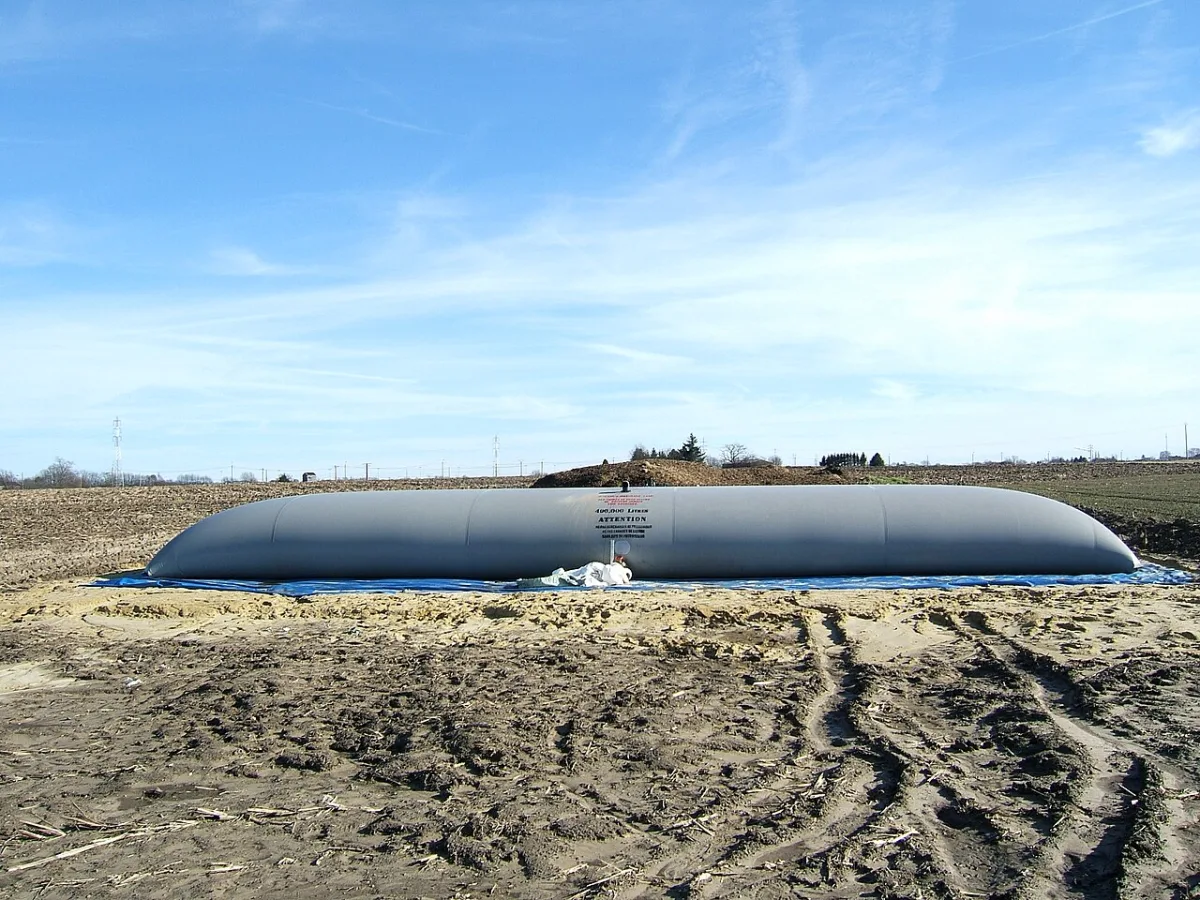
Liquid manure is stored for 2 to 6 months, depending on soil and climatic conditions and management practices. For this, farm-based closed reservoirs with a capacity of 25–40% of the volume of manure accumulated over 2–3 months are used, and the remaining 75–60% of the mass is placed in field storage facilities. The latter are open pits with a film lining on the bottom and slopes, located in the center of the fertilized fields. Both farm-based and field storage facilities must be reliably waterproofed to prevent groundwater contamination.
Preparation of manure for application and calculation of rates
Liquid manure during storage inevitably stratifies into three fractions: a dense floating crust on top, sediment at the bottom, and clarified liquid in between. Without prior preparation, it is impossible to apply such fertilizer evenly. To ensure uniformity of the mass and prevent clogging of pumps, spreader tankers, and irrigation systems, manure is prepared before use.
- Removal of large particles and foreign inclusions.
- Grinding of feed residues.
- Systematic mixing of the mass to a homogeneous state.
- Separation into fractions (if necessary).
Nutrient losses during the storage of liquid manure are significantly lower than those of solid manure, as no self-heating processes occur in it. The temperature of the mass in the storage containers does not rise above 10–17 °C. Nevertheless, natural losses of organic matter and nitrogen occur and depend on the season.
| Storage period | Organic matter losses, % | Nitrogen losses, % |
|---|---|---|
| Winter time | 5–8 | 9–8 |
| Summer time | 9–15 | 4–14 |
If manure disinfection is required, the most accessible method is methane fermentation. This method prevents nitrogen losses and organic matter losses, and also allows for obtaining combustible gas for use as fuel.
Application of the prepared fertilizer to fields is carried out according to one of four technological schemes. When calculating specific application rates, the agronomist takes into account the crop's nutrient requirements, the soil type and its nutrient supply, the previous crop, transport distance, and the total volume of accumulated manure. Correct consideration of these factors guarantees a high return on fertilizer through yield.
- Scheme 1: farm storage → pipeline → irrigation system (or spreader tanker) → field.
- Scheme 2: farm storage → spreader tanker → field.
- Scheme 3: farm storage → pipeline → field storage → spreader tanker → field.
- Scheme 4: separation of manure into solid and liquid fractions (solid is applied using solid manure technology, liquid — using one of the first three schemes, most often using irrigation systems).
Timing and methods of application for main crops
When using liquid manure on hayfields and pastures, it is necessary to consider the composition of the herbage. If many grain legumes grow in the areas, the application rate is reduced. On pastures, liquid fertilizer is best applied in winter before the start of the growing season or in autumn after it ends. When top dressing during the growing season, the grass loses its palatability, so manure is applied strictly after grazing.
Do not apply liquid manure less than 25–30 days before the next pasture grazing. Failure to observe this interval results in livestock refusing to feed, as well as an increased risk of spreading infections and infestations.
For large livestock complexes, it is important to organize year-round use of manure. However, during the winter period there are strict restrictions: it is forbidden to distribute fertilizer on slopes and flood-prone areas, from where meltwater can wash it into water bodies.
- Straw residue on the field — 5–7 t/ha
- Liquid manure over straw — 80–100 t/ha
- Proportion in compost (manure : straw) — 3–4 : 1
- Interval before pasture grazing — 25–30 days
Below are the application rates and incorporation methods for liquid manure for major crops. All doses are calculated for undiluted manure with a nitrogen content of about 0.4%.
| Crop | Application rate, t/ha | Application timing | Incorporation method |
|---|---|---|---|
| Cereals | 35 | Before primary tillage | Ploughing |
| Winter grain crops | 25 | In winter for top dressing | Spring harrowing |
| Potatoes | 40–60 | In autumn, winter, and spring before spring ploughing | Ploughing |
| Sugar beet | 50–60 | In autumn, winter, and spring before spring tillage | Ploughing or disc harrowing |
| Fodder beet | 80–90 | In autumn, winter, and spring before spring tillage | Ploughing or disc harrowing |
| Corn for green fodder and silage | 60–80 | In autumn, winter, and spring before spring tillage | Ploughing or disc harrowing |
| Perennial grass-legume mixtures* | 60–80 | In winter and after mowing | Harrowing after mowing |
| Meadows* | 50–60 | In winter and after mowing | Harrowing after mowing |
| Pastures | 50–60 | At the end of the growing season, in winter before the growing season, during irrigation after grazing | Harrowing at the start of the growing season |
| Annual grasses | 30–40 | In autumn for winter ploughing, in winter or spring before pre-sowing tillage | Ploughing, disc harrowing |
| Rye for green fodder | 35 | Before ploughing or pre-sowing tillage | Ploughing, disc harrowing, cultivation |
* Note: the annual rate for meadows and perennial grass mixtures should be applied in 2–3 split applications.
Incorporation rules and agrotechnical requirements
To improve soil fertility, it is advisable to apply liquid manure over chopped straw remaining after grain harvesting (5–7 t/ha). Straw is chopped by combine harvesters or mowers directly in the field, manure is distributed, and the mixture is incorporated to the depth of the arable horizon. Combined use of liquid manure and straw provides 1.5 times more organic matter to the soil than using standard solid manure. Another effective option is preparing composts, where there are 3–4 parts of liquid manure for every part of straw or peat.
Fertilizer efficiency depends directly on adherence to application and incorporation rules, depending on soil type and tillage technology:
- Storage periods. Do not keep manure in storage facilities for too long. Overfilling containers leads to losses of nutrients, environmental pollution, and the spread of infections.
- Calculation of doses. Determine the application rate strictly based on the nitrogen uptake of the planned harvest. It should not exceed the actual needs of the crops. This takes into account the nitrogen content in the manure itself, its utilization coefficient, and the cultivation level of the field.
- Soil type consideration. In autumn, liquid manure is distributed primarily on soils with a high adsorption capacity. On light sandy, loamy sand, and light loamy soils, manure is applied only together with straw or under winter catch crops to prevent nitrogen leaching into lower horizons.
- Incorporation specifics. Apply the fertilizer to those fields where it can be quickly ploughed in. If ploughing is not immediately possible, incorporate the manure with disc harrows or cultivators right after the spreader. On slopes, winter application is allowed only if immediate incorporation is guaranteed.
- Specifics of tillage. When deepening the arable horizon, do not bury the manure too deeply. It is more correct to apply it to the overturned low-fertility layer before re-ploughing or discing. In farms with non-inversion tillage, manure is applied under row crops and cereals, incorporating it under inversion ploughing in years when it alternates with non-inversion loosening.
- Fallow fertilization. For crops occupying fallow, manure is applied before winter ploughing. If crops are harvested early (e.g., vetch-oat mixture for green fodder), then the manure is ploughed in immediately after their harvesting.
To prevent nitrate accumulation in produce and groundwater, aim to distribute manure in moderate doses over a larger area. It is ecologically and economically more profitable to apply 30 t/ha to the entire arable area than 60 t/ha to half of the fields. The only exceptions are severely depleted lands that require cultivation improvement.
When planning a nutrition system, liquid manure is used as the primary nitrogen source, but it should not fully meet the plant's requirements. Some nutrients must be compensated for using mineral fertilizers. In this regard, it is important to maintain a balance, as an excess of nitrogen during certain growth stages of crops harms the quality of the harvest.
| Crop | Minimum application rate of fertilizer, t/ha |
|---|---|
| Cereals | 15 |
| Row crops | 25 |
- Share of nitrogen from manure — 50–80 %
- Minimum for cereals — 15 t/ha
- Minimum for row crops — 25 t/ha
When applying liquid manure to bare fallow for winter crops, it must not be supplemented with nitrogen mineral fertilizers. In a fallow field, especially with a high humus content in the soil, a significant amount of nitrates accumulates naturally.
Overdose risks and technological limitations
Violation of the liquid manure application technology poses a serious threat to the farm's ecology. There is a high risk of nitrate pollution of nearby water bodies, soil, and groundwater. Due to excessive application rates, the concentration of nitrates increases sharply in the plants themselves, especially during the early phases of their development.
Systematic use of liquid effluent on the same fields leads to a deterioration of the physical and chemical properties of arable land. As a result of regular treatments, the soil accumulates excessive volumes of chemical elements and compounds. This can significantly degrade the properties of the root zone and even lead to soil salinization. The following accumulate in the soil:
- potassium, calcium, magnesium, and sodium;
- heavy metals;
- chloride ions and sulfate ions.
The main reason for the low efficiency of liquid manure is infrastructural in nature. Due to the irrational placement of livestock complexes, the balanced cycle of substances in agriculture is disrupted. The livestock population often does not correspond to the arable area available for the standard disposal of effluent. Additionally, the situation is complicated by a low level of mechanization in the processing and application of liquid organic matter.
Read next
Agrochemistry For students
Efficient use and storage of liquid manure in agriculture
Agrochemistry For students
Poultry manure as a concentrated organic fertilizer for crops
Nutrition and fertilizers For gardeners