
The role and biological characteristics of the grape leaf apparatus
8 min read
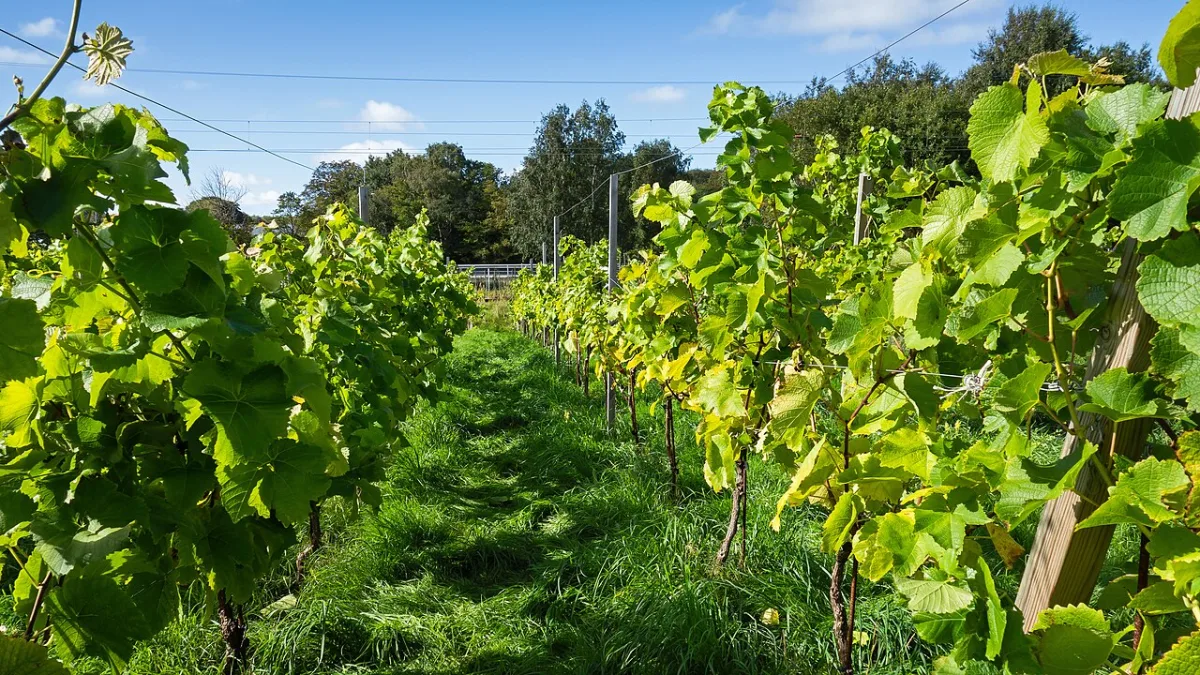
Development of the leaf apparatus and the influence of external factors
The leaf is the main organ of the grapevine, responsible for photosynthesis. The production of carbohydrates, sugars, and amino acids necessary for bush growth, fruit set, and sugar accumulation in berries depends on the activity of the leaf apparatus. Anatomically, the leaf consists of a long petiole and a blade with five main veins forming a dense conductive network. Water with minerals enters the leaf through these veins, and the products of assimilation are transported away.
- Optimum growth temperature — 28–30 °C
- Cessation of photosynthesis — below 6 °C
- Leaf growth period — 4–5 weeks
- Leaf blade area — 120–300 cm²
- Share of lateral shoots in leaf area — 40–50%
Leaf growth occurs in three waves and takes about a month. During the first 6–9 days, the blade grows slowly, increasing by 2–8 cm² per day. The period of maximum growth falls on the second and third weeks, when the leaf increases by 14–20 cm² per day. By the end of the fourth week, the growth rate drops to 3–5 cm² per day. By the time of flowering, more than half of the leaves on a shoot reach their maximum size, and by full flowering, 12 out of 19 leaves on a shoot become the most productive.
The size of the blade depends on its position on the shoot. The largest leaves are formed in the area of the 6th node, the smallest develop at the 25th node, and leaves at the lower 1st node have average parameters. The leaves are arranged on the shoot in an opposite-alternating manner, which protects the canopy from self-shading. Growth intensity is also influenced by the rootstock: for example, on the Rupestris du Lot rootstock, scion leaves grow faster and more vigorously than on own-rooted plants.
Formation and productivity of the bush leaf surface
The total leaf area of a bush depends on the training system, planting scheme, shoot load, and the performance of green operations. Different types of bush management form different volumes of the leaf canopy.
| Bush form and trellis type | Leaf surface |
|---|---|
| Single-armed and double-armed Guyot | up to 12 m²/bush |
| Small goblet form | 8–9 m²/bush |
| Large fan forms on a two-plane trellis | up to 23,000 m²/ha |
| Trellis with a canopy | 21,800 m²/ha |
| Vertical trellis | 16,000 m²/ha |
| Ground-running culture | 8,000 m²/ha |
The bush load directly affects the size of the leaf blade: as the load increases, the leaves become smaller. Planting density also changes the indicators: with dense planting, there are 3.26 m² of leaves per 1 m² of feeding area, while with sparse planting, there are 2.55 m². The total assimilation area includes lateral shoots. If they are not pinched, they form up to half of all the foliage of the bush, and pinching at 4–5 nodes leaves them with up to 40% of the total volume.
Complete removal of lateral shoots reduces the leaf surface of the bush by 30–55%. However, in dense plantings, shaded leaves cease photosynthesis, do not form fruit buds in the leaf axils, and begin to consume resources, taking nutrients from other parts of the plant.
Photosynthesis is most efficient under good lighting and a temperature of 28–30 °C. Any decrease in temperature weakens the process, and it stops completely when the temperature cools down below 6 °C. The activity of plastids drops sharply when leaves turn yellow due to aging, chlorosis, or lack of light. Also, for active photosynthesis, a rapid outflow of metabolic products is critical.
The distribution of photosynthetic activity along the length of the shoot changes throughout the season. At the beginning of the growing season, the lower tier (from the 5th to the 12th node) is the most productive, while in the middle and end of the season, the middle (from the 15th to the 20th node) and upper tiers are the most productive. Leaves begin to provide part of the produced substances to other organs upon reaching 30% of their size, and full outflow of assimilates begins when the blade grows to half of its optimal size. Young two-week-old leaves are completely dependent and live off the reserves accumulated in the roots and perennial wood.
Leaves on fruit-bearing grapevine shoots always have a higher assimilation capacity than those on non-fruit-bearing shoots.
The yield and commercial quality of grapes depend directly on the number of healthy leaves on the bush and the activity of their photosynthesis. The more developed leaves that participate in nourishing the plant, the more carbohydrates they produce. This determines the shoot growth vigor and vine maturation in the current season.
- Optimal leaf area — 28,000 m²/ha
- Stomatal density on the underside — 140–190 units/mm²
- Evaporation from 1 m² of leaf — up to 1.5 l of water per day
- Leaf humidity at the beginning of the growing season — up to 82%
- Humidity of an aging leaf — up to 70%
- Ash content in an old leaf — from 4.5 to 12%
The tip of the shoot and young growing leaves consume more nutrients than they produce. Conversely, in the middle and lower zones of the shoot, assimilation prevails over respiration — it is these leaves that provide the bush with carbohydrates.
The leaf apparatus is responsible not only for photosynthesis but also for respiration and transpiration. During respiration, an oxidative breakdown of carbohydrates into carbon dioxide and water occurs, which provides the bush with free energy for life. This process takes place through numerous stomata on the underside of the leaf.
At a temperature of 30–40 °C, leaf respiration occurs most intensely, which leads to a significant loss of carbohydrates. To maintain respiration within the normal range, the plant requires sufficient air humidity and soil moisture (for the swelling of plasma colloids), free access to oxygen, and a reserve of its own carbohydrates.
The evaporation of water by leaves creates a pumping force that pulls moisture and the nutrients dissolved in it from the roots to the top of the bush. In addition, transpiration effectively reduces the temperature of the leaf blade on hot days. The intensity of evaporation depends on soil moisture, air temperature, wind speed, and the degree of stomatal opening.
Throughout the growing season, the balance between the accumulation and expenditure of substances changes along the length of the shoot. Young leaves at the tip consume nutrients more actively than they produce them. At the same time, the leaves of the middle and lower zones of the shoot work for accumulation — in them, assimilation prevails over respiration.
The direction of assimilate movement in shoots is reorganized sequentially according to the development phases of the grapevine:
- In very young shoots.
- During the flowering period of the bushes.
- After fruit set of the berries.
Leaf Anatomy and Seasonal Changes in Composition
The ratio of water to dry matter in leaves changes from spring to autumn. While at the beginning of the growing season the tissues are maximally hydrated, by the time of harvesting and cooling, the processes slow down and the ash content increases. This is clearly shown by analysis data:
| Growing season | Water content, % | Ash content, % | Features of substance distribution by tiers |
|---|---|---|---|
| Beginning of growing season | Up to 82 | Insignificant amount | Ash dry substances accumulate predominantly. |
| End of growing season | Up to 70 | From 4.5 to 12 | There is more ash in the leaves of the lower tier than in the middle and upper ones. |
Leaf aging leads to the cessation of assimilate outflow, which makes them heavy and dense. The chlorophyll content in them decreases, with the most green pigment remaining in the middle zone of the shoot. In autumn, the leaf apparatus changes color: in white and pink cultivars the blade turns yellow, while in dark-colored ones it becomes purple-red. This occurs due to the destruction of chloroplasts and the accumulation of anthocyanins and xanthophyll.
Before leaf fall, sugars, starch, nitrogen, and phosphorus flow out of the leaf blade into the stem. Then, at the point where the petiole attaches to the shoot, a corky abscission layer forms. The leaf falls, leaving a characteristic dark scar on the vine.
The internal structure of the leaf ensures protection and photosynthesis. The upper leaf blade is protected by a dense cuticle and epidermis, which restrict excessive evaporation. Beneath them lies the palisade parenchyma, whose cells are densely packed with chloroplasts for active photosynthesis. Below is the loose spongy parenchyma with air intercellular spaces, where there are significantly fewer chloroplasts.
The underside of the leaf blade plays a special role. It is here that the main organs for gas exchange and plant protection are concentrated. On the lower epidermis are located:
- stomata for gas exchange;
- hairs and bristles, forming protective pubescence;
- special glands that perform a protective role.
Read next
Viticulture For agronomists
Biology of grapevine shoot pinching and practical use of lateral shoots
Viticulture For agronomists
Organization of phytotechnics and rules for tying grapevine bushes
Pruning and training For students