
Identification of fruits and toxic properties of lesser celandine
1 min read
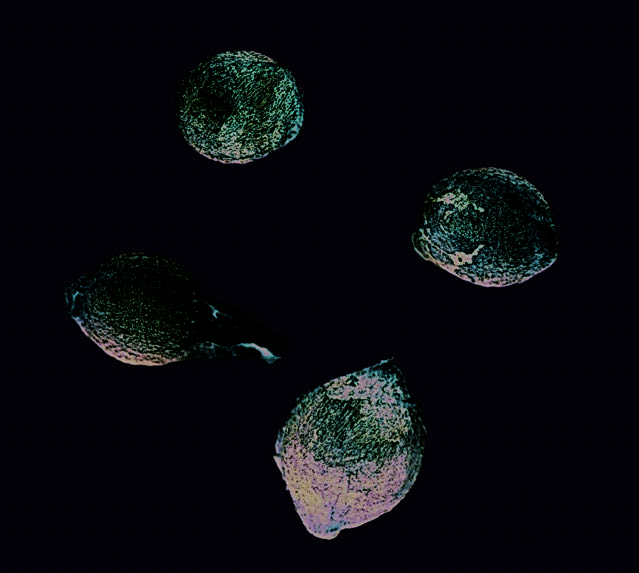
Lesser celandine is widespread almost everywhere in the European part of the country, in Crimea, the Caucasus, as well as in Western Siberia and Central Asia. This plant is completely poisonous and poses a serious danger if it gets into feed or seed material. To detect this weed in a field or in a seed lot in time, it is necessary to accurately identify it by the morphological characteristics of its fruits.
Morphology of lesser celandine fruits and related toxic species
The fruits of lesser celandine are aggregate fruits (etaerios) consisting of individual nutlets of a pear-shaped or round-oval shape. The apex of each fruitlet ends in a broad, slightly longitudinally ribbed remnant of the style, and the hilum has the form of a small protrusion. The surface of the fruit is furrowed-tubercular and covered with light down. The color of the nutlets is usually light yellow, but becomes darker directly at the hilum.
- Fruitlet length — 2,5–3,5 mm
- Fruitlet width — 2–2,5 mm
- Fruitlet thickness — 2–2,5 mm
Lesser celandine is completely poisonous. Its toxic properties are due to the presence of protoanemonin.
Representatives of many other genera in the Ranunculaceae family also possess toxic properties. These plants also contain dangerous substances and require attention when assessing the quality of plant raw materials. The table below systematizes the toxic components characteristic of related genera of the Ranunculaceae family.
| Plant genus | Toxic substances |
|---|---|
| Anemone (Anemone) | Protoanemonin, anemonin |
| Baneberry (Actaea) | Alkaloids, saponins |
| Marsh-marigold (Caltha) | Protoanemonin, anemonin |
| Burr-buttercup (Ceratocephala) | Ranunculin, alkaloids |
| Bugbane (Cimicifuga) | Triterpenoids, alkaloids |
| Clematis (Clematis) | Alkaloids, saponins |
| Hellebore (Helleborus) | Alkaloids, ranunculin, protoanemonin |
| Pasqueflower (Pulsatilla) | Protoanemonin, alkaloids |
| Meadow-rue (Thalictrum) | Alkaloids, cyanoglycosides |
| Globeflower (Trollius) | Alkaloids, saponins |
Read next
Seeds and varieties For agronomists
Aristolochia clematitis is a dangerous poisonous weed of gardens and vegetable plots.
Seeds and varieties For agronomists
Seed morphology and geographical distribution of Ranunculus sceleratus
Seeds and varieties For agronomists