
Botanical characteristics of seeds and toxicity of sun spurge
2 min read
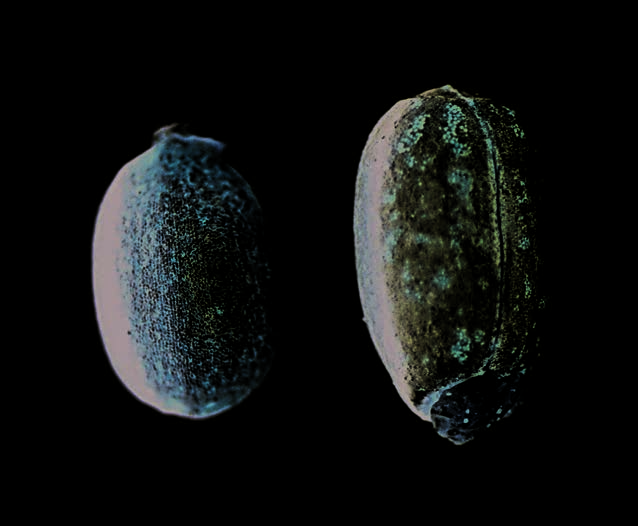
Seed pods are spherical. Seeds are oval, obovate, almost perfectly round in cross-section; at the upper part, a seed appendage protrudes sharply in the form of a blunt projection. The seed suture runs along the ventral side and is slit-like. At the base, there is a rounded, weakly visible ridge. The seed surface is punctate-rough. The coloration is heterogeneous: light gray, light brown, sometimes with a faint violet tint. Often, there are brownish spots against a general light background. The seed appendage is light yellow; the seed suture is dark brown or dark gray. Length is 2.5–3.5 mm, width and thickness are 1.5–2.5 mm. It infests crops of cereals and grasses. Distribution: European part (western and southwestern regions). Toxic properties: Most spurges are toxic to varying degrees. The plants, especially the roots (active ingredients in milky sap), contain triterpenoids (euphol, euphorbol), diterpenoids, flavonoids, etc. They cause poisoning in livestock when mixed into hay (rarely while grazing). Other species: The most toxic are: Euphorbia waldsteinii (E. virgata, E. helioscopia, E. stepposa, E. humifusa, E. palustris, E. falcata). Among other Euphorbiaceae, the following also possess toxic properties: mercury (dog's mercury): M. perennis and annual mercury M. annua L. They contain cyanogenic glycosides, saponins, and alkaloids. Representatives of the genus Chrozophora contain diterpenes, saponins, and alkaloids.
Securinega suffruticosa contains the alkaloid securinine, which has an effect similar to strychnine (it stimulates the central nervous system, the cardiovascular system, and respiration, and increases muscle tone and blood pressure).
Read next
Seeds and varieties For agronomists
Botanical description and characteristics of the seed of annual mercury
Seeds and varieties For agronomists
Identification of fruits and toxic properties of lesser celandine
Seeds and varieties For agronomists