
Description of Russian knapweed seed and quarantine significance of the weed
2 min read
Russian knapweed (creeping thistle) is a dangerous quarantine weed that infests crops of cereals, row crops, industrial crops, and vegetable crops, as well as alfalfa, clover, and cotton. It grows actively in meadows and pastures, crowding out valuable grasses. Even 0.01% of knapweed achenes by weight in wheat or other cereal grains hopelessly ruins the taste of flour. The resulting product becomes bitter and unsuitable for baking.
Russian knapweed is included in the "List of pests, plant diseases, and weeds of quarantine significance for the Russian Federation." The plant contains toxic alkaloids and sesquiterpene lactones (repensine, acroptilin, and hircanin), which are dangerous for horses. If cows are fed hay containing knapweed, their milk develops a bitter taste.
The weed infests fields in the southern regions of the European part of Russia, Crimea, the Caucasus, and Central Asia. It is also found in the central regions of the European part, but as an introduced plant. Control of this quarantine object must begin at the first signs of its appearance in the field.
How to identify Russian knapweed seeds
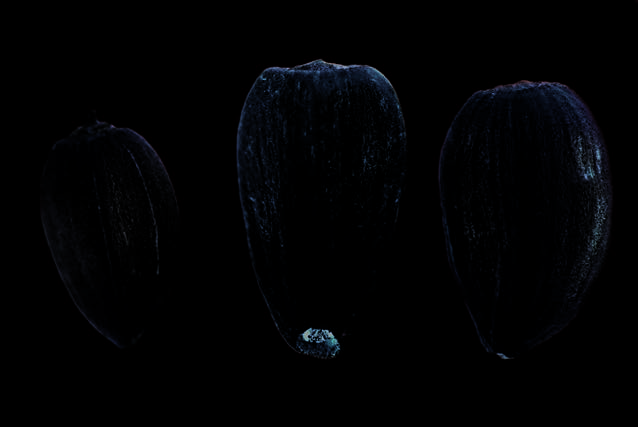
The contaminant can be identified in a bulk of grain by its characteristic flower heads and achenes. The flower heads of the knapweed are egg-shaped with bracts that adhere tightly to each other. In the lower part, these bracts are thickened, while in the upper part, they are membranous. The inner bracts of the flower heads are distinguished by their narrow shape and noticeable pubescence.
The achenes themselves are obovate or broadly oval, sometimes narrower and compressed. On their concave side, a broad rounded keel stands out, and the expanded truncate apex is equipped with the remainder of the style with a loose, spongy rim. The deciduous pappus is usually absent in cleaned grain. The oval or round hilum is located at the center of the base of the achene or slightly shifted to the side. The bare surface of the seeds with faint longitudinal wrinkling can be matte or have a weak sheen, and their color varies from greenish-yellow to greenish-gray.
| Achene parameter | Size, mm |
|---|---|
| Length without pappus | 2.54 |
| Width | 1.252.75 |
| Thickness | 1.251.75 |
Read next
Seeds and varieties For agronomists
Morphology of achenes and toxic properties of common groundsel
Seeds and varieties For agronomists
Morphological characteristics and quarantine significance of perennial ragweed
Seeds and varieties For agronomists