
Technology for training classic cordon canopies in intensive horticulture
4 min read
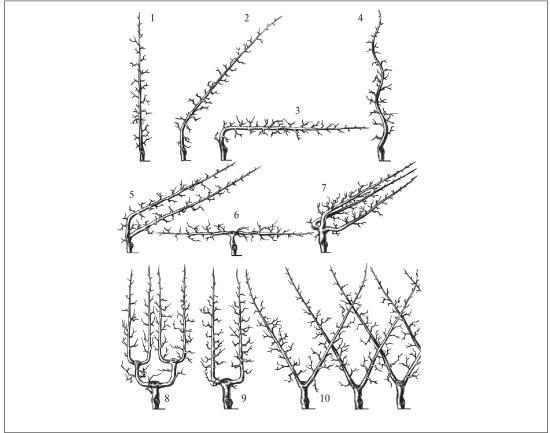
Cordon canopies are simple, flattened structures where branches are positioned in a single plane: horizontally, vertically, or at an angle. Due to the high labor intensity of their training and the need to install trellises, they are used primarily in small-scale intensive orchards and home gardens. A correct combination of cordons with other canopy shapes provides a stable harvest and a high aesthetic effect. Training any cordon starts with a one-year-old nursery plant. When planting an oblique cordon, plants are placed at a 45° angle; in all other cases, nursery plants are planted strictly vertically, and the direction of the shoots is regulated using trellis wire.
- Planting angle for an oblique cordon — 45°
- Height of the first pruning of a one-year-old plant — 30–40 cm
- Bending distance for U-shaped arms — 25–30 cm
- Pinching of medium shoots — above the 5th–6th leaf
Technology for training horizontal and U-shaped cordons
Creating a classic horizontal cordon requires a precise sequence of operations. Mistakes during pruning or untimely tying of branches will disrupt the balance of tree growth and fruiting. To properly train the canopy, follow this algorithm:
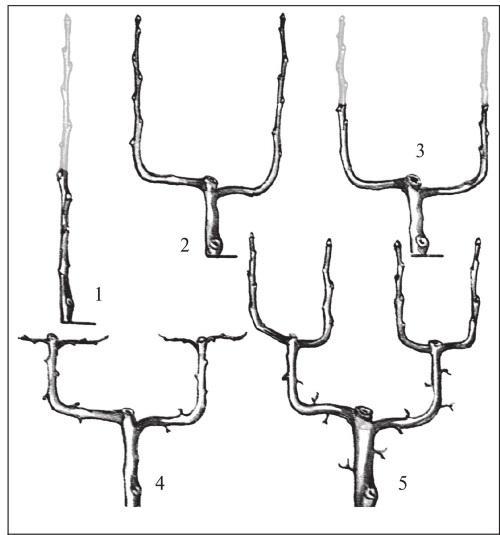
- Shorten the one-year-old plant at a height of 30–40 cm from the soil level to stimulate branching.
- Leave one strongest shoot for a single-arm cordon or two shoots for a double-arm one.
- Direct the selected branches horizontally in opposite directions and tie them to the trellis wire.
- Perform spring pruning of the current growth, adjusting the degree of shortening depending on the cultivar's ability to produce shoots.
The degree of spring pruning depends directly on the bud break capacity of the cultivar. Weak shoot-forming ability requires heavy shortening, but excessive pruning will trigger unwanted vigorous shoot growth. With high natural bud break capacity, branches may not need shortening.
To accelerate growth and quickly increase arm length, the tip of the horizontal shoot is left raised when tying. In this position, it grows actively until the end of the growing season.
When training U-shaped structures, the same basic scheme is used with the pruning of the one-year-old plant at a height of 30–40 cm. The resulting arms are initially directed horizontally, and after 25–30 cm, they are brought into a vertical position. To create a complex double U-shaped cordon, each vertical branch is pruned once more, resulting in four vertical leaders. The entire structure is attached to a trellis, where the central leaders and fruiting branches are tied to individual wires.
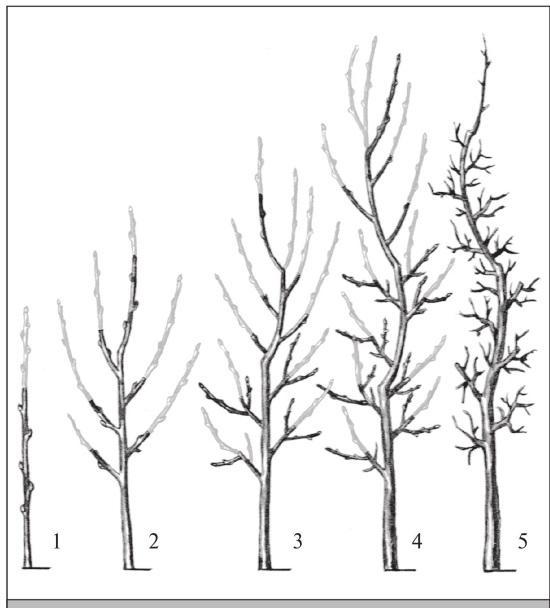
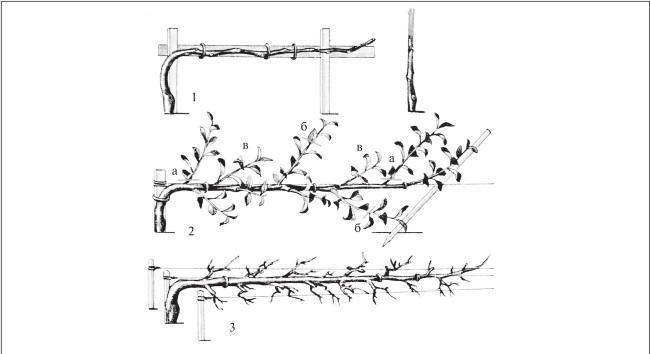
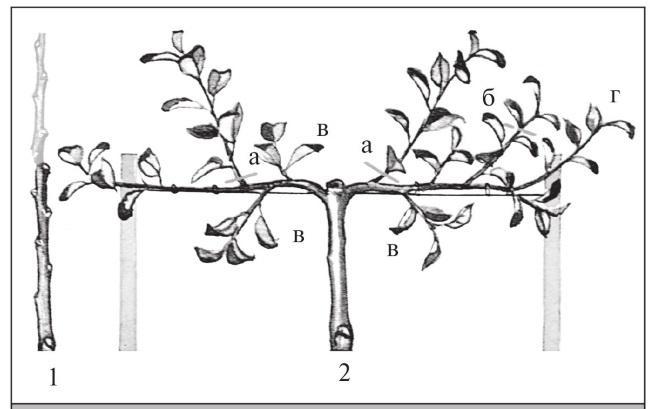
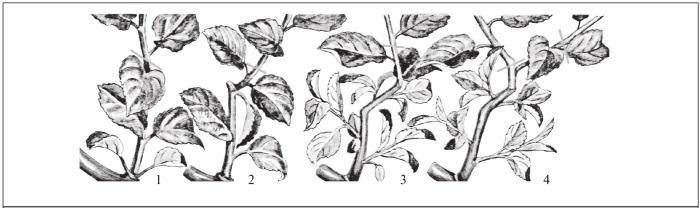
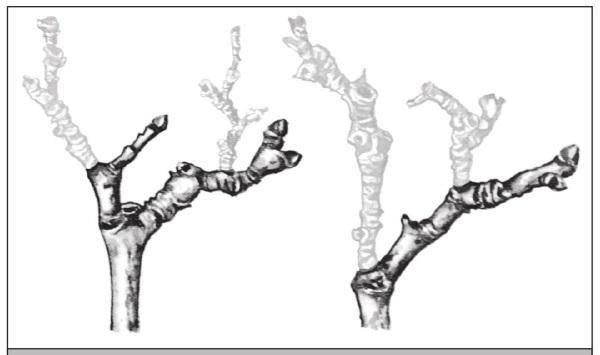
Summer pruning serves as the main tool for regulating growth when creating cordons. It helps redistribute nutrients in the canopy and stimulate the formation of fruit buds on short branches. All major operations are carried out in June–July. If any branches were missed during the season, they are pruned in the spring of the following year before sap flow begins.
- Summer pruning period — June-July
- Pruning of lateral shoots — above the 6th–8th leaf
- Stub height for "heel" cut — 5 mm
- Cut height for a one-year-old tree — 30–40 cm
- Length of arms before training upward — 45–50 cm
During summer tillage, lateral branches are shortened above the sixth to eighth leaf. Some of the actively growing vertical shoots are completely pruned to the branch collar to avoid overcrowding. The remaining shoots are cut to a "heel," leaving a small stub about 5 mm high. When rejuvenating old fruit-bearing branches of apple trees trained as cordons and palmettes, 2–3 strong fruit buds are left.
Technology for forming U-shaped cordons and palmettes
Do not allow vertical shoots to overgrow when forming U-shaped cordons. A difference in branch vigor will disrupt the canopy balance, so lagging branches must be stimulated, and leading ones must be pinched in a timely manner.
To create a U-shaped (double vertical) cordon, a strict sequence of operations is followed. This allows for a symmetrical shape and uniform distribution of sap in the plant.
- Prune a one-year-old tree in spring at a height of 30–40 cm from the ground.
- Form two opposite horizontal arms from the grown shoots.
- When the length of the arms reaches 45–50 cm, direct their tips vertically upward.
- Continue forming the upright branches as two independent vertical cordons.
A double U-shaped cordon is established on a similar principle. Each of the resulting horizontal arms is pruned once more, and new vertical branches are formed from two adjacent upper buds. Such decorative forms are perfectly suitable for wall-trained crops, decorating gazebos, entrances to a plot, and garden paths, while providing a high-quality harvest.
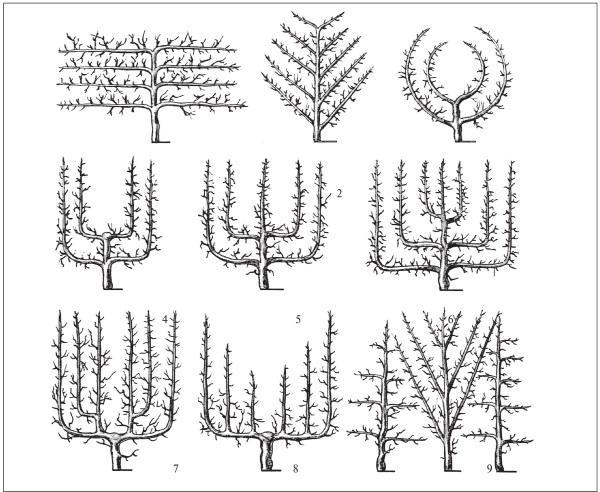
All types of classical palmettes are various combinations of simple cordons. Depending on the direction of the branches, they can be horizontal, oblique (sloping), circular, or vertical — the latter include the Verrier palmette (with 4, 5, or 7 branches), double Verrier palmette, candelabra form, and Cossonay system. Their main branches are positioned at strictly defined distances, and fruiting wood is created through intensive pruning. A group of artificial rounded canopies, which include spindle-shaped, vase-shaped, and pyramidal forms, is distinguished separately.
Read next
Pruning and training For agronomists
Regulation of tree growth and fruiting by changing the branch angle
Pruning and training For agronomists
Methods for forming columnar and spindle-shaped canopies of fruit trees
Pruning and training For gardeners