
Technological features of separate rearing of turkey poults and duck meat production
11 min read
Sex-separated rearing of turkey poults for meat allows for better use of facilities, reduced feed consumption, and increased labor productivity.
Table 55. Recipes for complete feed mixtures for turkey poults reared for meat (9/)
Poultry age (days) Ingredients 1—60 61—120 Maize ground 22 39 Wheat ground 20 20 Sunflower meal 20 13 Fish meal 10 8 Meat and bone meal — 2 Dried skim milk 8 — Feed yeast 10 5 Grass meal 6 8 Bone meal — 1 Chalk 2.6 27 Salt 0.4 0.3 Premixes 1.0 1.0 Total 100.0 100.0 100 g of feed mixture contains (9%): metabolizable energy, kJ 1176 1197 crude protein 28 22 crude fiber 5.0 5.5 calcium 17 1.7 phosphorus 0.8 0.8 sodium 0.3 0.4 lysine 1.5 1.2 methionine -- cystine 1.0 0.8 tryptophan 0.3 0.24 Energy-to-protein ratio 420 544
Turkey poults are reared separately from one day of age; this allows for slaughtering at different ages and better realization of the poultry's biological characteristics. Male poults grow faster and finish their main growth at 160—180 days of age. In females, the growth intensity is 25—30% lower than in males. Furthermore, the main growth of females ends at 90—120 days of age. With separate rearing, the slaughter age for males and females is different, which partially changes the turkey meat production technology. Sex-separated rearing of turkey poults allows for the differentiation of feeding and housing conditions. In this case, the live weight of females increases by 12—14%, of males — by 8—9%, and feed costs per 1 kg of gain decrease by 7—5%.
Differentiation of feeding and housing conditions during sex-separated cage rearing of turkey poults begins from 20—30 days of age. When rearing on the floor, four males or five females are placed per 1 m². The feeding front for one male is 4.5 cm, the feeding front for a female is 3.5 cm; the drinking front is 2.3 and 1.7 cm, respectively.
Slaughter of turkey poults and carcass processing are carried out using the same technology as for broiler chickens. However, turkey carcasses are cooled for a longer time until the internal temperature of the carcasses reaches 0 to +4°C.
Duck meat production
} ‚ Duck meat production in the country and abroad was carried out for many years using extensive methods. Ducks were mainly reared in farms with large bodies of water, relying on the use of natural feed, which allowed for savings (of 30—35%) on con-
Centrated feed. The extensive method of duck meat production is seasonal, depends on climatic conditions, and does not allow for full use of their biological characteristics — early maturity and high growth intensity. With intensive rearing methods, 45—50-day-old ducklings already weigh 3.0—3.5 kg or more; during this time, their mass increases by more than 60 times compared to the mass of day-old ducklings. For 1 kg of live weight, ducklings consume 2.5—3 kg of feed mixture.
After the first laying cycle, ducks begin to molt. The molting continues for 3—4 months, but it can be accelerated artificially. After the molt is finished, the ducks begin a second laying cycle, which lasts 7—9 months. Over two laying cycles, one laying duck can produce 200—230 eggs and raise 130—160 ducklings with a total mass of 270—310 kg. Ducks can be reared in any climatic conditions. They maintain good productivity both with floor-based rearing and in cage housing conditions. |
Industrial production of duck meat in specialized farms is based on year-round production of hatching eggs and their incubation, as well as uniform rearing of poultry for meat in all seasons and months of the year. With the intensive method of meat production, a dry feeding system is used, and there is extensive use of mechanization and automation of all technological processes.
Typical specialized duck meat production farms are poultry factories that have a closed production cycle. In addition to poultry factories, ducks for meat are reared in specialized state farms and collective farm poultry units.
To assemble the parent flock, healthy, well-developed young birds are selected before the start of egg-laying at the age of 150—160 days. Eggs for incubation are collected from parent flock ducks at the age of 180—400 days. With year-round assembly, parent flock ducks are usually kept in windowless poultry houses with a controlled microclimate. In farms with seasonal production, the parent flock is kept in summer in poultry houses
Fig. 63. Parent duck flock, of a lightweight type or under sheds, and in winter — in more capital structures. For more efficient use of ducks, most farms use induced molting; during the second laying cycle, approximately as many eggs are obtained from older ducks as from first-year layers. By using older ducks in the parent flock, the livestock of replacement young birds can be reduced. Induced molting of ducks can be carried out according to the following scheme. For males, induced molting is not recommended as it reduces their reproductive qualities. Drakes are used over two duck laying cycles.
Table 56. (Forced molting schedule for ducks (according to A. A. Senikov) Period from the beginning of molt Feeding Watering Notes 1st day No feeding Watering Ducks moved from the stationary poultry house to grass range
2nd day 55—60 g of grain per head per day is fed | No watering — (wheat, barley)
3rd day No feeding Watering —
4th day 55—60 g of grain is fed | No watering —
5th day 55—60 g of grain is fed | Watering —
By 7-10 days | The amount of grain fed is in-| Watering The feather cover of ducks creased up to 170 g per head per should begin to fall day. Gradually begin to use granulated balanced compound feed
After 4 weeks Sufficient and complete feed-| Watering — ing
After 7 weeks Balanced granulated com-@@ Watering The ducks are transferred to of molting pound feed is gradually replaced by granulated compound feed for the duck breeding flock
After 8 weeks The ducks are fully transferred to the duck house
Eggs for incubation are selected from healthy ducks. They must have a good shell, correct shape, and weigh at least 80 g. To improve the output of standard ducklings, eggs are calibrated before incubation. Eggs are loaded into incubators in large batches, corresponding to the capacity of the duckling rearing facility. From 100 loaded eggs, on average, 70—80 standard ducklings are obtained. After hatching, ducklings are sorted. Standard ducklings stand firmly on their feet, are mobile, react to tapping, have a well
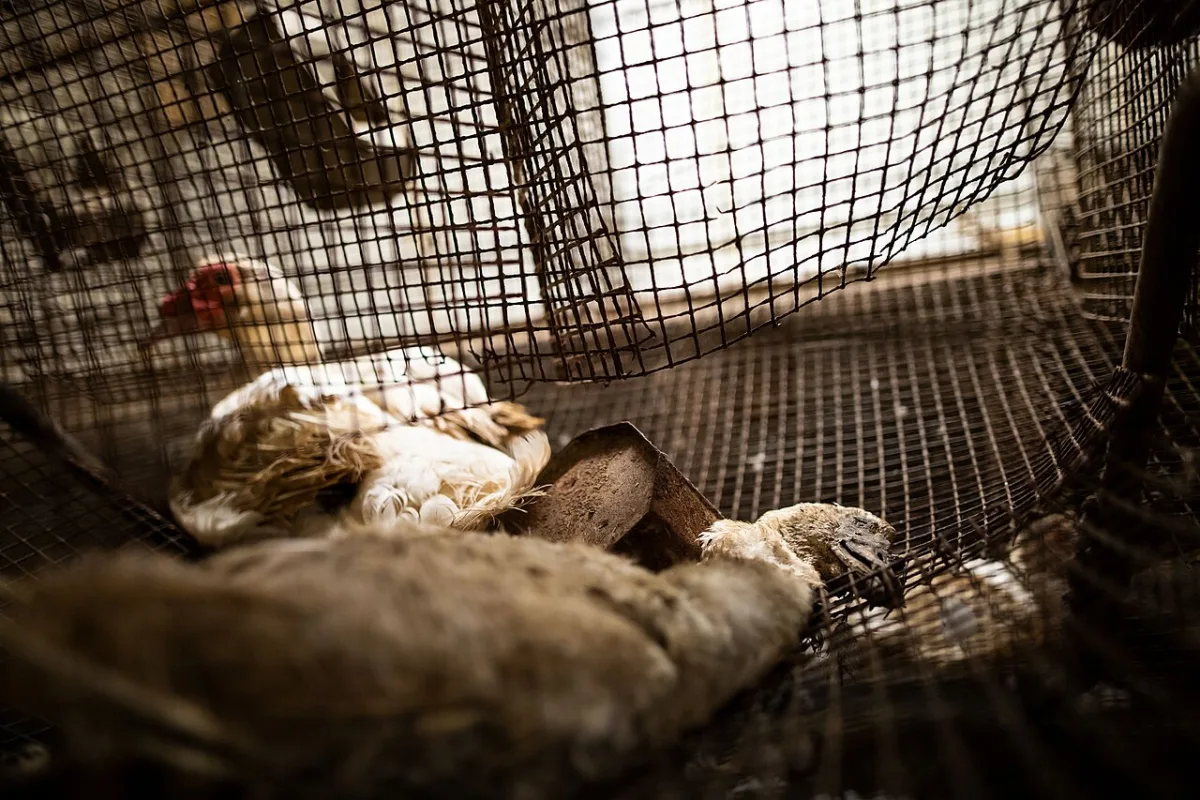
Fig. 64. Ducklings in cages (Yagotinskaya Poultry Farm, Kyiv Region).
pigmented beak and shanks, eyes are shiny, open, belly is soft, navel is healed, down is clean and shiny. Uniform hatch of standard ducklings depends on the feeding and keeping of the parent flock and the incubation qualities of the eggs.
There are various ways of raising ducklings for meat. At an early age, they are kept on deep litter, on wire floors, and in battery cages. Only standard ducklings are taken for rearing. Regardless of the rearing method, day-old ducklings are placed in pre-prepared facilities in small groups (in sections of 150—200 heads), adhering to the principle of single-stage placement of same-age poultry.
Raising ducklings on deep litter. Day-old ducklings from the hatchery arrive in heated facilities (brooder houses), where they are raised until 10 or 20 days of age, depending on the season and climatic conditions. The stocking density up to 10 days is 14—16 heads per 1 m² of floor area; when raising up to 20 days of age — 12 heads. After this period, ducklings are moved to acclimatizers (in winter) or under sheds (in summer). In acclimatizers, 6—7 ducklings are placed per 1 m² of floor; under sheds — 7—8 heads without loosening until the end of the rearing period. In summer, ducklings use restricted runs.
Regarding litter quality, wood shavings are used from the first days of duckling rearing, and in older age — sawdust, cut straw, peat. In the first 5—6 days of rearing, sawdust should not be used as litter, as ducklings peck at it, which leads to digestive disorders. Litter with manure is removed from the brooder house after moving the ducklings to the acclimatizer.
Raising ducklings on a wire floor. With this rearing method, ducklings are also placed in small groups in the sections of the poultry house on a wire floor. The mesh (10 x 10 mm cell size) is stretched over wooden frames, which are placed over concrete trenches sloping towards the center. Manure falls through the mesh into the trenches, from where it is removed by hydraulic flushing or a mechanical scraper. On 1 m² of wire floor, 22—25 ducklings are placed up to 10 days of age, and 8—10 at an older age. Raising ducklings on a wire floor allows for increased efficiency in facility use, mechanization of the labor-intensive manure removal process, and eliminates the need for litter.
Raising ducklings in battery cages. Various battery cages are used for raising ducklings from 1 to 20 days of age. Up to 30 ducklings are placed per 1 m² of cage floor when raising them up to 10 days of age. At an older age, they are thinned out, leaving no more than 8—10 ducklings per 1 m². At the Malodubenskaya Poultry Farm in the Moscow Region, ducklings in battery cages are kept until 50—55 days of age. At this age, the live weight of the poultry reaches 2.5—2.8 kg with a feed conversion rate of up to 3 kg of compound feed per 1 kg of weight gain.
Raising ducklings in cages makes it possible to reduce construction costs, mechanize work processes, and simplify the duck meat production technology.
When raising ducklings for meat, the microclimate in poultry houses is adjusted according to the age of the ducklings and their housing method. It has been established that in the first days of rearing, the air temperature in the room should be no lower than 28—30° C. Starting from the age of 5 days, it is lowered by approximately 4°C per week. Relative humidity of the air">Relative humidity of the air in the poultry house is 65—80%. The duration of daylight at the beginning of the rearing period is maintained at 22—24 hours, and at the end — 12—14 hours. The light intensity during the day should be 10—15 lux, and at night — 7—8 lux. Approximate standards for temperature and lighting for ducklings being raised for meat are shown in Table 57.
Table 57. Light regime and air temperature in a poultry house when raising ducklings for meat
Age of ducklings (days) | Air temperature in the room (°C) | Air humidity (%) | Light duration (h/min) | Light intensity (W/m²)
1—5 30—28 65—70 22—24 10—15 5—8
6—15 25—23 65—70 20—22 10—15 5—8
16—25 21—18 70—75 14—16 8—10 3—4
26—55 16—14 75—80 12—14 8—10 3—4
For the normal growth and development of ducklings kept in high concentrations in enclosed spaces, it is necessary to ensure an adequate supply of fresh air. For this purpose, supply and exhaust ventilation is used. During the hot season, at least 6—7 m³ of fresh air per kg of live weight per hour should be supplied; in the cold season — 2—3 m³.
In specialized farms, ducks are fed dry loose or pelleted compound feed, or grain and concentrate feed. Poultry is fed according to standards developed taking into account their age, live weight, method of keeping, and genetic characteristics of growth and productivity.
Table 58. Recipes for complete compound feeds for ducklings raised for meat, (%)
Age of poultry (days) Ingredients 1—20 21—55 Corn 16.3 39.8 Wheat — 30.0 Barley 44.0 10.0 Millet 15.0 — Sunflower meal 1.0 3.0 Fish meal 8.0 5.0 Meat and bone meal 1.0 4.0 Fodder yeast 2.0 2.0 Grass meal 4.0 3.0 Shell, chalk 1.5 1.9 Table salt 0.2 0.3 Premixes 1.0 1.0 Total 100.0 100.0 100 g of compound feed contains (%): metabolizable energy, kJ 1155 1239 crude protein 18 16 crude fiber 5.0 6.0 calcium 1.2 1.2 phosphorus 0.8 0.8 sodium 0.4 0.4 lysine 1.0 0.9 methionine + cystine 0.7 0.6 tryptophan 0.2 0.2 Energy-protein ratio 642 774 (kJ: crude protein)
With the dry feeding system, compound feed is poured once a day into automatic hopper feeders; with the combined system, in addition to dry compound feed, wet mashes are distributed to ducks in trough feeders 2—3 times a day. Ducklings raised for meat are fed ad libitum with complete compound feed, which ensures good growth and contributes to reducing feed costs. Experiments by Scott (USA) established the possibility of regulating the meat composition of ducklings to a certain extent by increasing the protein content in the compound feed and decreasing the energy-protein ratio. Increasing the amount of crude protein and lowering the energy-protein ratio in the compound feed allows for a 7—8% reduction in the fat content of the duckling carcass while simultaneously increasing the amount of protein.
Read next
Poultry For agronomists
Technology for assembling the parent stock of turkeys, ducks, and geese
Poultry For agronomists
Norms for the content of amino acids and microelements in poultry diets
Poultry For agronomists