
Genetic plant immunity and modern methods of soil disinfection
4 min read
Genetic shield: the difference between plant immunity and resistance
Growing resistant cultivars is the cheapest and most effective way to protect crops from diseases. In practical agronomy, it is important to distinguish between plant immunity, resistance, and tolerance. Immunity is absolute: a plant does not become diseased even in the presence of an active pathogen and ideal conditions for infection. Resistance, however, is always relative — the plant is affected by the pathogen, but to a minor degree.
The opposite of immunity is susceptibility, when a plant cannot withstand infection. However, even a susceptible crop can turn out to be tolerant (hardy). A tolerant plant is affected by disease, but practically does not reduce the volume and harvest quality. Resistance genes control not only protection against pathogens but also reactions to drought, frost, and other environmental stress factors.
Plant immunity is classified by its nature:
- Specific (cultivar-specific) — manifests at the level of a particular cultivar toward specific pathogens.
- Non-specific (species-specific) — the species-level impossibility of being infected by a particular pathogen. For example, tomato is never affected by cereal smut, cucumber by clubroot of brassicas, and pear/apple by scab.
- Innate (natural) — genetically controlled and inherited; it can be active or passive (determined by constitutional characteristics).
- Acquired (artificial) — formed during the growing season.
When preparing substrates, take into account infection risks. Seedling mixtures may be slightly contaminated with pathogenic fungi of the genera Gizayit and E osyuta. At the same time, annual composts that have undergone a normal thermal phase do not require sterilization. They contain many beneficial saprotrophs, and fungi of the genera Rizamit and Ru shit are found in them only as rare, isolated colonies.
Disinfection practice: steaming and chemical soil fumigation
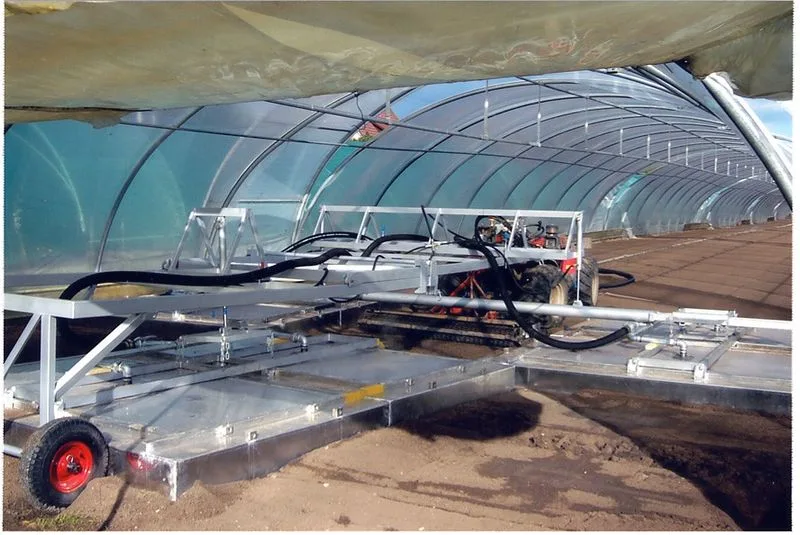
For deep disinfection of greenhouse soils, thermal or chemical methods are used. The thermal method (steaming) destroys most pathogens due to high temperature. Treatment time depends directly on the degree of substrate heating.
| Substrate temperature, °C | Steaming time |
|---|---|
| 100 | 1 h |
| 70 | 18–24 h |
When the temperature drops, the steaming time must be increased proportionally. The technology requires strict adherence to the sequence of actions for uniform heating of the entire soil mass. Particular attention is paid to the airtightness of the cover.
- Ploughing and loosening. The soil is loosened with a rotary tiller to a depth of 25–30 cm without turning the soil layer, throwing the soil from the perimeter toward the center.
- Equipment setup. Steam is supplied through a metal "comb," burying vertical perforated pipes 30 cm into the soil.
- Covering. The area is covered with heat-resistant film, pressing its edges tightly with sandbags or chains.
- Steam connection. The pipe system is connected to a steam generator using a flexible hose with a diameter of 50 mm.
- Temperature control. Contact thermometers are installed under the film for remote monitoring at a depth of 30 cm.
Before starting steaming, be sure to disconnect the plastic subsoil heating pipes to avoid rupture. Use only dry steam — wet steam creates an excess of condensate, lowers the soil temperature, and delays treatment. Entering the steamed area in non-disinfected footwear is strictly prohibited.
After completing the steaming, the greenhouse soil temperature is lowered. Well-rotted compost and liming materials are applied to the treated area. They are incorporated with a rotary tiller to a depth of 20–30 cm.
The second effective method of disinfection is fumigation with methyl bromide. Before starting chemical treatment, mineral and organic fertilizers are applied to the soil, after which the soil is tilled using a rotary tiller. Then the surface is leveled and loosened with an electric cultivator to a depth of 10–15 cm. The presence of clods is unacceptable, as the gas flows around them and does not penetrate inside. Dry soil is pre-irrigated.
- Soil moisture — 60–70 % of field capacity
- Soil temperature — 18–20 °C
- Exposure duration — 144 h
- Methyl bromide application rate — 50–80 g/m²
- Reduction in root-knot nematode population — 90–96 %
During fumigation, gas is supplied through perforated tubes laid in grooves along the perimeter of the greenhouse sections under the film. The concentration of the preparation under the film and in the surrounding area is measured daily with a gas analyzer. After work is completed, the greenhouse is ventilated through vents and raised edges of the film, and the soil is irrigated and loosened with a rotary tiller. In its disinfectant activity, methyl bromide is not inferior to steaming, effectively suppressing fungal pathogens and reducing the root-knot nematode population.
Read next
Plant protection For agronomists
Methods and efficiency factors of soil disinfection in agricultural technologies
Plant protection For agronomists
Technologies and methods for deep soil steaming in greenhouses
Plant protection For agronomists