
Technologies and methods for deep soil steaming in greenhouses
10 min read
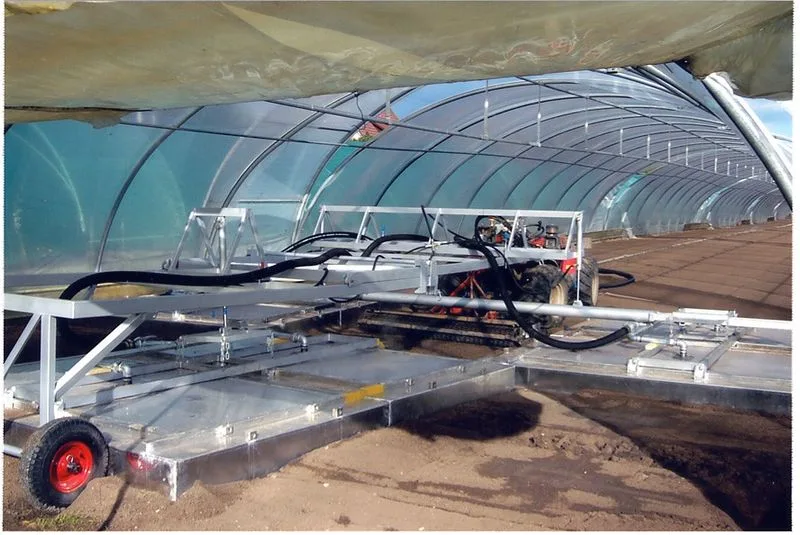
Over the past 50 years, greenhouse soil steaming technologies have changed significantly. Complex subsoil systems have been replaced by economical surface steaming under cover, which requires far less manual labor. However, for deep disinfection, subsoil steam injection is still used, which has its own technological peculiarities.
- Pipe laying depth — 30 cm
- Distance between pipes — 25 cm
- Steam outlet diameter — 3 mm
- Processing time — no more than 20–30 min
- Area per procedure — up to 5–6 sq. m
Deep steaming: from steam pipes to a steam plough
The Hoddesdon system remains the most effective method of subsoil heating. It uses L-shaped steel pipes 2 to 4 meters long with a relatively short vertical section of up to 0.5 meters. Along the underside of the horizontal pipe, 3 mm diameter holes are drilled at 12–13 cm intervals, and the end is sealed. Steam exits through the holes, condenses on soil particles, and heats the soil as it spreads upward and outward.
- Loosen the soil until it reaches a fine-crumb, dry state.
- Dig a trench 30 cm deep and place the pipes in it parallel to each other at a distance of 25 cm.
- Connect the pipes to a steam source and cover the area with a tarpaulin, burlap, or plastic film.
- Start the steam supply slowly to avoid disturbing the entire system, and heat the soil until the steam reaches the surface.
- Keep the steam on for another 10 minutes after the soil has warmed up evenly to the very surface.
Despite its high efficiency, the Hoddesdon method requires a great deal of heavy manual labor. Furthermore, if the pipes are not placed strictly horizontally, the steam penetrates the soil to different depths. The soil surface is the last to heat up, even though the concentration of pathogens is highest in the top layer. Below the pipes, the steam does not penetrate deeper than 2.5–3 cm.
The labor cost issue is partially solved by using needle steam pipes. The pipes here have the same dimensions, but instead of holes on the underside, short needles, narrowed at the bottom and sealed, are installed every 22–30 cm. A few small steam outlets are made 2 mm from the tip of each needle. The structure is laid out on the loosened soil and the needles are pressed into the ground.
The holes in the needles are easily clogged by soil particles and condensate, causing areas of the soil to remain untreated. Steam often travels along the needles following the path of least resistance, over-moistening the soil and hindering its proper heating.
Needle pipes and Hoddesdon steam pipes can be assembled into comb-like grids. They are convenient for steaming isolated beds according to their individual size, as well as for treating seedling composts in containers. To automate the process and eliminate manual pipe layout, a steam plough is used.
A steam plough is a metal grid of pipes that moves through the soil in a straight line at a constant depth. At a speed of about 6–7 m/h, the device effectively treats a soil layer up to 30 cm deep, and sometimes more. Before starting work, the soil must be thoroughly loosened so that the unit can move freely.
For the steam plough to operate, the greenhouse must be completely clear of obstacles, and sturdy anchor points are required at the ends of each run. The system must be equipped with an automatic steam shut-off valve in case the plough shifts.
Surface steaming: minimal labor and fast processing
The surface steaming method is the most widely used today. While it is inferior to deep methods in terms of disinfection depth, it is usually very effective and superior in terms of cost-efficiency. The technology allows for the rapid treatment of the top layer of soil, where the majority of disease pathogens are concentrated.
To retain steam on the soil surface, heat-resistant film, tarpaulin, or special metal covers are used. In practice, needle grids covered from above with a metal sheet or tray are also employed. Steam is supplied under the cover and gradually penetrates deeper, destroying pathogens in the top horizon.
Steaming under covers and polyvinyl chloride film
For local soil disinfection in greenhouses, semi-circular metal covers measuring 3x0.5 m are used. They are placed on the prepared soil in a single line, and steam is supplied from one end. Under the heavy structure, excess pressure is created, which allows heat to quickly penetrate deep into the well-loosened substrate.
| Process parameter | Technological value |
|---|---|
| Steam pressure under the cover | 9.8 kg/m² |
| Duration of one cycle | 30—45 min |
| Processing area per cycle | 6—7 m² |
This method reduces the share of heavy manual labor but requires high overall time expenditures due to the need to constantly reposition the covers. For treating large areas (up to 30x3 m), heat-resistant polyvinyl chloride films are widely used today. Steam is supplied under a hermetically secured cover through a hose directed into a special distribution box. In this process, steam penetrates on average to 2/3 of the depth of the loosened soil layer.
- Thickness of reinforced film — 0.25 mm
- Time for filling the dome with steam — 1—1.5 h
- Soil heating time under the film — 8 h
- Steam pressure under the film — 0.5 kg/m²
- Heat penetration rate into the soil — 3—4 cm/h
For supplying steam under the film, long and low distribution boxes are often used — this technology is called the "suitcase method." Treatment productivity directly depends on the capacity of the boiler plant. Thus, a boiler with a capacity of 450 kg of steam per hour allows for treating about 45 m² of area in a single cycle with an average steam consumption of 0.9 kg per 0.09 m² per hour.
So-called "flash steaming" for 2—3 hours heats the soil only to a depth of 6—10 cm. This is insufficient for reliable protection of crops with a long growing season from deep-seated infection.
What determines the efficiency of film steaming
The depth and quality of soil disinfection depend on its structure, humidity, and preparation before the work begins. To ensure heat penetrates evenly, it is necessary to properly prepare the area to be treated and adhere to the sealing technology.
- Carry out deep loosening of the soil. The tillage depth should be approximately 1/3 greater than the planned steam penetration depth. For creating a coarse-structured layer, manual or mechanized digging is best.
- Ensure high-quality drainage. Soil compaction, excessive humidity, and a high water table hinder air displacement and steam movement. Dry soil absorbs more condensate and heats up better.
- Hermetically secure the edges of the film around the entire perimeter. For this, chains, sandbags are used, or the edges are covered with soil. To slightly increase the pressure under the dome, cover the film from above with a protective net or heavy fabric.
The type of soil also dictates its own conditions. On heavy clay soils, clods of various sizes are formed: steam easily passes between them, but extra time is required to fully heat them from the inside. Sandy soils prone to rapid compaction are harder to treat than structured moist peat. Milling for loosening is recommended only for soils with a high content of clay fractions.
Do not allow air to be sucked in along with the steam under the film. Although air helps inflate the dome faster, it creates an insulating layer on the soil surface, which inhibits its heating and reduces the treatment temperature.
To improve the efficiency of the film method, one can use stationary subsurface steam lines or drainage systems installed below the level of standard ploughing (at a depth of 50—55 cm). For this, the pipes are insulated with a layer of coarse gravel or ash. On its own, an underground system heats the top layer of soil poorly, therefore it is combined with laying a film on the surface: the film traps the rising steam and ensures high-quality treatment of the entire horizon. At the same time, it is important to ensure that the holes in the underground pipes are not clogged by soil.
Steam-air mixtures. When heating up to 100°C, phytotoxic concentrations of chemicals sometimes accumulate in the soil, especially manganese, ammonium, and nitrites. An excess of manganese in soils allocated for tomatoes and cucumber can be especially dangerous, as both crops are very sensitive to this element and show symptoms of phytotoxicity. In soils with high organic matter content or when organic fertilizer application is performed shortly after heating to approximately 100 °C, an excess of ammonium and nitrites is also created, because bacteria that convert ammonium and nitrites into nitrates perish at such high temperatures. At the same time, bacteria that convert ammonium into nitrites withstand heating; as a result, nitrites reach peak concentrations approximately three weeks after steaming. As a rule, at low soil temperatures, the nitrite concentration returns to a safe level after six or more weeks. The problem of manganese, ammonium, and nitrite toxicity can be largely solved without raising the soil temperature above 82 °C to avoid the death of beneficial nitrifying bacteria. A maximum temperature within 82 °C is provided by treatment with a steam-air mixture in a 1:1.5 ratio. If the share of air is increased, a further reduction in the mixture temperature occurs. A steam-air mixture can be applied in the same ways as pure steam. However, such treatment provides an advantage that offsets the special costs of obtaining the mixture only on some soils, and therefore it has not found wide application.
Other methods of warming the soil. For thermal soil disinfection, electric heating, calcination, and heating using burning paraffin are also used, but mainly only when preparing substrates for compost for seedlings.
Read next
Plant protection For agronomists
Methods and efficiency factors of soil disinfection in agricultural technologies
Soil and tillage For students
Influence of soil structure and composition on capillary moisture transfer
Soil and tillage For students