
Diagnosis and prevention of root rots in ornamental potted crops
11 min read
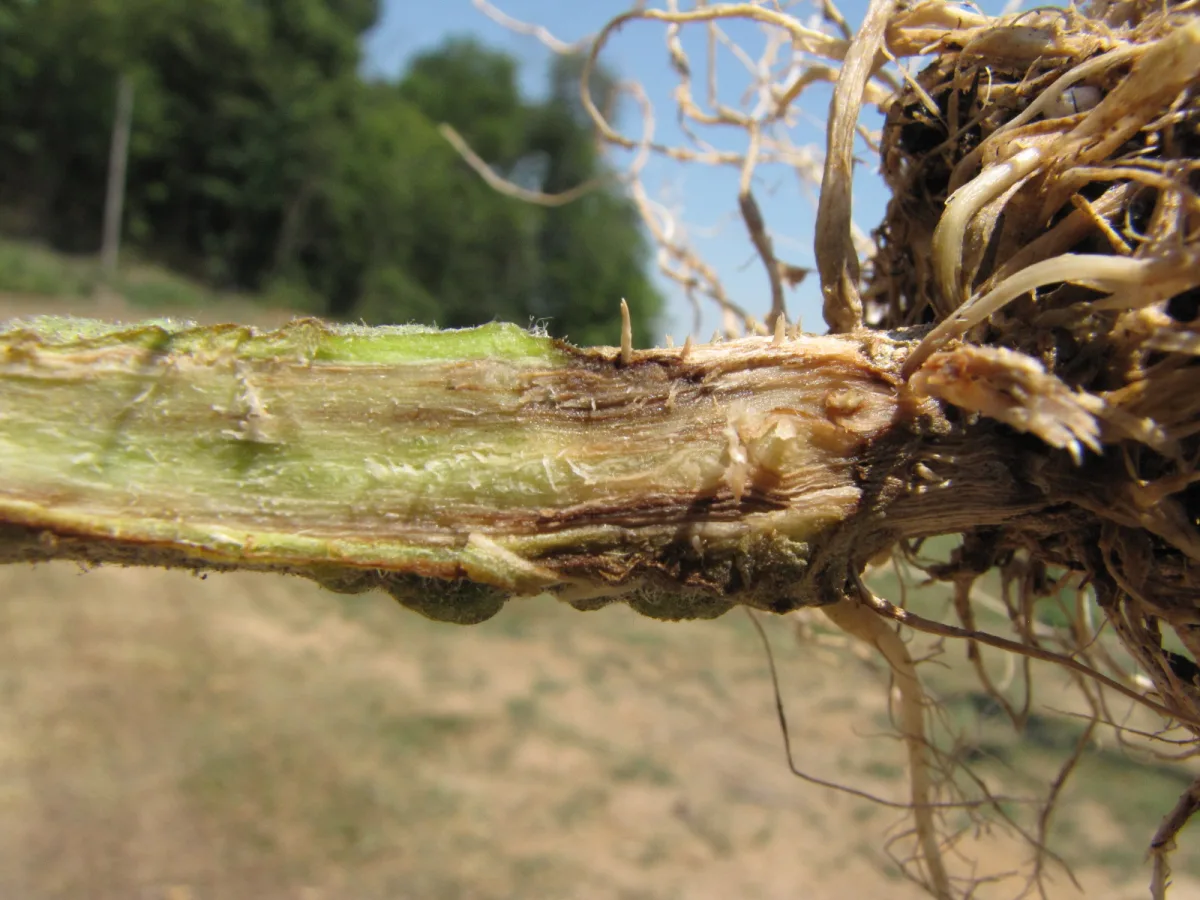
Root and collar rots (Pythium and Phytophthora species)
Almost all potted crops are susceptible to these fungi. Symptoms of infection include seedling damping-off, corm rot, root rot of unknown origin, crown rot of cuttings, and stem rot of established plants that are almost ready for sale.
Hosts: aloe, azalea, begonia, calceolaria, bellflower, chlorophytum, celosia, coleus, cineraria, dracaena, fatshedera, fuchsia, gloxinia, ivy, hydrangea, kalanchoe, peperomia, philodendron, poinsettia, primula, saintpaulia, scindapsus, zygocactus.
The first typical indicator of root, crown, or corm rot is most often stunted growth, followed by chlorosis of the leaves and sometimes wilting, especially on sunny days. When signs of wilting appear in a greenhouse, additional irrigation is usually provided, which, as a rule, leads to a worsening of symptoms. Examining affected plants reveals black, water-soaked spots at the base or root rot (including the peeling of the outer layers of roots) or corm rot.
Pathogens of these rots inhabit the soil or water and are brought into the greenhouse most often with non-disinfected substrate, but sources of infection can also include contaminated pots, trays, and shelves, as well as pond water and water stored in tanks, but not tap water. Cuttings contaminated with soil are another source of pathogens.
Increased damage is generally associated with a high concentration of inoculum, excessive soil moisture, or soil warming to 10–20 °C. Optimal temperature for the rapid development of the pathogen is species-specific. At the same time, healthy plants can grow in compost that was heavily infected at the beginning of the season if conditions for them are ideal. The development of symptoms is often determined by the growth rate of the root system: if a plant rapidly forms new roots, it appears healthy, but when root growth slows down, sharp symptoms of infection appear on it.
Fig. 17.1. Different stages of development of root and crown rot in cineraria (pathogen: Phytophthora cryptogea); top left — healthy plant.
Control. It is necessary to maintain hygiene, use cuttings from healthy mother plants, and carry out propagation in clean containers and disinfected substrate. In the case of dense planting in a small area, it is advisable to remove all propagated plants that show even very faint signs of infection, as well as some outwardly healthy plants around the infection site. Some protection against Pythium and Phytophthora species is provided by incorporating fungicides such as etridiazole and propamocarb hydrochloride into the soil or applying them via irrigation after rooting. On some plant species, irrigation with captan, zineb, and thiram has been used successfully. However, chemical control is hardly effective if treatments are started after symptoms have appeared. Rhizoctonia stem and root rot (Rhizoctonia solani)
Symptoms of infection with Rhizoctonia are often indistinguishable from those caused by Pythium and Phytophthora species. The pathogen affects roots, corms, stems, and sometimes leaves.
Hosts: azalea, begonia, calceolaria, cineraria, cissus, cyclamen, fittonia, fuchsia, gloxinia, gynura, hoya, kalanchoe, pellionia, peperomia, poinsettia, primula, schizanthus, sonerila, and tradescantia.
A detailed examination of affected plants sometimes allows for the detection of typical signs of Rhizoctonia. The pathogen forms a coarse brown mycelium that covers the affected tissues, especially on leaves and stems, and sometimes spreads over the surface of the substrate or compost. The layer of overgrowing mycelium can be so dense that infected plants can only be removed from pots with a clump of compost or soil. On stems, cormels, buds, and leaves, the pathogen causes light brown, usually dry necrosis.
Rhizoctonia solani is a widespread soil-borne fungus that develops rapidly in compost, especially at temperatures around 20 °C. It becomes particularly aggressive in warm and humid environments but loses activity in very dry or waterlogged substrates. Spore formation occurs rarely; the disease spreads through vegetative growth of the mycelium, with infected plants, or contaminated materials.
Control. The same control methods are effective against Rhizoctonia as against Pythium and Phytophthora species. Upon the appearance of symptoms, all diseased and neighboring healthy plants should be removed, especially in dense plantings. Fungicides effective against R. solani include iprodione, quintozene, tolclofos-methyl, and to some extent benomyl. Quintozene is best incorporated into the compost, although some plant species are very sensitive to it, so it is advisable to conduct a test treatment first. Iprodione and benomyl can be used via spraying or irrigation as preventive measures or to suppress an already developed disease.
Black root rot (Thielaviopsis basicola)
When roots are affected, symptoms similar to those caused by Pythium and Phytophthora species appear. Diseased plants develop poorly, chlorosis appears on the leaves, and wilting begins in an unfavorable environment.
Hosts: begonia, cineraria, cyclamen, gloxinia, kalanchoe, pelargonium, poinsettia, primrose.
It is most easily identified by microscopic examination. The outer tissues of the roots usually rot, turning light brown, sometimes black. The infection can spread to the base of the stem. The pathogen forms numerous chlamydospores, which can persist in the soil for a long time. Chlamydospores and conidia are spread with plant debris, water splashes, or with irrigation water. The main sources of infection are contaminated compost and containers. Increased disease development usually manifests on plants in damp compost with a temperature of 15—20 °C.
Control. Black root rot does not develop into an epiphytotic if hygiene rules and cultivation techniques are followed. Experience shows that root protection, prevention, or disease suppression is ensured by irrigation with certain fungicides. Benzimidazoles and, to a slightly lesser extent, propamocarb hydrochloride, zineb, and captan are effective against T. basicola.
Brown root rot (Melanospora damnosa, syn. Cylindrocarpon destructans)
This pathogen causes brown root rot of many potted plants; its symptoms are indistinguishable from other root rot pathogens.
Hosts: azalea, begonia, cyclamen, gloxinia, pelargonium.
In diseased plants, the root cortex is severely damaged, leading to the peeling of cortical tissues from the central vascular bundle. The rot can gradually encompass the entire root system and move to the base of the stem. When root tips are affected and adventitious roots develop, also showing signs of brown rot, the entire root system appears highly branched. In moist conditions, the pathogen forms numerous spores on the affected tissues, which are carried by irrigation water. The main sources of infection are compost and soil; the spores are not transmitted by air.
Control. If hygiene rules are followed and compost free of spores is used, the disease develops rarely. The introduction of non-disinfected components into compost, such as rotting leaves, often leads to severe outbreaks of brown root rot.
Good results are obtained by irrigation with fungicides, for example, zineb, captan, or benomyl, applied before symptoms of the damage appear. Regular irrigation of affected plants at intervals of 2—3 weeks curbs the further spread of root rot and promotes the recovery of affected plants.
: чл 5: 3 7 4 4 \ № м ме”: “ к | „Г С ‚ с: = $7 В. ^— и. } т 5 | ‚ 1% а ее т. * АУУ и, / И. а и. мт их ож Fig. 17.2. Root rot of cyclamen caused by МИЯ Вт. % вх. 1 ч:% $ г $ < А». Е уу Melanospora damnosa. При по0х 7 “ %.М Л, As the damage begins, the roots turn brown and black, their tips 5 к ах рение и почернение т ОЕВНХ ин С Ч | become thinner, and new adventitious за <. корешков, их кончики о;,ь\ 20: 8. roots are formed. утоньшаются, формируется ги “+ че. ОК ь а придаточных корешВы ь А? т СХ веде Вых 12+ 355 Grey mold (Botrytis cinerea)
This widespread pathogen affects leaves, stems, and flowers of many plants. Hosts on which the disease is particularly harmful include begonia, cineraria, cyclamen, fuchsia, pelargonium, poinsettia, saintpaulia, and tradescantia.
Spots of typical light-brown rot develop on affected leaves and stems, which in moist conditions become covered with a grey mold coating. On flowers, small dark-colored spots are visible, often purple, which sometimes grow, leading to complete rotting of the flowers. The fungus can grow saprophytically on any organic substrate, forming numerous spores that are easily spread by wind. On affected tissues, black sclerotia sometimes form, capable of surviving for long periods of drought, as well as at high or low temperatures. Disease development is promoted by high relative humidity and temperatures in the range of 15—25 °С.
Control. The most effective method of protection against grey mold epiphytotics is maintaining the relative humidity in the greenhouse at a level unfavorable for the development of the pathogen. Disease development weakens sharply in the absence of wilting leaves and mechanical damage, which serve as ideal entry points for infection.
Fungicide treatments and monitoring the greenhouse climate always ensure the suppression of grey mold. The most effective fungicides include iprodione, vinclozolin, and benzimidazoles, provided that the pathogen has not developed resistance to them (see p. 131), as well as captan and thiram. When fighting flower spotting, caution must be exercised, as symptoms of phytotoxicity or fungicide residue on flowers and leaves may prove more harmful to the resulting product than the disease itself.
Powdery mildew affects many pot plants, causing a typical white coating on the surface of leaves, and sometimes on stems, petioles, and flowers.
Hosts: begonia (Oidium begoniae), cissus (Oidium sp.), gloxinia (Oidium sp.), hydrangea (Microsphaera polonica), cineraria (Sphaerotheca fuliginea), kalanchoe (Erysiphe polygoni), saintpaulia (Oidium sp.).
When developing on hydrangea, saintpaulia, Cissus antarctica, and Begonia rex, the fungus forms circular spots of powdery coating of various colors (from dull gray-brown to white), with or without conidial sporulation. In saintpaulia, the pedicels and sepals are usually the first to be affected. For most pathogens, development requires high relative humidity and temperatures from 15 to 20 °C. According to many floriculturists, plants are more susceptible to powdery mildew when there is a lack of moisture (approaching the wilting point).
The disease spreads via spores, which are carried by the air over long distances, but they do not survive in severe drought or sharp temperature fluctuations. Pathogens are generally host-specific or have a very limited range of hosts. Therefore, the main source of infection is the subsequent planting of the same host plant.
Mother plants must be kept in a healthy state at all times. If powdery mildew has already appeared in the greenhouse, it is difficult to suppress it completely, as symptoms of the disease appear only under conditions favorable for the pathogen. Regulating air humidity helps prevent an outbreak, but this is not enough for a complete victory over the disease. On most crops, it is impossible to do without standard high-volume spraying with fungicides.
The range of products against powdery mildew is huge. However, due to the species and cultivar diversity of pot crops, agents with unknown properties must first be tested on a few plants. Only after this can you proceed to a full-scale treatment.
Most fungicides leave a residue on leaves, which impairs the commercial appearance before sale. In addition, some products cause physical damage to flowers in the form of spotting.
Benzimidazoles, dinocap, imazalil, pyrazophos, and bupirimate show high efficiency against the pathogen. For treatments during flowering or before the sale of pot plants, combinex — a mixture of thiram with mineral oil and permethrin — is often used. This product does not leave a visible residue on the leaves, but works reliably only when the powdery mildew development is mild.
Non-pathogenic leaf outgrowth: causes and prevention
This non-pathogenic disorder often affects ivy-leaved pelargonium and kalanchoe. Ficus, ivy, hydrangea, pilea, and solanum are also in the risk group. The main sign of the disorder is convex vesicles the size of a pinhead or corky warts on the underside of leaves. The plant develops normally, but loses significantly in quality.
Tissue outgrowth occurs due to an imbalance: leaves absorb water faster than they can evaporate it. As a result, cells in the stomatal zone become overfilled with moisture. The problem is exacerbated by high relative air humidity and soil heating, with plants having a powerful root system showing more severe leaf damage.
Sometimes edema occurs due to fungicide residues after treatments. Products based on mineral oils can clog stomata and hydathodes. Secondary pathogens and bacteria — the agents of soft rots — often colonize the damaged areas.
To prevent the appearance of physiological outgrowths, follow the care rules:
- avoid high air humidity and severe heating of the soil, especially during the active growth phases of plants;
- carry out treatments with products based on mineral oils with caution and not too frequently;
- space pots on racks more freely for good air circulation;
- water plants moderately and inspect them regularly for secondary rots.
Read next
Plant protection For agronomists
Control of black rot and rhizoctonia during plant propagation by cuttings
Plant protection For agronomists
Diagnostics and prevention of diseases in Peperomia, Pilea, and Poinsettia
Plant protection For agronomists