
Propagation technologies and agrotechnical features of growing potted crops
7 min read
Peculiarities of propagation and cultivation of pot crops
Pot crops are a very diverse group of species, including both plants that require tropical conditions and winter-hardy plants for growing in temperate climates. Some pot crops are grown for their flowers, others for their decorative foliage, and some for both reasons. They can be annuals or perennials with very different methods of propagation:
- by cuttings (propagation vegetative);
- by seed;
- by corms and tubers.
Pre-planting preparation and plant rooting
For the propagation of many species, a temperature of 21 °C is usually sufficient. Ideal conditions for seed germination and transplanting seedlings are similar to those described for nursery crops. A peat-sand mixture (50:50) is most widely used, although some flower growers still use loam. Before planting into loamy soil, it is mandatory to perform steaming, which is not required for peat-sand composts.
For rooting, nursery plants are planted in pure peat or in a mixture of peat with sand or perlite. Root formation occurs faster in turgid plants placed in a humid environment with a substrate temperature of 20 °C. If the conditions for rooting are close to optimal, the need for root growth stimulants is eliminated.
The method of propagation by cuttings is determined by the plant species:
- pelargonium — by stem segments with a node;
- fuchsia and hydrangea — by pieces of internodes;
- cissus and ivy — by leaf buds;
- peperomia and saintpaulia — by leaf stalks;
- rex begonia — by segments of leaf blades.
Young plants are planted in small pots (7 cm) filled with peat-sand compost (75:25). Transplanting into larger pots depends on the species.
Pot plants react differently to artificial lighting: in some, growth is accelerated, in others, flower bud formation is induced or, conversely, delayed. For example, the flowering of Calceolaria can be accelerated by 6—8 weeks (for sale in April) using weak additional lighting. Campanula isophylla forms many cuttings under long-day conditions or with a two-hour night break in illumination and blooms earlier. Poinset-
PLANT SPECIES GROWN AS POT CROPS Common name, Name, Latin name | accepted in Great Britain | provided in the book (p.) Adiantum sp. Maidenhair fern Fern (367) Aloe sp. Aloe Aloe (352) Aphelandra squarrosa Saffron spike Aphelandra (358) Asplenium filix-femina Moer spleenwort Fern (367) Begonia argentea B. sBegonia (358) comata Begonia hiemalis Rieger elatior Begonias Begonia (358) Begonia rex San plant Begonia (358) Begonia semperflorens Begonia (358) Beloperone guttata Shrimp plant Beloperone (360) Calceolaria Calceolaria Calceolaria (361) herbeohybrida Calceolaria hybrida Calceolaria Calceolaria (361) multiflora Campanula isophylla Campanula Bellflower (361) C. (isophylla var. alba Cockscomb Celosia (362) Celosia cristata var. Cockscomb pyramidata Chlorophytum comosum var. Bernard's Spider lily Chlorophytum (361) variegatum, C. capense var. variegatum Cissus antarctica Kangaroo vine Cissus (362) Coleus blumei Coleus Coleus (362) Cordyline terminalis Cordyline (363) Cyclamen persicum Cyclamen Cyclamen (363) Cyrtomium falcatum House Holly fern Fern (367) Dieffenbachia exotica, D. amoena Dumb cane Dieffenbachia (364) Dracaena sander, D. deremensis Dragon tree Dracaena (366) Euphorbia pulcherrima Poinsettia Poinsettia (377) Fatshedera lizei Ivy tree Fatshedera (366) (Fatsia japonica x Hedera helix) Fatsia japonica Fatsia (367) Ficus elastica Weeping fig Ficus (367) Ficus elastica var. decora Rubber plant Ficus (367) Ficus carica var. Leafy fig Ficus (367) Ficus pumila Ficus (367) Ficus radicans var. variegata Ficus (367) Fittonia verschaffeltii Fittonia (353) var. rubra Fuchsia corymbiflora, Fuchsia Fuchsia (368) Fuchsia boliviana, other species Gynura scandens Gynura (368) Hedera helix, H. canariensis, H. macu Ivy (368) Hoya carnosa Hoya (353)
Latin name | accepted in Great Britain | provided in the book (p.) Hydrangea hortensis Hydrangea (370) Kalanchoe blossfeldiana Kalanchoe Kalanchoe (371) Nephrolepis exaltata Ladder fern Fern (367) Pelargonium domesticum Regal pelargonium Pelargonium (371) Pelargonium peltatum Ivy-leaved pelargonium Pelargonium (371) Pelargonium zonale Geranium Pelargonium (371) Pellionia daveauana Pellionia (353) Peperomia caperata Peperomia (376) Peperomia hederaefolia Crinkled leaf plant Peperomia (376) Peperomia magnoliaefolia Desert peer Peperomia (376)
Pilea cadierei var. nana Aluminum plant Pilea (377) Primula acaulis, P. obPrimula (378)
Pteris cretica Brake Fern (367) Rhododendron simsii Azalea Azalea (358) Rhoicissus rhomboidea Grape ivy Rhoicissus (378) Saintpaulia ionantha African violet Saintpaulia (379) Sansevieria trifasciata, S. trifasciata var. laurentii Mother-in-law's tongue Sansevieria (379)
Schizanthus (379) Scindapsus (379) Cineraria (361) Gloxinia (368) Sonerila (380) Solanum (380)
Streptocarpus (380) Syngonium (380)
Tradescantia (380)
Arum (380) Zygocactus (381) forms flowers and bracts at a day length of 13 hours or less, and to delay its flowering until the end of December, the day length must be increased.
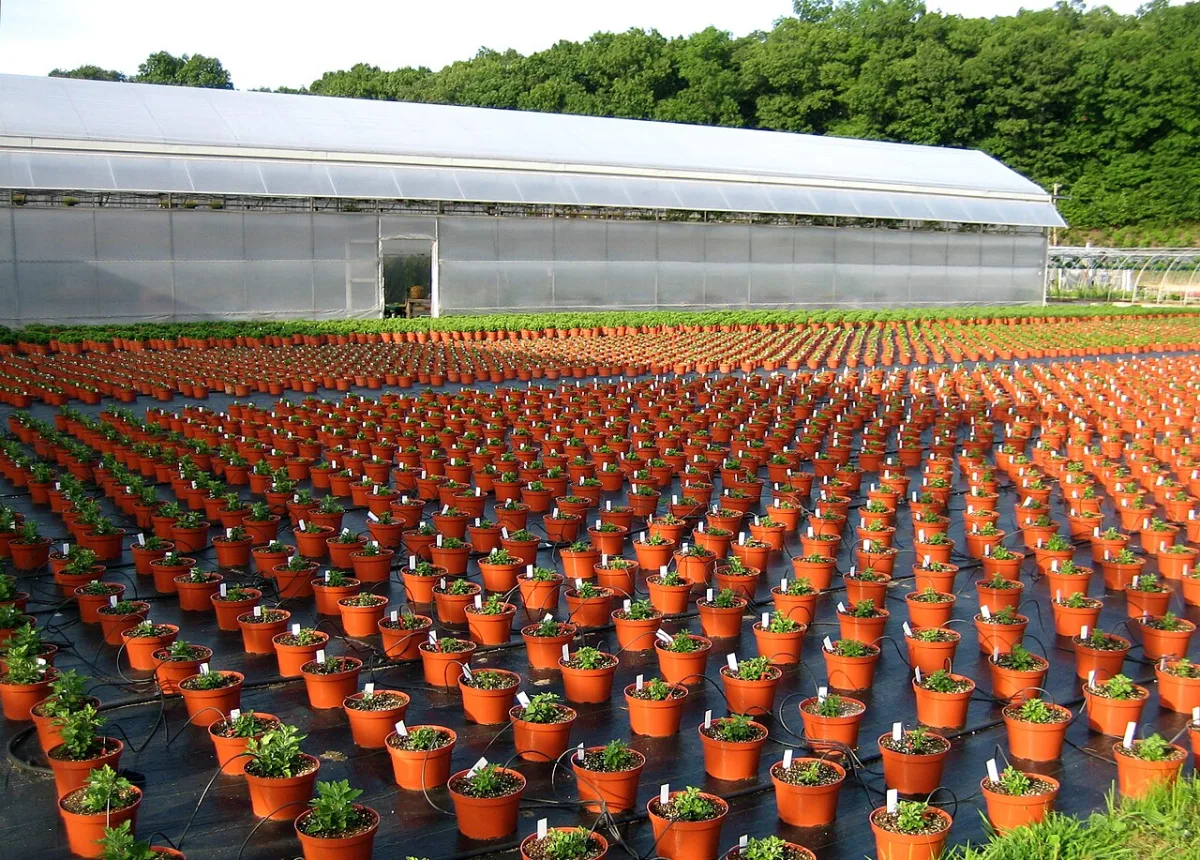
When growing pot plants, various automatic and semi-automatic irrigation systems are used, including drip irrigation, laying out water-absorbent materials, ebb and flow benches, and sub-irrigation benches. The growing environment regime is determined by the crop type. Most pot plants are resistant to low temperatures and only require protection from frost.
The production volume depends on the age of each crop and, consequently, on the size of the plants by the time of sale, averaging 300,000–600,000 plants per 1 ha. DISEASES
The diseases described in this section develop both during propagation and during the cultivation of pot crops. Various new pathogens may appear on plants that have already been sold, leading to new problems, but these are not covered here, although seedling diseases occur at any stage of plant ontogenesis. Certain symptoms, such as root rot, are common to many plant species. Therefore, diseases caused by the same or related pathogens that produce similar symptoms are grouped into general subsections, with a list of host plants provided for each. The absence of a specific species in such a list does not at all mean it is resistant. Most likely, it can be affected by a particular disease, but this has not yet been established.
Many pot plants originate from tropical or subtropical regions and are susceptible to diseases not found in temperate countries where these plants are grown. As a result, and because many pot crops are propagated in one country and grown in another, diseases entirely new to specific conditions are introduced. Very often, cases of new pathogen emergence are isolated, although in some cases, the agents adapt to the given environment and gradually become a common problem. Difficulties also arise with the application of fungicides. There is little or no data on their suitability for treating many species, especially those rarely grown. In the absence of relevant information, it is advisable to first test the preparation on a small number of plants and only then treat the entire planting. Pre-treated plants should be monitored for signs of phytotoxicity for at least a week, although for some slowly developing processes, such as growth disorders, this time is insufficient.
The rooting substrate and water serve as mass sources of infection; therefore, it is especially important to strictly observe all hygiene measures during propagation, which are described in Chapter 5 in relation to pot crops.
Read next
Plant protection For agronomists
Diagnostics and prevention of diseases in Peperomia, Pilea, and Poinsettia
Plant protection For agronomists
Diagnostics and pathogens of Kalanchoe and Pelargonium diseases
Plant protection For agronomists