
Current state and development prospects of domestic grain harvesters
7 min read
Modern agriculture is based on industrial technologies of production, i.e., the use of high-performance machines with minimal labor costs. In the last few years, the industry producing harvesting machinery has begun to intensify in our country.
Its main manufacturer is OAO Rostselmash, which is modernizing the combine harvester "Don-1500" as it improves it. A number of enterprises are also actively developing production capacities:
- OAO Krasnoyarsk Combine Plant has put the "Kedr" family of combine harvesters into serial production.
- OAO Tula Combine Plant has mastered the production of a trailed combine harvester.
- OAO Taganrog Combine Plant produces a small quantity of KZS-3 machines, designed for harvesting small areas.
The process of improving harvesting machinery is aimed at increasing the productivity of combine harvesters, their engine power, grain tank capacity, and the mechanization of regulation, control, and monitoring processes. Problems of reducing grain losses, increasing the service life of combine harvesters, their high-quality repair, and effective use can only be solved if the people operating these complex machines are well-versed in their design and technical capabilities, use modern setup and adjustment tools, and perform maintenance in a timely and professional manner.
In modern literature, the above-mentioned issues are not covered broadly enough; therefore, the purpose of this manual is a more detailed examination of domestic and foreign combine harvesters. This chapter covers in detail the basic model of the "Don-1500" combine harvester, its design, adjustments, and settings for various operating conditions, and describes the differences of the "Don-1500B" combine.
Fundamentally new rotary combine harvesters "Don-Rotor" and PN-100 "Prostor" are also considered. The main technical data of promising Russian combine harvesters are provided, and for comparison, the parameters of imported combine harvesters from companies are given.
The history of combine harvesters began in the United States of America at the beginning of the XIX century. As early as 1828, the first complex combined system for harvesting grain crops was patented in the USA. The machine autonomously cut the plants, threshed them, and cleaned the grain from debris. However, this machine was never built.
The first realized project of a combine harvester should be considered the machine invented by Americans Briggs and Carpenter in 1836. The machine was mounted on a four-wheeled carriage and moved by horse-drawn power. The drive for the cutting and threshing apparatus was provided by a transmission from the rear wheels.
In the same year, 1836, designers Moore and Hascall patented a machine that, in terms of basic operating principles, was very similar to the design of modern combine harvesters. In 1854, this machine worked in the fields of California and harvested about six hundred acres, which is approximately equal to 240 hectares. It is worth noting that until 1867, the development and creation of combine harvesters were mainly carried out in the eastern states.
In 1975, in the same California, Peterson built a machine that finally received recognition from manufacturers. And by 1890, six industrial companies were already producing combine harvesters for sale. All combine harvesters were mainly made of wood and moved by horses or mules, while the drive to the working parts of the combine was provided by the wheels.
THE EMERGENCE OF SELF-PROPELLED COMBINE HARVESTERS The creator of the first self-propelled combine harvester was the American company Holt. It was the one that released the first model of a combine harvester that had its own steam engine with a power of 120 hp, and its cutting apparatus had a reach of 11 m. This combine harvester was born in 1905. And as early as 1907, the same company released an internal combustion engine. This was an important step in the development of combine manufacturing. In the coming years, more modern materials and lightweight high-RPM gasoline engines began to be used. All these factors made it possible to significantly reduce the cost of combine harvesters, which made them more accessible and useful for agriculture. However, only very large farms could afford such a purchase. Only from 1926 did combine harvesters begin to be more or less actively introduced into the agricultural industry of the United States of America. The "Depression" of the late 20s hit the production of combine harvesters significantly. However, it became an incentive for the introduction of small machines with a cutting width of up to five meters, although they cannot be called successful. According to statistical data, in 1930 in the USA, only one percent of agricultural companies and individual farms owned combine harvesters.
The first combine harvester in Russia appeared in 1913. However, it was not of domestic manufacture but was brought by the Holt company to an agricultural exhibition held in Kiev. It was a machine made of wood, which had a gasoline engine and a single-track crawler tread. The reach of the machine's cutting apparatus was 14 feet (4.27 m). The engine powered both the undercarriage and the cutting apparatus of the machine. The combine harvester underwent testing at the Akimovskaya testing station, but it did not find application in the agricultural conditions of Russia of that period.
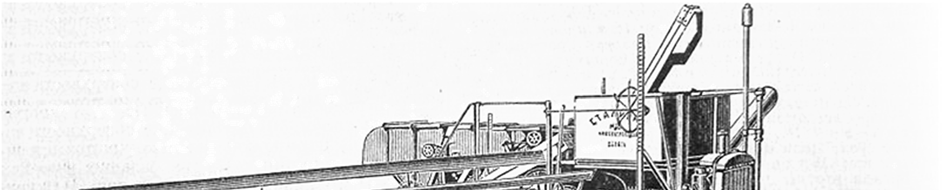
Mass mechanization of domestic agriculture began after the First World War. Between 1929 and 1931, the Soviet government purchased combine harvesters in the USA for large-scale commodity production farms. At the same time, domestic production was being established: in 1930, the Zaporizhia "Kommunar" plant produced the first 10 domestic combine harvesters. From 1931, the Rostov "Rostselmash" plant began producing "Stalinets" combine harvesters, and in 1932, the Saratov "Sarkombain" plant commenced operations.
| Combine model | Engine type | Power, hp |
|---|---|---|
| "Kommunar", "Sarkombain" | Ford-NATI gasoline | 28 |
| "Stalinets" | STZ/KhTZ kerosene | 30 |
The movement of the first harvesting machines across the field was provided by ChTZ tractors. Since these models were not adapted for harvesting damp grain in northern conditions, the Lyubertsy plant started producing the specialized northern combine harvester SKAG-5-A (Northern combine, 5th model) in 1936. The creation of this equipment made it possible to solve the problem of harvesting grain in regions with high humidity.
Choosing the harvesting method and agrotechnical requirements
The optimal combination of direct combining and the swathing method allows for achieving minimal harvesting costs. The ratio of these methods is calculated based on the situation in a specific field. If there are no extreme factors, direct combining and swathing are combined in approximately equal proportions.
When choosing a harvesting technology, an agronomist considers the following key factors:
- crop cultivation conditions;
- availability of headers, combine harvesters, and units for grain processing and drying;
- agrobiological characteristics of the cultivated cultivars;
- weather conditions expected during the harvesting period.
Thin, short-stemmed cultivars must be harvested by direct combining, while weed-infested crops — by the swathing method. Swathing harvesting is preferable for crops prone to lodging and in intensive technologies characterized by high stalk moisture at full grain maturity and susceptibility to lodging. Direct combining is used in case of a forecast of a prolonged rainy period during harvesting operations.
For the swathing method of harvesting, mounted headers ZhVN-6A-01 and ZhVR-10-03, aggregated with the KPS-5G power unit, or mounted headers in combination with the SK-5 "Niva" combine, are used to mow grain into swaths. ZhVR-10-03 (ZhVR-10) headers are used in the swath-doubling mode when mowing grain with a 20 m cutting width. Depending on the zone and harvesting conditions, the "Don" combine can be equipped with a straw collector for collecting straw and chaff, or with a chopper for delivering the mass to trailed carts or spreading it across the field.
Compliance with loss standards is a key indicator of the quality of the harvesting and transport complex. For swathing, grain losses behind the swather are allowed at no more than 0.5% for erect grain and no more than 1.5% for lodged grain, and when picking up swaths — no more than 1%. Behind the combine header during direct combining, up to 1% of losses is allowed for erect grain and up to 1.5% for lodged grain. For grain legumes and cereal crops, the crushing rate is set at no more than 3%.
- Grain purity in the grain tank (swathing) — at least 96%
- Grain purity in the grain tank (direct combining) — at least 95%
- Losses due to incomplete threshing and with straw (cereals) — no more than 1.5%
- Losses due to incomplete threshing and with straw (rice) — no more than 2%
- Crushing of seed grain — no more than 1%
- Crushing of food grain — no more than 2%
Read next
Farm machinery For agronomists
Design features and advantages of double-drum threshing units of Yenisei combine harvesters
Farm machinery For agronomists
Design and operating principle of the DKSh 64 Volzhanka irrigation machine
Farm machinery For agronomists