
Classification of sprayers and setting of spraying parameters for the working solution
6 min read
How to choose the spray type and set up nozzle operation
The quality of pesticide application directly determines their field efficacy. It is important for an agronomist to achieve optimal droplet size and uniform coverage of leaves or soil. Droplets that are too fine are prone to wind drift, while large ones quickly run off the leaf surface to the ground, reducing the protective effect.
Depending on the tasks at hand, spraying is divided into three technological types. The high-volume method requires large volumes of water and large droplets. Low-volume and ultra-low-volume applications allow working with concentrated solutions, significantly saving water and time spent on tank refilling.
| Spraying type | Droplet size, µm | Dose for field crops, l/ha | Dose for perennial plantations, l/ha | Working solution concentration |
|---|---|---|---|---|
| High-volume | More than 250 | 300–600 | 800–2000 | Low |
| Low-volume | 50–250 | 10–200 | 100–500 | High |
| Ultra-low-volume | 25–125 | 10–200 | 100–500 | Highly concentrated ready-to-use product |
Droplet size is regulated using the machine's operating components — spray nozzles. Two factors play a role here: system pressure and nozzle orifice diameter. To reduce droplet size, it is necessary to increase pressure or install a nozzle with a smaller aperture. Liquid consumption increases with higher pressure and larger nozzle orifice diameter.
- Coarse spray — more than 300 µm
- Fine spray — 150–300 µm
- High-dispersion spray — 50–150 µm
- Aerosol spray — less than 50 µm
Coarse spray (more than 300 µm) is used for aerial sprayers in windy weather. Keep in mind that the spray fan angle changes noticeably with pressure only up to 0.5 MPa, while at higher pressures this parameter stabilizes.
Sprayers are selected based on crop structure and farm characteristics. Machines can be specialized (for treating a single crop, such as vineyards, hop yards, or cotton) and universal (for multiple crops). Depending on the method of coupling with the tractor, they are divided into mounted, semi-mounted, trailed, and implement-mounted, and according to the distribution type — into boom, air-blast, and combined.
Technical characteristics of popular sprayer models
The reliable operation of machinery in the field depends on its design parameters. Domestic farms often use trailed boom and air-blast machines. Below are the detailed technical parameters of three common sprayer models for various types of treatment.
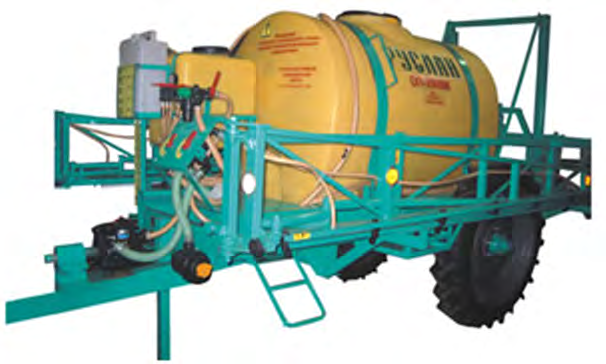
The OP-2000 M "Ruslan" trailed sprayer is designed for treating field crops with pesticides and liquid fertilizer. It is equipped with a 2000-liter main plastic tank, hydraulically controlled booms, and a 100 l pre-mixing tank. The model is equipped with an Italian pump with a capacity of 133 l/min, the shaft of which is protected from vibrations by an intermediate support. For the convenience of the operator, a 20-liter hand-washing canister is provided.
| OP-2000 M "Ruslan" parameter | Technical data |
|---|---|
| Main tank capacity, l | 2000 |
| Additional tank capacity, l | 100 |
| Boom working width, m | 18 |
| Hand-washing tank capacity, l | 20 |
| Pump capacity, l/min | 133–140 |
For the chemical protection of perennial plantations, the OPV-2000 air-blast sprayer is used. A two-speed fan with adjustable blade angles allows for tuning the airflow to the specific crop, saving the power of MTZ-80/82 or YuMZ tractors. A diaphragm-piston pump ensures stable pressure, and two-position spray heads with cut-offs allow for quick switching of application rates.
| OPV-2000 parameter | Technical data |
|---|---|
| Orchard treatment width, m | 1–2 |
| Vineyard treatment width, m | 2.4 |
| Hop yard treatment width, m | 6–8 |
| Tank capacity, l | 2000–2400 |
| Working liquid consumption, l/ha | 100–1500 |
| Operating pressure, MPa | 2; 5 |
| Overall dimensions in transport position, mm | 4200 × 1800 × 1800 |
| Weight, kg | 2960 |
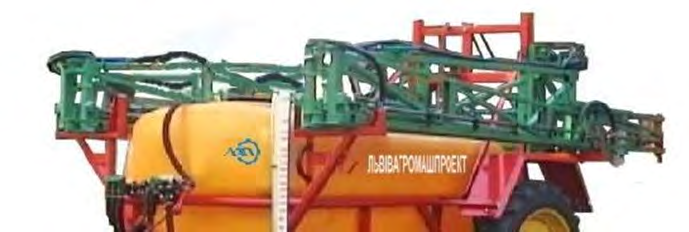
The OPSH-2000 field boom combined sprayer solves tasks of surface application of pesticides and liquid mineral fertilizers. It is also suitable for whitewashing works and firefighting. The model is equipped with slit nozzles and a reliable NShN-600N pump, delivering an output of up to 380 l/min.
| OPSH-2000 parameter | Technical data |
|---|---|
| Aggregation type | Trailed |
| Productivity per hour of main time, ha/h | 9.9–16.2 |
| Productivity per hour of operational time, ha/h | 4.0–6.7 |
| Operating speed during main operations, km/h | 6–10 |
| Working width, m | 16.2 |
| Working liquid consumption, l/ha | 75–300 |
| Operating pressure in boom manifold, MPa | No more than 0.3 |
| Nozzle type | Slit |
| Pump model | NShN-600N |
| Maximum operating pressure, MPa | 0.42 |
| Pump output, l/min | 380 |
| Tank capacity, l | 2000 + 20 |
| Maximum turning radius at the extreme outer point, m | 9.5 |
| Overall dimensions in working position (length × width × height), mm | No more than 4450 × 15500 × 1890 |
| Overall dimensions in transport position (length × width × height), mm | No more than 4550 × 2450 × 1890 |
| Track width, mm | 1400 ± 30, 1500 ± 30 |
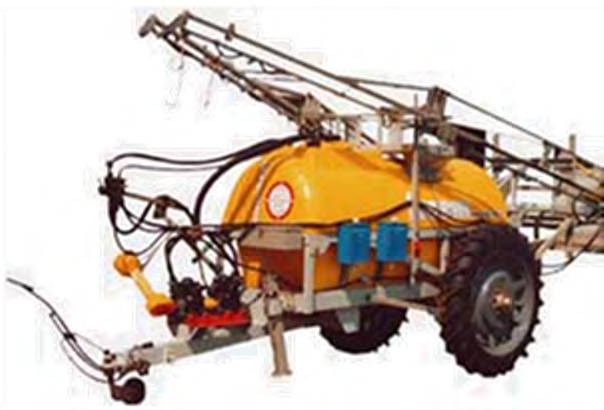
The use of OP-22 and OTM 2-3-01 trailed sprayers allows for the effective treatment of field crops with pesticides and the application of liquid complex fertilizers. The OP-22 model was designed for treating cereals, beet, vegetables, and potatoes, including those grown using intensive technologies. The OTM 2-3-01 semi-trailed sprayer is suitable for use in regions with a temperate climate and works with all types of pesticides in the form of solutions, emulsions, and soluble powders, as well as with liquid complex fertilizers.
- OP-22 tank capacity — 2 cubic meters
- OTM 2-3-01 tank volume — 2000 l
- OP-22 working width — 22.6 m
- OTM 2-3-01 working width — 18 m
- OP-22 pesticide consumption — 80–200 l/ha
Technical parameters and operation features of sprayers
The wide-reach OP-22 sprayer is designed for aggregation with 0.6–0.9 class tractors (including MTZ 80/82) with a drawbar pull of 6–9 kN. Its diaphragm-piston pump is driven by the power take-off shaft via a 10.016.2000-03.04 driveshaft (manufactured according to TU 23.2.21 07-89). To prevent plant damage, the wheel-support boom of this model has a track of 11500 mm, which allows the support wheels to pass precisely along the rows of beet, sunflower, and corn.
The semi-trailed OTM 2-3-01 sprayer is aggregated with 1.4 class tractors (Belarus brand). The sprayer is equipped with a hydraulic drive for automatic boom unfolding and lifting, as well as a three-stage filtration system for working fluid to protect the nozzles. The design provides for the possibility of self-refilling the sprayer with water directly in the field.
Observe the pressure limitations: the working pressure of the OTM 2-3-01 must not exceed 0.6 MPa, while the OP-22 diaphragm-piston pump requires a pressure of at least 2 MPa.
The boom height adjustment for the OP-22 is performed manually in the range of 600–1250 mm, whereas for the OTM 2-3-01, the boom installation height is set via hydraulics within 0.4–1.5 m.
| Technical characteristic | OP-22 | OTM 2-3-01 |
|---|---|---|
| Sprayer type | Trailed wide-reach with wheel-support boom | Semi-trailed boom |
| Compatible tractor class (brand) | 0.6–0.9 with 6–9 kN drawbar pull (MTZ 80/82, etc.) | 1.4 (Belarus) |
| Tank volume | 2 cubic meters | 2000 l (polyethylene) |
| Working width, m | 22.6 | 18 |
| Productivity for pesticide spraying, ha/h | 25 | up to 17 |
| Productivity for liquid fertilizer application, ha/h | 15–20 | up to 17 |
| Working fluid consumption (pesticides), l/ha | 80–200 | 100–300 |
| Working fluid consumption (liquid fertilizer), l/ha | — | 100–600 |
| Operating speed, km/h | 12–18 | up to 12 |
| Wheel track width, mm | Base — 1500 (1420), adjusted — 1780 (1860) | 1.4 m; 1.5 m; 1.8 m |
| Pump and drive parameters | Diaphragm-piston (Italy 135 (145)), flow rate no less than 132 (145) l/s | Pump shaft speed — 540 rpm |
| Working pressure, MPa | no less than 2 | no more than 0.6 |
| Total power consumption for travel and pump drive, kW | — | no more than 25 |
| Boom support wheel track, mm | 11500 | — |
| Boom unfolding and adjustment system | Manual | Hydraulic drive for boom unfolding and lifting |
| Boom installation height | 600–1250 mm | 0.4–1.5 m |
| Agrotechnical clearance, m | — | 0.5 |
| Machine weight, kg | no more than 850 | 1400 |
| Overall dimensions (L × W × H), m | — | 5.6 × 3 × 2.25 |

Read next
Plant protection For agronomists
Pesticide registration and the procedure for their approval for use
Farm machinery For agronomists
Classification and design features of modern agricultural seeders
Agrochemistry For students