
Classification and design features of modern agricultural seeders
3 min read
The choice of a seeder design directly affects the cost of sowing and the quality of seed distribution in the field. By method of sowing, machines are divided into drill, hill-drop, check-row, precision, and broadcast seeders. By purpose, they are classified into three groups: universal, special, and combined. The latter are additionally equipped with fertilizer-dispensing units for the simultaneous application of fertilizer.
Universal seeders (e.g., grain and grain-grass seeders) are suitable for sowing cereals, legumes, oilseeds, certain industrial crops, and grasses. Using a single machine for various tasks reduces farm costs: the equipment fleet is reduced, the operating time of each unit per season increases, and maintenance is simplified.
Replacing special seeders with universal ones is not recommended. The physical properties of seeds, sowing rates, seeding depth, and row spacing for beets, cotton, corn, and vegetables differ significantly, which requires the use of highly specialized machines.
Design features and aggregation methods for seeders
Based on the layout of working components, seeders are divided into three main types. The choice of a specific scheme depends on the required productivity and the sowing technology:
- Monoblock. All working components are mounted on a single frame. Seeds from one or two hoppers enter the metering units, from where they travel through seed tubes directly to the furrow openers.
- Separated-aggregate. Consist of modules: a large-capacity hopper is installed on the tractor or a separate trailer, and the sowing unit is attached to the rear. Seeds from the hopper pass through one or two metering devices into a pipeline, from where they are transported by air pressure from a fan to one or two distributors on the sowing unit frame, and then to the furrow openers.
- Sectional. Consist of independent sowing sections fixed to a frame. Each section is autonomous and has its own hopper, metering unit, drive, furrow opener, gauge wheels, press wheels, and covering devices. By moving the sections along the frame, it is possible to quickly change row spacing, which is necessary for wide-row and precision sowing of special crops.
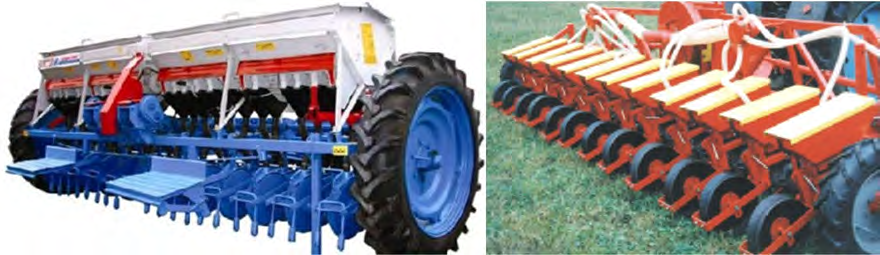
The method of aggregation with a tractor is chosen based on the scale of the fields and the crops grown. Seeders are available in mounted and trailed versions. Grain machines are usually made as trailed units—this allows for assembling wide sowing units from one to six seeders for rapid work on large areas. Industrial crops (sugar beet, cotton, grain corn) and vegetables are more often grown on smaller areas and under irrigation, which is why it is more efficient to use maneuverable special mounted seeders here.
Read next
Farm machinery For agronomists
Technical design and features of Monosem sowing units
Farm machinery For agronomists
Structure and operating principles of the SZP-3.6 grain drill in agriculture
Farm machinery For agronomists