
Vegetable growing technology in small-sized plastic tunnels and covers
18 min read
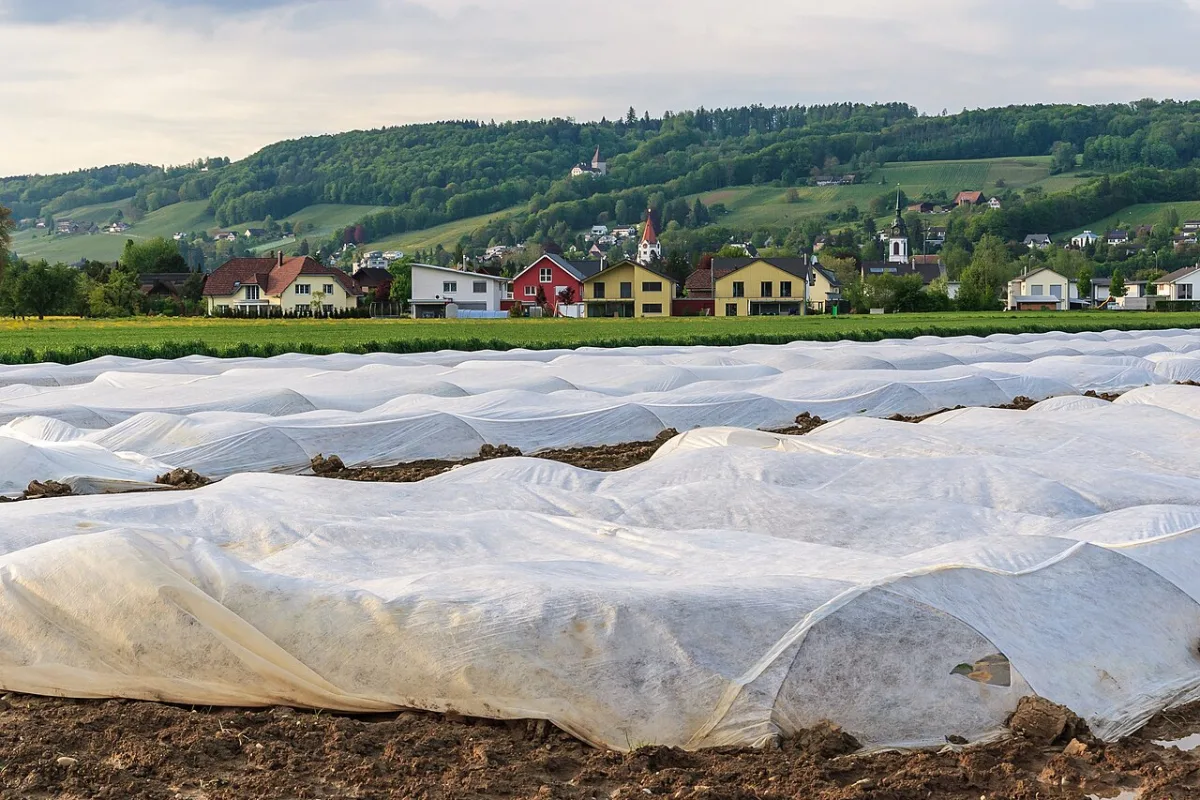
Group covers. Now we will talk about framed and frameless covers, in which soil ridges serve as support for the film. Soil frames are set up in a ploughed field by a machine that cuts ridges and simultaneously performs sowing of seed, spreads film in the form of a tunnel 100—150 m long, and covers its edges with soil. Under such a cover, cucumber, watermelon, and melon grow for 25—35 days, after which the film is rolled up again by the machine. This method of growing cucumber increases the yield of early produce by 4 times compared to open ground.
Arched, or tunnel, covers are used quite often. The frame for them is made in the form of semi-oval arches from vine, metal wire rod, or rods. Depending on the material from which they are made, the bent arches are installed at a distance of 0.6—1.6 m and tied from above and on both sides with twine or wire. A film is stretched over the frame. At the ends, it is tied with twine to stakes, and along the sides, it is covered with soil. This method of securing _) 7-42 i. Ri o ny o: t ‚ — in _ - __ o ny and Fig. 1. Arched and block greenhouses at the experimental testing ground of UNIIOB r > 0 Ch x S => k Ts r 5 film is simple but not very convenient in operation. Every time for ventilation, it is necessary to rake up and then re-apply soil onto the film. It is more convenient when only one edge of the film is covered with soil, and the second is nailed to a wooden plank, onto which the film is wound during ventilation.
The width of the covers is from 0.6 to 2.5 m, height is 0.3—0.8 m, length is arbitrary. If a wide cover is made of two sheets of film, the arches at the top are fastened with a wooden bar, to which the film is nailed with wooden strips and nails. These frames are convenient in operation, easy to install in the field, and move during mechanical tillage. The semi-cylindrical shape of the covers increases their wind resistance.
Transplants of vegetable crops under covers are planted 25—30 days earlier than in open ground. The first harvesting begins 3—4 weeks earlier than in open ground. The productivity of plants under the cover is 2—2.5 times higher than without it.
'Tunnel covers can have various modifications. Under the cover, plants are sown or, even better, transplants are planted in an ellipse, adhering to a distance between axes 1600 (] t y —ch - \ Ts - _\ lv A ya 4 ^ \ 2 & IV zy 0.6-0.3 1.6-\ Fig. 2. Tunnel covers <; g h x 1
> 25) and 1200 cm. Arches are installed according to the contour and covered with film. After 3—4 weeks, the film is removed, and the plants are tied to a pole installed in the center with a wheel at the top. Over time, a tent is formed, which provides an optimal microclimate for the cucumber. In the center, there is a container with water or fermenting cow manure (aqueous infusion of cow dung).
The fundamental difference between these covers and dual-pitch hotbeds is the absence of side bracing.
As a cover for heat-loving crops, it is advisable to use a primitive "shack". An enclosure is made of four bricks placed on edge. In the center, one brick is placed vertically and covered with film. The film is covered with soil. At the four corners, cucumber seeds are sown, or at two corners — melon or watermelon. The brick has high heat capacity; it heats up during the day and releases heat at night. Instead of bricks, one can use plastic bottles filled with water (they guarantee protection from frosts). During 3—4 weeks, until the plants reach the film, there is practically no need to ventilate such covers. Gradually, the cover is opened, preparing the plants for the conditions of open ground.
Hotbeds are the oldest type of protected ground structures, intended primarily for growing seedlings. All scientific and technical progress in protected ground has been associated with the replacement of hotbeds with plastic greenhouses — structures that provide higher productivity and labor culture, as well as better quality of seedlings. At the same time, it is currently advisable to pay attention to hotbeds, which are the least energy-intensive structures.
A standard hotbed consists of a pit, bracing, frames, and mats. The length of a 20-frame hotbed is 21.2 m. The depth of the excava0 X = y
$. 20 ev 55 8 ‹ r tion, which serves to accommodate biofuel or heating devices in it, is 45—70 cm depending on the service period. Early hotbeds are the deepest and are set up at the end of January — early February; mid-season ones — from the second half of February — early March; the shallowest, late ones — in mid-March.
The hotbed frame, which serves to increase the cubic capacity of the sub-frame space and acts as a support for placing and holding the hotbed sashes, can be made of wood or reinforced concrete with a depreciation period of 10–12 and 20–25 years, respectively. The northern side board is 10–20 cm higher than the southern one to create a specific slope for the hotbed sash. The hotbed sash serves to provide the necessary light and additional thermal regime in the hotbed. A standard hotbed sash is 160 cm long and 106 cm wide, consisting of a wooden frame, glazing bars, and glass. Often, instead of glass, a translucent polymer film is used. To insulate hotbeds, mats are used—straw mats, 2x1.2 m in size, are the best—which significantly reduce the heat loss of the hotbeds. The length can vary and is determined-
1600 700 and II they r EE a u Yop... - - ki k => o and IE eee NY $929 fight ii „2:99:12: AK» ke eto: mA ANY VO O AIIIu se. 6, *: 1. -0-.6:>0-. 19-57 0-79 VI 1 4. DEL VAA 220 U x x \ 1200 Fig. 3. Single-pitched sunken hotbed: 1 — manure; 2 — nutrient mixture; 3 — southern side board; 4 — hotbed sash; 5 — northern side board > de I x d by the number of sashes. Based on the need for hotbed area for a 3–5–7-sash hotbed, the length of the excavation pit should be 3.18–5.30–7.42 meters.
In hotbeds, both biological and technical heating are possible. Among vegetable growers, there are many skilled craftsmen who can build a successful hotbed of their own design. For example, for many years now, I have been using a stationary ground-level hotbed designed by my husband on my summer cottage plot. The dimensions of the hotbed: length — 3.5 m; width — 2.0 m; height — 0.5 m. The frame is made of wooden bars and covered with polyethylene film. On top, it is covered with 4 sashes, which are easy to remove and put back. The dimensions and design of the hotbed allow me to fully provide myself with vegetable and flower transplants, and in the second cycle — to grow a good harvest of eggplants without applying toxic chemicals against the Colorado potato beetle, which finds it difficult to overcome the 50-centimeter film barrier.
Among double-pitched hotbeds, the most practical value belongs to the collapsible-portable hotbed with film covering. The frame for one section of the 6x1.6 m hotbed is made of boards, on which three pairs of structural legs are placed, fastened at the top with a beam. The ends of the hotbed are closed with a triangular frame covered with film. The covering is a curtain-type film in the form of a continuous sheet. At the top, the film is attached to the beam, and its edges are attached to wooden bobbins. The mass of one section is 48 kg. When operating the sections, they are placed end-to-end.
Greenhouses Greenhouses under glass are generally built according to standard designs; they form the basis of greenhouse complexes intended for year-round operation. In farming enterprises and the private sector, it is more practical to use film greenhouses, especially during the spring-autumn period. Therefore, we will focus mainly on the construction of film greenhouses. < 9. «oe ь о 22° 3<24e 08 22 З`73 > 8> 9 a 3a> 77 > x > 5 ” and pitona o ket 7 c a. i i EO o — __ - na ay SA IV BB o i E o a mo i i r o o i ly o o aaa I o M t m a g. ya | a 7 a. o. Se r, i be a 1 o, __ | y de o i vo Ro t mi _ zhi o.. _ u. va _ 8%. _ o v yy - # ny v o m sy za a __ o o, o o No o E. ya r — iy ay kg E k ly ve. ь. r a r. ee % i o ya _ v o me a |: _ oe o | iy a t ь — i a. iy o o m No - _ G o - o i, o. o __. ne o. _ G. d. m.. G o, s, i. 4. 8 a:: t o ee.). ee m 2 m. ”. o Sh re y. d o Ea v ty o._ o o _ - a r - # $ m __ E z: o m _ oe.] _ osh eo G. ь: r: ь shche» ›.. 1 v t” o _ G o os o V i r __ a o _ ya _ o i ® my i i.” o et o ly o i a a a _ — | O my t i __ o — o o | o o —.. o o o o __ _ o o __ o = o i o o — _ a o: a _ a —_ i Fig. 4. Tomato crop under a double-pitched hotbed after the film has been removed A x o Am
For many years, at the test site of the Ukrainian Research Institute of Vegetable and Melon Growing (URIVMG), we have been testing various designs of plastic greenhouses, many of which are presented in the photographs in this book.
When constructing plastic greenhouses, it is very important to ensure the wind resistance of the cover, as wind is the primary enemy of the plastic film. It often happens that within a month or a month and a half, the film tears. Wind resistance depends on many factors. For instance, one should avoid large windage areas, and it is necessary to ensure the film adheres securely to the greenhouse structures, provide initial strong tension for the film, and include the ability to retighten it. An arched roof shape is the best. You must not leave the ends of the film unsecured. To attach the film securely to a wooden beam, you must wrap its edge around a lath. The film is most easily damaged on the roof, specifically at the top ventilation section.
Creating good, reliable ventilation that ensures an optimal temperature regime for cucumber crops, which prefer a steam-bath atmosphere, or for tomatoes, which love drafts, or for hardening off transplants for open ground, is not a simple matter. Top ventilation, which is most suitable for many heat-loving crops (primarily for cucumbers), complicates the structure, especially on arched greenhouses. Many years of practice have not yet yielded an optimal solution regarding the design of top ventilation in industrial plastic greenhouses.
Microclimate control and side ventilation
Properly adjusted ventilation in small-scale plastic covers allows for the regulation of temperature and air humidity under the dome. Rolling up the side enclosure to a height of 1–1.5 m on both sides creates optimal conditions for hardening off transplants before planting. To protect heat-loving plants from overcooling during cold periods, a protective plastic apron is installed at a height of 20–50 cm from the ground. When growing cucumbers, as the stems grow, this apron can be raised to a height of more than 1 m.
In moist soil, opening the side ventilation to just 5% of the total roof area lowers the temperature inside the greenhouse to a level close to that of the open ground (with a difference of +1—2 °C). This allows for flexible control of the microclimate depending on the needs of a specific crop.
When choosing a ventilation mode, consider the biological characteristics of the vegetables being grown. Cucumbers require high soil moisture and air humidity, so ventilation openings are opened moderately. Tomatoes, on the contrary, prefer dry air and drafts. An optimal temperature regime for them is created by intensively rolling up the side film on one or both sides.
Assembly of a wind-resistant arched frame
During testing, the universal arched greenhouse showed high reliability and resistance to wind loads. The frame and film maintain their integrity even during hurricane-force winds capable of destroying power lines. The structure has a standard width of 5.5 m, an arbitrary length, and is intended for year-round growing of transplants and vegetables.
- Greenhouse width — 5.5 m
- Height at the ridge — 2.3—2.4 m
- Distance between arches — 2.4 m
- Overlap width of film sheets — 600 mm
- Diameter of pipes for arches — 25 mm
For the foundation, reinforced concrete pillars with a cross-section of 120x120 mm or 350x350 mm and a length of 600—1000 mm are used. A hole with a diameter of 400 mm is dug or drilled for each pillar. A concrete pad 150 mm thick is placed at the bottom, the pillar is installed, another 250 mm of concrete is poured, and after it hardens, the hole is filled with soil and tamped down firmly.
The top of the foundation pillar must protrude at least 100 mm above the soil surface. The pillars are mounted strictly in a single line and at the same height. A height gradient is allowed, but only if the surface of the soil layer in the greenhouse has exactly the same gradient.
The assembly of metal structures and the covering of the frame are performed in a strictly defined order. This guarantees the rigidity of the structure and prevents the covering material from sagging under the weight of precipitation or due to wind gusts.
- Drill through steel water and gas pipes with a diameter of 25 mm and a length of 8 m using a 4 mm drill bit at intervals of 300 mm in a single plane.
- Bend the drilled pipes into a perfect semicircle with a radius of 2.5 m using a pipe bender.
- Mount the resulting arches onto the foundations using electric welding at intervals of 2.4 m, spreading the ends of the arcs to a width of 5.5 m.
- Install cross-shaped wind braces made of 16 mm metal rod or 25 mm pipe on the ends, welding them at the intersection point (a total of 4 elements will be needed — two for each end).
- Connect the ridges of the arches with a steel water and gas pipe, which will simultaneously serve as a main irrigation line.
- Pull galvanized wire with a diameter of 3 mm through the holes in the arches, tension it, and secure it to the end arcs to protect the film from sagging.
- Install the end gates, perform the strapping of the ends, and attach 40x60 mm wooden beams to the arches at a height of 1 m from the foundation on both sides of the greenhouse.
To cover the greenhouse, a polyethylene film with a sleeve width of 1.5 m (3 m when unfolded) is used. The greenhouse is covered with separate three-meter sheets overlapping each other. The overlap width is maintained at 600 mm so that its center falls exactly on the metal arch. When the sheet is tensioned, the film fits tightly against the pipe, ensuring reliable sealing of the interior space.
Installation of the film cover and ventilation rules
To protect the crops from drafts and maintain an optimal microclimate, it is important to correctly distribute the film sheets when covering the frame. The upper part of the greenhouse is covered with separate polyethylene sheets 3 m wide. They are fastened to the installed beams with a wooden batten measuring 2040x3000 mm and nails. The lower part (from the beam to the ground) is covered with a single solid sheet along the entire length of the greenhouse: one edge is nailed to the wooden beam with a lath, and the other is covered with soil or sand.
Even in cold weather, the crops in the greenhouse require regular ventilation. When growing cucumbers, ventilation is carried out throughout the entire period by sliding the sheets apart at the joints and fixing the openings with wooden sticks. For hardening transplants and summer ventilation, as well as when growing tomatoes, the side sheets are opened on one or both sides. With a short greenhouse length, end ventilation is effective, the size of which is regulated using an additional apron.
The arch frame can be made independently from polymer pipes. For this purpose, it is convenient to use plastic water pipes: they are easy to bend when heated with steam, and a standard set of parts intended for plumbing installation is suitable for assembly.
Wind-resistant greenhouse structures and methods of film fastening
Large-scale arch greenhouses are well-suited for growing transplants and vegetable crops. They provide reliability of the film cover and a stable microclimate. According to the test results at the proving ground, two designs demonstrated excellent wind resistance indicators: a large single-span greenhouse with an area of 1000 m² and a three-section beam-arch model.
- Greenhouse area — 1000 m²
- Frame width — 6.8 m
- Structure length — 154 m
- Ridge height — 2.7 m
- Truss-arch spacing — 2.8 m
The frame of the large greenhouse consists of semi-elliptical rod truss-arches (rod diameter — 14 and 18 mm) installed on concrete posts. From the inside, galvanized wire with a diameter of 2.5 mm is attached to the trusses every 30–50 cm. The cover is assembled from separate sheets of polyethylene film 3.2 m wide (40 cm wider than the distance between the trusses), laying them with an overlap of 40 cm. The ends of the film at a distance of 0.6–0.8 m are fixed in clamps made of three wooden slats, pulled to the frame, and fastened with a staple to the trusses on a comb at the ground level.
Standard film fastening with individual clamps often leads to failures: in strong winds, the hooks slip off the comb, and gaps form between the sheets due to arch deformation. It is recommended to modernize this assembly.
- Nail a solid batten with a cross-section of 6x6 cm along the entire length on both sides of the greenhouse (at a height of 1 m for vegetable greenhouses and 1.5 m for transplant greenhouses).
- Wrap the edges of adjacent sheets around the batten twice or three times, overlapping them.
- Secure the wrapped film with No. 5 and No. 8 nails, using a film strip measuring 280x1x3 cm for strength.
- Every 16.8–25.2 m, leave openings one span wide between the trusses for removable sheets, which are fixed from the outside using loops and chains.
- Attach the lower sheets on one side to the side batten, and cover them with soil on the other.
- For additional wind protection, secure the film every two meters with No. 10 nails, followed by bending them.
The second tested option is a three-section beam-arch greenhouse with a section width of 4 m, the frame of which is made of half-inch metal pipes. The structure perfectly withstands even hurricane-force winds that break trees. The reliability of the film cover directly depends on its thickness and wind speed.
| Film thickness, microns | Wind speed, m/s | Cover wind resistance |
|---|---|---|
| 120 | 30 | Satisfactory |
| 180–200 | 10 | Excellent |
The increased wind resistance of the film cover on this greenhouse is due to the spherical shape of the roof and the small size of the arch (section width of 4 m). The metal clamps used provide sufficiently reliable fastening of all edges of the film. The greenhouse provides satisfactory conditions for performing film covering work, which is also important for high wind resistance. Due to the increase in arch curvature, the issue of constantly keeping the film in a tensioned state has been resolved. Thanks to less windage, the film only needs to be tightened once, whereas on greenhouses with a span width of 9 m, it needs to be done 2—3 times.
Read next
Greenhouses and covers For gardeners
Frame covers and modern agrotextile materials for plant protection
Greenhouses and covers For gardeners
Types and methods of DIY construction of individual covers for vegetables
Greenhouses and covers For agronomists