
Construction of frameless film covers and hotbeds for vegetables
12 min read
pits; b — Steam ridge; c, d — steam furrows; e — steam nursery bed for structures. In such places, protected from cold winds, the temperature is 3—5 °C higher than in open areas of the plot. At the same time, the sum of active temperatures for the growing season increases by 220-250 °C compared to northern slopes and open areas.
The simplest are film frameless covers. In them, the support for the film consists of soil ridges 25-30 cm high, between which transplants or early vegetable crops are grown.
The film is thrown over the ridges located along the beds and covered with soil in the furrow. The height of the film above the plants in this case reaches 10-15 cm. At o 15° o °. o 1. °. 6
Frameless covers: a — on a bed; b — on a ridge; c — cover with perforated film (dimensions in centimeters)
When arranging an earthen mound for frameless covers, you can use old, already used, but well-washed film. Earthen mounds are arranged using a special form in the shape of a truncated cone or a bucket according to the following technology:
- The form is installed in a pre-marked place.
- Soil is heaped around it and filled to the top.
- The contents are well compacted.
- The form is removed, resulting in a cavity, at the bottom of which seed is sown or transplants are planted.
To insulate the covers, glass is placed on them with a slope to the south, and in the evening they are covered with mats or straw. The glass is removed finally only when warm weather sets in and the plants fill the cavity of the mound.
| Crop | Effect of using the mound |
| Squash, cucumbers, melons, watermelons, etc. | Harvest acceleration by 7-10 days |
Warm pits serve mainly for growing cucumbers and squash. On pre-marked places, best protected by a shelter partition, pits 40—50 cm deep and 30-40 cm wide are dug. Hot manure is laid in them in a 25-30 cm layer, and fertile soil (10-12 cm) is poured on top.
The cavity for planting the plant is also arranged using a form in the shape of a truncated cone or a bucket. For this purpose, the bucket is placed on the pit filled with manure and soil, moist soil is heaped up to it, and after filling it to the edge, it is well compacted. After this, the bucket is removed.
Instead of compacted soil, wooden boxes can be used, which are covered with earth from all sides so that cold air does not penetrate to the plants. Warm pits are covered with glass, and at night — with mats as well.
The simplest frames for film covers can be made of wire, willow rods, thin poles, boards, plastic or metal pipes, and other similar material. The easiest to manufacture are frames made of wooden trestles and a rail laid on top, or wooden triangles. Trestles are made of bars with a cross-section of 3x3 cm and a length of 100-120 cm, connected by a nail or a bolt. If you deepen the spread trestles into the soil by 20-35 cm, the height of the cover will be 45—60 cm, and the width — at least 75 cm. The film thrown over the trestles is buried with soil at the bottom. The constructed cover can be ventilated if necessary through the ends or by lifting the longitudinal sheets.
Wooden triangles are installed with a spacing of 8.0-120 cm, wire, fishing line, or weather-resistant twine are secured on them and covered with film. The cross-section of the triangle bars is taken to be at least 4x4 cm. |
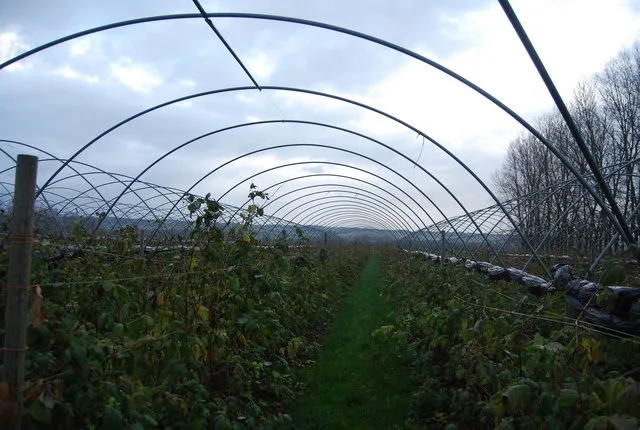
Tunnel film covers produced by the industry, as a rule, consist of a set of metal or plastic parts.
Cover: arch construction is assembled from tubular aluminum semi-arches connected by bolts with a ridge pipe. The assembled frame is moved to the site and secured (7 $ ja OO | a b Simplest frames; a — trestle; b — triangle (dimensions in centimeters)
25% r IR "O 7 a b c
Tunnel covers: a — on a bed; b, c — on a ridge (dimensions in centimeters) and fastened on the bed with metal hooks. Then polyethylene film is stretched over the frame, the edges of which are secured in the soil, and at the ends are gathered into folds, tightened with a cord and tied to hooks previously driven into the soil.
The modular cover is also of arched construction made of polyethylene tubular semi-arches connected with plastic parts to the ridge pipe.
The assembled structure is fixed in the selected place by pressing the lower ends of the arches into the soil to a depth of 15-20 cm. On the sides, the edges of the film are covered with soil.
The small-sized modular cover is made of galvanized steel wire with a diameter of 6 mm. The frame is assembled at the installation site from semi-arches with their subsequent connection along the ridge with a cord, which ensures the strength of the entire frame. The film is put on the frame like a cover and secured along the contour of the cover with a cord. The ends of the film at the ends are tightened and secured on pegs. y
The disadvantage of such a cover is its large width, which complicates the care of plants in the center of the bed. In addition, it is inconvenient to ventilate this cover.
A tunnel is a small-sized arched cover that can be made of wire and film. To do this, galvanized wire with a diameter of 5–6 mm is cut into segments 160–170 cm long, bent into arches, and buried in the soil to a depth of 15–20 cm or attached to wooden bars.
The arches are set at a distance of 80–100 cm from each other. The width of the cover is 75–120 cm, and the height is 40–60 cm. The arches are covered with film from above, the longitudinal edges of which are covered with soil.
Simple film tunnels and collapsible portable frames
Instead of covering the edges of the film with soil, it is more practical to weld pockets to the sheet and use water as a weight. Such a design allows for quick ventilation of the plantings — it is enough to lift the edge of the film to the required height. The method is well suited for tunnels with a base width of 100 to 160 cm.
- Tunnel base width — 100–160 cm
- Water pocket height — 10 cm
- Length of side boards for collapsible portable covers — 600 cm
- Cross-section of rafter bars — 3x5 cm
- "Wigwam" sleeve length — 150 cm
- "Wigwam" frame diameter — 45 cm
For large areas, collapsible portable covers are suitable. The structure consists of a box (base) made of side boards and three rafter frames. Individual sections of these covers are easily joined together, allowing beds of any length to be covered. The joints are protected by overlapping film curtains and clamped with two hinged boards. At the end of the season, the sections are quickly disassembled and sent for storage.
Side boards for these covers are made of planks 600 cm long with a cross-section of 2x15(20) cm. The rafters are assembled from wooden bars with a cross-section of 3x5 cm or metal angles. A ridge beam of a similar cross-section (3x5 cm) is inserted into the slots between the rafters. When securing the film with a wooden bead, it is pre-wrapped into the edge of the sheet for one or two turns.
When assembling the frame, strictly maintain the axial dimensions of the parts. Deviations will disrupt the tension: the bobbin should hang freely and stretch the film solely due to its own weight.
Installation of the cover begins in early April, after clearing the site of snow. When the soil under the film warms up, the sheet is wound onto bobbins, and the ground is dug up and leveled.
- Secure one edge of the film to the bobbin using a slat and 30–35 mm long nails (spaced 15–30 cm apart), leaving free ends of at least 30 cm at the ends.
- Place the bobbin at the base of the hotbed, straighten the sheet, and throw it over the ridge.
- Nail the film to the ridge beam through a cover strip with nails spaced 50 cm apart.
- Similarly, secure the second edge of the film to the opposite bobbin.
Individual "wigwam"-type covers protect single plants. To do this, a film sleeve 150 cm long and 140 cm wide is stretched over a frame 45 cm in diameter made of branches or steel wire 5–6 mm in diameter. The upper part of the sleeve is gathered and tied to a central stake, and the lower part is fixed with external pegs 50 cm high to the height of the added soil mixture.
Another simple option is a folding frame with two sashes. The transparent sash with stretched film is oriented to the south, and the blind one (covered with roofing felt or tar paper) to the north. The structure takes up little space during storage and is quickly installed on the garden bed.
Modular and portable arched structures
Modular portable covers are assembled on the principle of a gable roof and adjusted to any width of the garden bed. The sashes are connected at the ridge with hinges, which allows for adjusting the angle of inclination and the width of the base. The frame is assembled from metal profile with a trough-shaped cross-section, and clamps on the longitudinal rails allow for precise adjustment of the grooves to the thickness of the glass or film.
The height of the modules can be increased up to 80 cm due to sliding two-section side rails. To protect against wind loads, the structure is fixed in the soil with anchor pins. Connecting plates allow the modules to be combined into a continuous line of the required length, and the ends are closed with film, securing it with push pins or upholstery nails to the wooden rails.
To protect tomatoes and cucumbers from spring frosts, portable arched covers are used. The kit for one garden bed consists of the following elements:
- arches made of steel wire 100 cm long and 3–4 mm in diameter;
- two wire retainers 120 cm long and 5 mm in diameter;
- polyethylene film.
- The arches are installed at a distance of 30 cm from one another.
- Their ends are immersed in the soil to a depth of 20 cm.
- Then the arches are covered with polyethylene film, and from above, at a distance of 60 cm, they are clamped with the same arches.
- At the ends, the film is stretched and pressed with retainers, for which the pins are stuck into the soil.
Portable arch cover: 1 — arch; 2 — fastener (dimen-
The cover can be easily opened. To do this, loosen the pressure of the fasteners on the film and slide it along the entire length of the garden bed to one side and downwards.
A collapsible frame for a portable cover can be quickly and easily made from old, worn-out folding beds. Two beds produce a cover frame with the following parameters:
| Length | 216 cm |
| Width | 120 cm |
| Height | 82 cm |
To use the skeleton, it needs some modification:
- First, saw off the arc of the central leg, leaving the crossbar.
- Then, by cutting off the rivets, remove the headboard arc.
- The ends of the outer leg arcs are sawn off so that they can rotate at a large angle and form a 30-degree angle with the bed arcs.
- In each leg, drill two holes for wire pegs 22 cm long, which secure the frame in the soil.
- Connect the arcs of the outer legs to the bed arcs using folding hooks made of wire 4—5 mm thick.
- Connect the bed arcs to each other using the same type of hook fasteners.
The assembled skeletons are installed on the garden bed at a distance of 70-80 cm from each other and secured in the soil with wire pegs. Place a ridge pole or pipe on top of the skeleton. Attach the ridge to the skeleton with screws, which should be screwed into wooden plugs inserted into the tubes. It remains to cover the frame with polyethylene film — and the cover is ready. For convenient access to the garden beds, it is advisable to attach the lower longitudinal edges of the film to laths.
Frames for portable film covers are created all over the world. Here are examples of designs by English vegetable growers and inventors.
—— 24 | АК р < м К З р ъ г 22 ро 7” = Collapsible frame for a cover (dimensions in centimeters) п #7 (2 >. К РР ИОН -, и 777777 77” Г. Bracket and ы. а вх ВАА р к, > я АЕ: —“ 7’. й Ре их — 2 «8 { 7 же 9 | \ 227” р у, 8 Е) О ии \: / РР 2777” ЕР г: ат ы и: б] в
Foreign frames for covers; a — with trapezoidal arcs; 6 — collapsible in assembled form; в — collapsible in disas-
In one of the patents, it is proposed to give the frame arcs a trapezoidal shape widening downwards with a curved upper part forming an angular inward projection inside the arc. The ends of the arcs are bent inwards and have vertical sections for installation into the soil. Intermediate sections are located at an acute angle to the vertical and side sections of the trapezoidal part of the arc. Due to the curved ends, the arcs are pressed into the garden bed at some distance from its edges, which prevents the walls of the bed from crumbling.
The end arcs are made higher; they are pressed into the soil at an angle, which keeps the film in a constantly taut state. The ends of the film are gathered and fastened to the soil with O-shaped clips. A cord is stretched over the film from above and tied to the O-shaped clips. The weight of the cord presses on the film and forms a channel from which condensate drips onto the plants. On the sides of the cover, the film is tucked under the projections of the arcs.
Read next
Greenhouses and covers For gardeners
Types and methods of DIY construction of individual covers for vegetables
Greenhouses and covers For gardeners
Fabrication and installation of collapsible portable film covers for vegetable crops
Greenhouses and covers For gardeners