
Types and methods of DIY construction of individual covers for vegetables
6 min read
Individual covers are covers designed for a single plant.
The simplest individual cover can be made as follows. Take an old flower pot, place it on the bed, cover it with soil on all sides, and pack the soil down. Carefully remove the pot and cover the resulting depression with a piece of glass or film. After planting the seedling, the edges of the film are covered with soil.
Transplants are planted into the ready-made cover. If the cover is made over an already planted plant, use a bottomless pot and place it on the soil so that the plant is inside the pot.
The walls of an individual cover can be made of roofing felt or tar paper (in one or two layers). Roofing felt or tar paper a CHAY YA b OKhA eto V
U 2 1% ChU = #1 4% — ——
Individual covers: a — recessed hole under glass; 6 — roofing felt or tar paper cylinder; в — paper caps; г — glass jar, plastic bottle; д — wire frames; е — plastic bag stretched over cut with scissors into strips 15-35 cm wide and 60— long
The strips are rolled into cylinders, tied with twine or fastened with wire, and installed vertically around the plants. The cylinders are covered with soil at the base from the outside and covered with a piece of glass on top. To ventilate the plants, the glass is removed from the cylinders or slid aside.
Caps made of ordinary thick or paraffin-coated (waxed) paper, cardboard, or tar paper, stitched with thread or fastened with wire, are used as individual covers. The caps can also be fastened with pieces of thick wire, which are stuck into the ground to secure the caps over the plants.
For plant protection, two- or three-liter glass jars placed upside down or 1.5, 2, and 5 liter plastic soda bottles with the bottoms cut off can be used, installed vertically. The most suitable are 2-liter bottles. The convenience of such bottles lies in the fact that, once installed, they can be left in place for a long time without needing to be removed for plant care. In hot weather, the caps are unscrewed to ventilate the covers, and plant irrigation is carried out through a funnel inserted into the bottle neck.
A good individual cover is a wire frame made in the shape of a cylinder, cone, truncated cone, or truncated pyramid and covered with polyethylene film.
The easiest to manufacture, convenient, and reliable design consists of two flexible, identical U-shaped sections (brackets). The brackets are bent at an angle to form semi-arches that are intertwined at their tops.
A polymer film bag of appropriate shape and size is placed over the wire frame of any type, and the finished cover is installed over the plant. When installing a cover made of brackets, their lower ends are stuck into the soil. For better attachment of the bag to the frame, the lower part of the brackets can be made corrugated, in the form of a sine wave or a helical spring. As an individual cover, three or four wooden slats stuck into the soil in a triangle or square pattern and covered from above with a piece of plastic film or a plastic bag are used. The edges of the bag are covered with soil at the bottom to protect it from being blown away by the wind.
Frameless covers
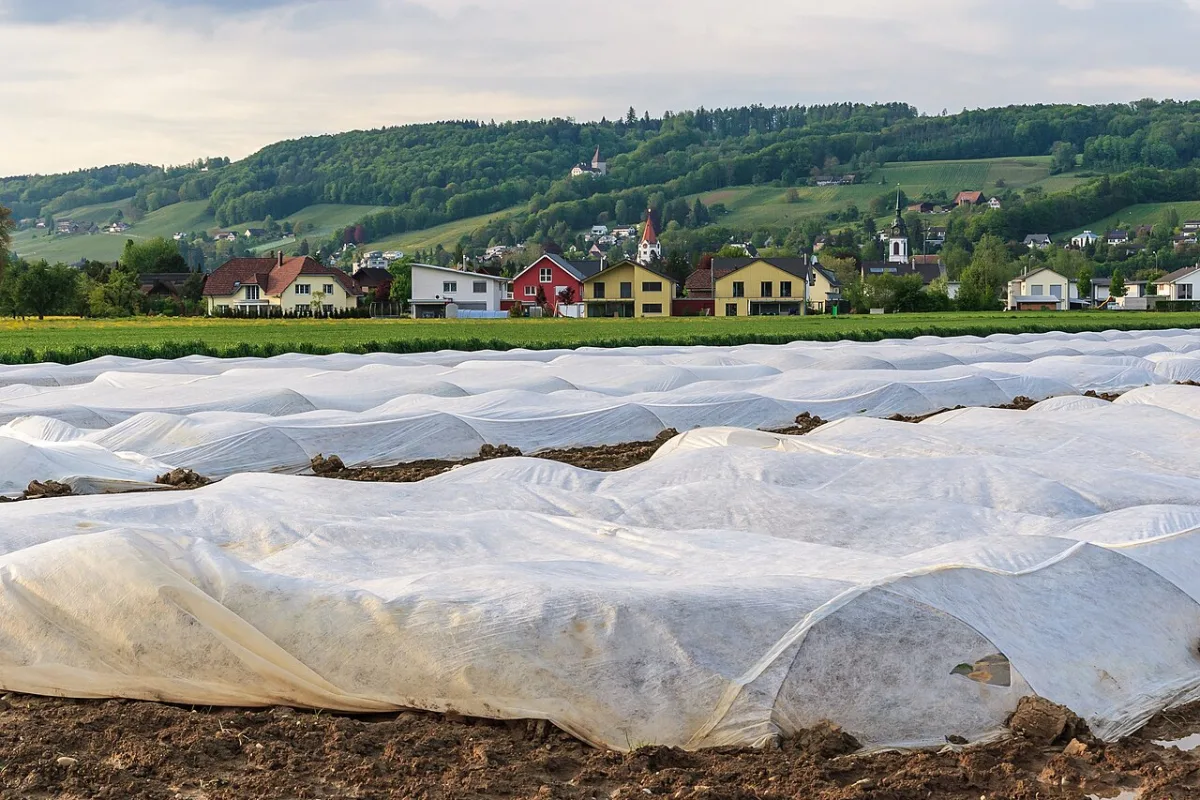
Frameless covers are usually used in early spring for more rapid heating of the soil in the beds and to accelerate the seedling emergence of early vegetable and leafy green crops, as well as to protect young seedlings from frosts. Therefore, frameless covers are called spring or sowing covers. When the seedlings grow a little larger, warm weather settles in, and the threat of frost disappears, these covers are removed.
One type of frameless cover is the ordinary bed covered with light-transmitting polymer film or white non-woven cover material, as well as beds covered at night with various insulating opaque materials: blankets, rugs, straw or reed mats, etc. The film is partially or completely removed during the hottest part of the day to ventilate the plants. Cover material does not necessarily need to be removed. Opaque coverings must be removed during the day.
Ventilation of the covers can be ensured by using pre-perforated film. The holes in the film provide access to the plants for air and moisture. Perforated film can be made by yourself. To make the necessary holes in the film easier and faster, roll it into a roll or fold it in several layers and cut holes with a sharp knife or punch them with a pipe puncher with sharpened edges.
To create a frameless cover, a sheet of film is thrown over the bed, and its edges are covered with soil or weighed down by slats, poles, or stones placed around the perimeter of the bed. Along the longitudinal sides of the bed, ridges 20-30 cm high can be made, onto which the film is placed so that it does not lie on the plants; it is draped over the ridges, and its edges, hanging down on the outer side of the ridges, are secured.
It is more convenient to operate the beds if they are equipped with side walls 20-30 cm high made of wooden planks, poles, or asbestos-cement sheets, i.e., they have a fence (enclosure).
In order for the film not to lie on young plants, beds with a fence can be supplemented with a simple structure consisting of several parts — a ridge element and transverse supports.
3 2 > а 2 д 0425 Ах О а 6
Frameless film covers (warmed beds and ridges): a — warmed bed; 6 — warmed ridges (1 — biofuel; 2 — soil; 3 — light-transmitting film; A4A — stones holding the film)
РР 3 22 57 3 —1 Ре 2 её 87 4 2 6
Sowing covers: a — appearance; 6 — sketch of the transverse support (1, 2 — longitudinal and end boards of the fence; 3 — ridge element; 4 — segment of a slat; 5 — transverse support; 6 — post; 7 — slat of the transverse support; 8 — rubber strip)
The ridge element can be placed on segments of slats nailed to the end boards of the fence or nailed to two low posts driven into the ground in the middle of the end sides of the enclosure. The transverse supports are placed on the ridge element and the longitudinal boards of the fence.
The ridge element and transverse supports are made of slats or thin poles. Each support consists of two short parts fastened together by a rubber strip.
The efficiency of the covers can be increased if, in addition to solar heating, biological heating (heating with biofuel) is used — so-called warmed (hot) beds or ridges.
Manure from cattle, horse manure, and others are used as biofuel. Hot manure is placed under the layer of soil in the form of beds, ridges, or piles.
Read next
Greenhouses and covers For agronomists
Vegetable growing technology in small-sized plastic tunnels and covers
Greenhouses and covers For gardeners
Frame covers and modern agrotextile materials for plant protection
Greenhouses and covers For gardeners