
Fabrication and installation of collapsible portable film covers for vegetable crops
7 min read
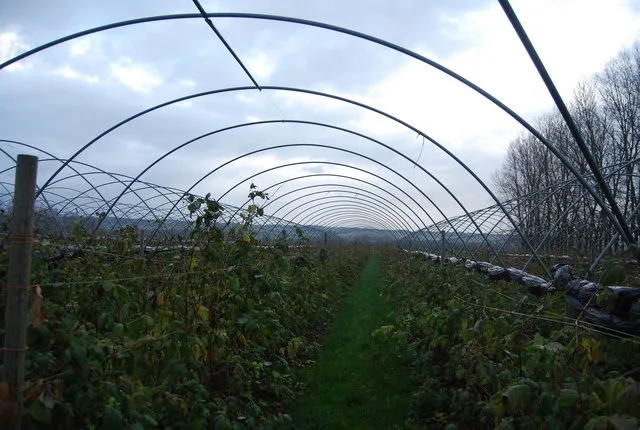
The film is attached to the reel using a lath and 30-35 mm nails, which are driven in every 15-30 cm. It is essential to leave approximately 30 cm of free film ends at both sides of the reel.
Once one edge of the film sheet is attached to the reel, it is laid at the base of the hotbed. Then, the entire sheet is straightened, thrown over the ridge, and nailed to the ridge beam. A lath is placed over the film onto the ridge beam, with nails driven in every 50 cm. This ensures the film cover is securely fixed.
4 2 7 р И Г < 2х О ИИ о В очи 131 Е —\
Collapsible portable cover: 1 — reel; 2 — lath for fastening the strip; 3 — ridge beam; 4 — film; 5 — cover made of two frames; 6 — overlay for joining frames; 7 — rafters with spring-loaded uprights; 8 — grooves for inserting the side board; 9 — side board; 10 — opening between rafters for inserting the ridge beam (dimensions in all figures are in centimeters)
The other edge of the sheet is attached to the reel in a similar way. The reels should keep the film taut so that it does not touch the soil.
The cover is installed on a site cleared of snow. When the soil underneath warms up, the film is wound onto the reels, and the soil is dug over and leveled.
To prevent plants in film covers from suffering from a lack of moisture, strips of slate 30-40 cm wide are placed under the edges of the film at an angle to the horizontal, with the apex pointing toward the center of the bed. Rainwater flows down the slope to the plants. In addition, the slate suppresses weeds between the beds.
To protect plant seedlings and transplants from possible cold snaps, portable frames are successfully used in southern regions. They can be made of metal, wood, or a combination of both. To make the latter, it is sufficient to build a wooden frame from two longitudinal bars with a cross-section of 4x5 cm and a length of 4.5-5 m, and three transverse laths 1.5-1.6 m long (two of which are attached at the edges, and one in the middle). Holes are drilled in the longitudinal laths according to the diameter of the wire (6, 8, or 18 mm) to a depth of 2.5-3 cm. The ends of the wire arches are inserted into these holes.
\ 22 жа —- Г а ый 222 2 <8* И 2 ы 22 7 й РА 724 = И 27 140—160 РАЯ 27 #77 272 а 79 720 2 Е 27 27 = 2 2
—— 7 ЕЯ b Portable frames for film covers: a — wooden; b — combined (dimensions in centimeters)
To add strength to the structure, the frame is tied in 2-3 places with twine or aluminum wire, and secured from below with metal pins or wooden pegs.
"Two ends, a nail in the middle" — this is a brief way to describe the design of folding trestles. They are made of one-meter-long wooden laths, fastened with a screw or even a nail, and the lower ends are sharpened.
When folded, the trestles require very little space for storage. When installing, it is enough to stick the spread ends into the soil to a depth of up to 30 cm, connect two pairs of trestles at the top with a lath, and drape the film over them.
Greenhouses, hotbeds... WINTER GARDEN AND CONSERVATORY AN OASIS AT HOME
A winter garden is an architectural element with a glass roof, artistically decorated with ornamental plants planted in the soil or displayed in pots. The transparent and seemingly weightless structure can serve as an extension of a room, expanding its boundaries, or as a standalone building.
Recently, winter gardens have been increasingly used in country houses as a space for a swimming pool, a gym, or a recreation room. Therefore, first and foremost, a winter garden can be called a part of the living environment where climatic conditions are most comfortable for a person; it is a place where one strives to rest, relax, have a pleasant time, and simply enjoy life. Thanks to new technologies, the most diverse design options for a winter garden are possible, which, undoubtedly, helps its owner to fully realize their fantasies.
Winter gardens began to appear as early as the XVI century in Europe. So-called "orangeries" became the prototype of the modern winter garden. These were greenhouses in which exotic plants from the New World were grown.
The very name "orangeries," apparently, originated from the perennial evergreen fruit plant of the genus Citrus of the rue family, known as the bitter orange. Its other name is bigarade, or bitter orange (Citrus aurantium). In the XVII century, buildings with glass walls began to transform into conservatories, without which no [building] could be built
Also, winter gardens began to be used to expand the living spaces of a house. In the XX century, the industrial production of metal and glass created the technological conditions for the emergence of the "classic" winter garden as decorative secular architecture. English architects set the tone. However, the technology of that time did not allow winter gardens to be used during the off-season. Heating was not provided for in them. The peak of popularity of winter gardens came at the end of the XIX — beginning of the XX century. They were favorite places for leisure. The beginning of the First and Second World Wars put an end to the popularity of winter gardens. In the 80s of the XX century, the traditions of winter gardens began to revive. This was facilitated by the development of technical progress, which allowed the use of the latest materials, heating, ventilation, and thermal insulation in the construction of winter gardens. Today, a winter garden is a joint effort of designers and household members. It can be assumed that
Winter gardens will soon cease to be an exotic feature and will become an integral part of any home. Just as they once were, winter gardens will become a sign of prosperity, luxury, and comfort. GARDEN AND HOME ARE ONE
Architectural features and winter garden layout
Ideally, a winter garden should form a single whole with the rest of the house, even if it is a standalone structure. This means that the dimensions and shapes must maintain the rhythmic line of the facade. In addition, one should be very attentive to the layout of the winter garden space, highlighting the main functional zones:
- relaxation area;
- garden;
- social area;
- passageway.
The area of a winter garden should be, on average, at least 15-20 sq. m. The most successful designs are those where the winter garden transitions into the residential house. In this case, a relaxation area can be equipped in the room adjacent to the garden, which will absorb its bright mood. A glazed facade will create additional volume for the room without diminishing its coziness. If you focus your attention on light and sunlight, the roof can be made entirely transparent. Only after fully visualizing the appearance and structure of the winter garden can you proceed to its layout.
Options for functional use of space
Provided that the winter garden is planned to be used as a living room or a relaxation corner, it is necessary to provide space in the relaxation area for a small table and a few chairs or armchairs. If the whole family will relax here or guests will be entertained, this area in the plan should be increased by reducing the number of plants and flowers. If, conversely, the garden will be used primarily for growing plants, the relaxation area should be significantly reduced. It is advisable to leave the passageway sufficient so that there is no feeling of crowding.
A slightly different division will take place if your winter garden will house a swimming pool or a gym. In that case, one cannot seriously consider growing exotic plants. However, you will get the opportunity to swim or exercise surrounded by light and greenery. For people who like to wake up with the first rays of the sun and observe the sunrise instead of the twilight of a regular room, the option of setting up a living room in their winter garden is perfect. This space will be equally suitable for children's games and, for example, for reading. In general, everything depends on the great variety of ideas and the desire to make your life brighter.
Read next
Greenhouses and covers For gardeners
Construction and operation of plastic-film hotbeds for protecting transplants
Greenhouses and covers For gardeners
Features of glass structures and aluminum profiles for winter gardens
Greenhouses and covers For gardeners