
Technology for growing tomato transplants and the fluid sowing method
14 min read
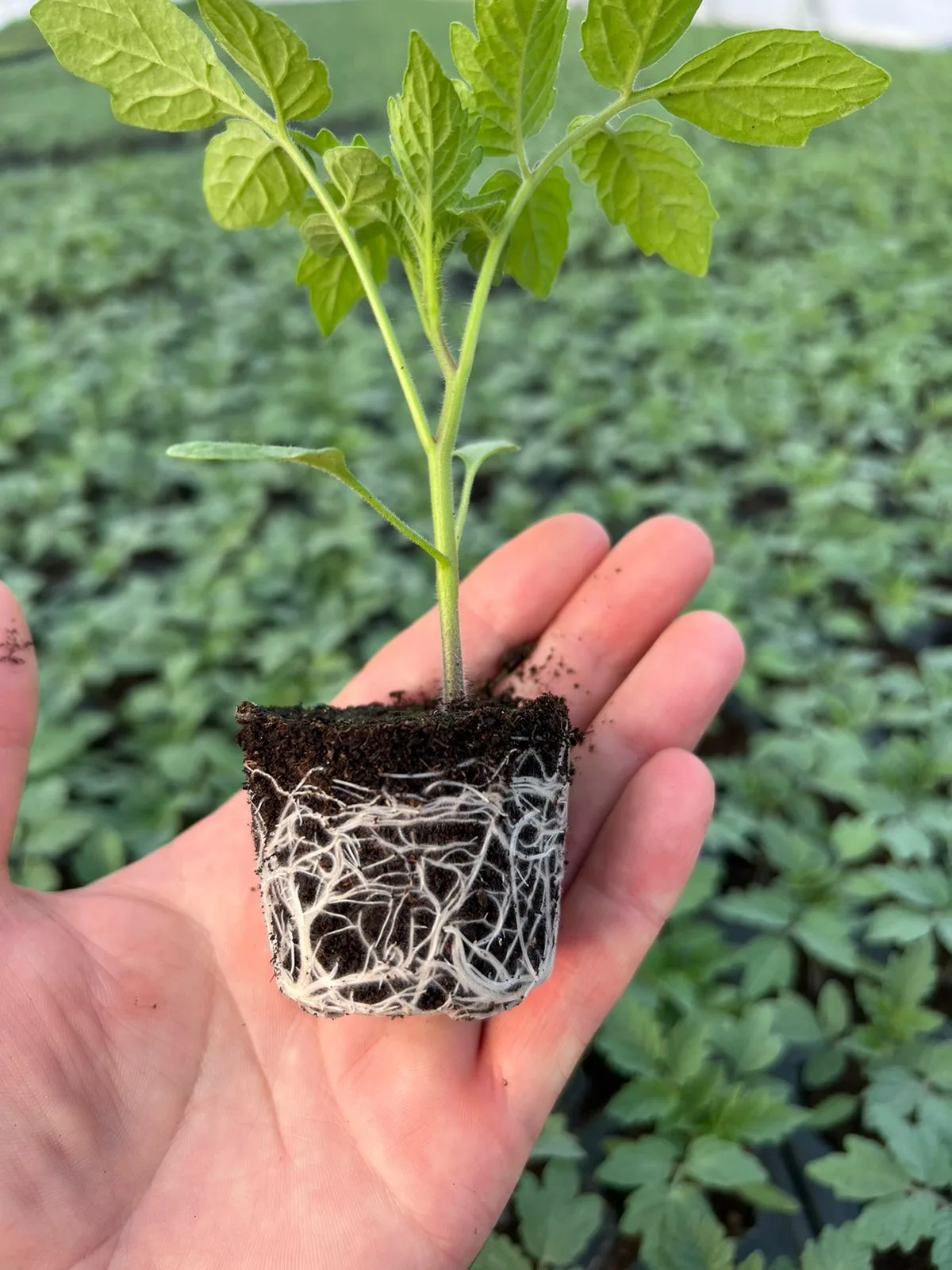
When growing tomato transplants without pricking, it is important to obtain strong, ready-to-plant specimens. By the time they are transferred to open ground, high-quality planting material must meet standard development parameters. Such plants take root faster and enter the fruiting stage sooner.
- Age of non-pricked transplants — 35–40 days
- Stem height — 16–18 cm
- Above-ground mass — 13–16 g
- Number of leaves — 7 units
To prevent the roots of non-pricked transplants from drying out and to improve their survival rate, dip the root system in a clay slurry solution immediately after pulling. For increased effectiveness, a small amount of manure can be added to it.
Energy-saving technology and fluid sowing of tomatoes
In conditions of heat deficit in unheated greenhouses, energy-saving technology with fluid sowing is effective. This method allows for uniform tomato emergence as early as the 2nd–3rd day, instead of the usual 10–15 days. This requires careful soil preparation and the application of optimal fertilizer doses.
| Component or fertilizer | Application rate per 1 m² (in a 10 cm soil layer) |
|---|---|
| Organic fertilizers | up to 50% by volume |
| Ammonium nitrate | 15–20 g |
| Superphosphate | 80–100 g |
| Potassium sulfate | 30–35 g |
- Site preparation and furrow formation. Thoroughly level the soil surface with a slight slope for water drainage to avoid waterlogging. Form beds across the greenhouse every 1.6–1.8 m along its entire width, leaving only the central path free.
- Loosening and warming. Loosen the soil several times when it reaches physical maturity to improve warming. Begin sowing in early April, when the morning soil temperature at a depth of 10–15 cm reaches 12 °C (during the day under the film, it will rise to 20–25 °C).
- Preparation of furrows. Cut furrows 6–10 cm deep along the beds at 24 cm intervals. Create a slight slope from the center to the sides of the furrows so that water does not stagnate in them.
- Preparation of seed. Treat the seed in a 1% potassium permanganate solution and soak in a macro- and micronutrient solution. Germinate them in a warm room between layers of film with a layer thickness of no more than 1 cm (or perform bubbling) until sprouts 1–2 mm long appear, then harden in a refrigerator for 1–2 days at a temperature of 0–1 °C.
- Fluid sowing. Sow the seed with water from a teapot, stirring the mixture constantly. Distribute 80 seeds per 1 linear meter of the furrow (water consumption — 0.75 L), which corresponds to 320 seeds and 3 L of water per 1 m² for 4 rows. Perform sowing in two passes from different sides of the path, then cover the seed with a 0.5–1 cm layer of soil.
- Covering the sown area. Immediately after finishing sowing, cover each bed with film, creating localized hotbed conditions. This will ensure uniform emergence on the 2nd–3rd day.
Keep the film over the seedlings for no more than two weeks. To avoid overheating the plants and to prevent temperatures from exceeding 20–25 °C, the cover should be removed during the day.
Seedling care and growing peppers and eggplants
When 3–4 true leaves appear, the furrows are filled with the previously removed soil during loosening, which stimulates the formation of additional roots. Frequent loosening with cultivators destroys weeds, improves air access, and prunes the roots, restricting stem stretching. A 24 cm row spacing makes maintenance convenient and effective. Unlike 6×6 or 7×7 cm square planting patterns, with wide-row sowing, the plant leaves do not close as quickly, ensuring maximum illumination in later stages.
Irrigation of tomato transplants should be infrequent, avoiding water contact with the above-ground part of the plants, especially at low temperatures. To combat spring frosts in the greenhouse, a complex of protective measures is used. Hardening of the grown transplants is carried out according to the standard scheme.
- using a second layer of film;
- irrigating the soil between rows, preferably through pre-cut furrows;
- sprinkling the surface of the greenhouse using nozzles to spray water onto the film.
Pepper transplants and eggplants are grown without pricking in greenhouses equipped with air heating and soil heating systems. To obtain 45–50-day-old plants ready for planting, it is important to observe the sowing dates and planting density standards. When calculating the growing space, consider that peppers require less space than eggplants.
| Crop | Sowing dates (Forest-Steppe and Polissya) | Sowing dates (Steppe zone) | Transplant yield per 1 m² | Sowing depth | Row spacing |
|---|---|---|---|---|---|
| Eggplant | March 25–30 | March 15–25 | 330 units | 1.5–2 cm | 12 cm |
| Pepper | March 25–30 | March 15–25 | 500 units | 1.5–2 cm | 12 cm |
Transplants of heat-loving crops: solanaceous and cucurbits
For rapid emergence, maintain soil temperature within 20–25 °С — then the first sprouts will appear on the 7–10th day. If the temperature drops to 13–15 °С, germination will be delayed by 20–25 days. During the period from emergence to the start of hardening, the optimum temperature of the soil should be 20–22 °С during the day and 15–17 °С at night and in the early morning hours.
When growing pepper transplants and eggplant, maintain air and soil temperatures 2–3 °С higher than for tomatoes, and strictly control substrate humidity. If the soil is too dry, transplant growth is stunted, which reduces future yield in the field. Waterlogging is dangerous due to the development of damping-off, especially in the early stages, while the leaves have not yet closed and the top layer of soil with fragile roots dries out quickly.
Eggplant is more sensitive than other crops to a reduction in productivity in the field due to drying out of the substrate during the transplant period. Do not allow the soil to dry out!
To obtain viable pepper and eggplant transplants, follow the irrigation schedule:
- Before emergence, perform 5–6 irrigations at a rate of 3 l of water per 1 m².
- In the period before the appearance of the first true leaf, water the transplants 1–2 times, using 7 l of water per 1 m².
- Before the start of hardening, perform 2–3 irrigations with an application rate of 15 l per 1 m².
- Be sure to water the transplants immediately before hardening.
For pepper and eggplant, regular loosening of inter-row spaces is critical. The period of transplant hardening should last no more than 10 days; do not allow prolonged drops in air temperature below 15 °С.
Parameters of solanaceous transplants ready for planting:
| Crop | Transplant age, days | Height, cm | Number of leaves, pcs. | Above-ground mass, g | Root mass, g | Yield per 1 m², pcs. |
|---|---|---|---|---|---|---|
| Pepper | 45–50 | 20–25 | 8–9 | 7–8 | 0.8–1 | 485 |
| Eggplant | 45–50 | 20–25 | 6–7 | 12–16 | 0.8–1 | 320 |
Growing cucumber, watermelon, melon, and squash using the transplant method is economically justified only for planting under film covers — an early harvest compensates for the costs. For open ground, these crops are sown with seed directly in the field.
- Cucurbit transplant growing period — 20–25 days
- Pot size for cucumber — 8х8 cm and 10х10 cm
- Pot size for watermelon and melon — 10х10 cm
- Optimum soil temperature for cucumber emergence — 26–28 °С
- Relative humidity for cucumber — 70–80 %
Cucumber seed are sown in pots, 1–2 pieces each, and watered with warm water. After emergence, maintain air temperature at 15–17 °С during the day and 12–14 °С at night for 4 days to harden them. Subsequently, set the following temperature regime: on sunny days — 19–20 °С, on cloudy days — 17–19 °С, at night — 14 °С. Soil moisture must be moderate. Cucumber transplants ready for planting have 3 well-developed leaves.
Watermelon and melon transplants are grown in 10х10 cm pots to avoid overgrowth. Maintain air temperature for them 2–3 °С higher than for cucumber. For squash, the temperature regime is similar to that of cucumber. Planting is carried out in the phase of 2–3 true leaves.
Growing late cabbage transplants and quality control
Late cabbage transplants are grown in open ground on 1 m wide beds. Soil preparation is carried out from autumn, just as for mid-season cabbage in greenhouses. In spring, after the soil matures, seed are sown in rows with row spacing of 12–15 cm, distance within the row of 5–8 cm, and at a depth of 2–3 cm. The cultivation rate is 150–200 plants per 1 m².
Cruciferous flea beetles are the most dangerous pests of cabbage transplants, capable of completely destroying seedlings. If they appear, perform 2–3 dustings every 4–5 days with a mixture of pyrethrum powder and road dust or ash in a 1:2 ratio.
To form stocky transplants with a powerful fibrous root system, use the pruning method:
- 10–12 days before planting, cut the soil with a knife along and across the inter-row spaces, forming cubes.
- Prune the roots at a depth of 5 cm.
- Immediately after pruning, water the bed abundantly.
One day before lifting, perform a hardening top dressing with phosphorus-potassium fertilizer. Irrigation is mandatory a day before lifting or 2–3 hours before planting — this will preserve the clod of earth on the roots. If the earth has crumbled anyway, dip the roots into a slurry made of clay or soil with the addition of 10 % manure. Cabbage transplants ready for planting should have 5–6 leaves.
The biological quality of finished transplants is assessed according to two groups of indicators: biometric parameters (ratio of root mass to above-ground mass, mass of leaves and stem, taking into account requirements for mechanized planting) and the state of physiological and biochemical processes.
To assess the quality of tomato transplants, a complex of biometric indicators is used. Key standardization criteria include transplant age, plant height, number of leaves, root and shoot mass, and the state of reproductive organs. High-quality transplants for early planting should have opening buds on the first inflorescence, and for mass planting periods — well-formed buds. Healthy transplants are always characterized by a dark green color.
Consider the specifics of plant development at different stages. Up to the age of 20 days, seedlings grow slowly as plastic substances are consumed for the formation of the inflorescence. Intensive growth of the shoot part begins later, and after the 30th day, high ambient temperatures sharply accelerate the process.
At temperatures of 16 °C at night and 30 °C during the day in May, the daily stem growth can reach 3–6 cm, and the mass of the shoot part can increase by 3–5 grams per day. In such conditions, transplants quickly become overgrown.
Methods for Regulating Transplant Growth
To curb plant stretching, retardants or mechanical methods are used. The preparation chlormequat chloride shows high retardant capacity if used to treat transplants at least 15 days before planting. If only 8–10 days remain before planting, plant height can be controlled using agrotechnical methods.
These techniques include root pruning at a depth of 5 cm, double leaf brushing, and maintaining air movement speed in the greenhouse at 1.5 m/s. These measures delay growth, reduce stem height by 30–40 %, and improve plant survival in a permanent location. Root pruning stimulates the proliferation of the main root mass in the top layer of soil, which simplifies the selection of transplants and eliminates root breakage.
Leaf brushing while preserving the growing point is optimal when cultivating early-maturing cultivars, where it is necessary to increase yield from the first harvests. The combination of root pruning and air blowing at a speed of 1.5 m/s directly affects the productivity of tomatoes.
| Harvest type | Yield increase, % |
|---|---|
| Early | 8–9 |
| Total | 11 |
- Root pruning depth — 5 cm
- Air movement speed — 1.5 m/s
- Stem height reduction — 30–40 %
- Stem pruning height — 18–20 cm
- Reduction of harvest period — 11 days
For tomato cultivars suitable for mechanical harvesting, stem pruning of transplants is used. This technique allows for the synchronization of fruit ripening and the optimization of machinery passes.
Pruning the stem of transplants at a height of 18–20 cm allows half of the harvest to be collected in a single pass. The fruiting period shifts to the window between August 10 and August 30, which reduces the total harvesting time by 11 days compared to unpruned plants.
Read next
Greenhouses and covers For agronomists
Specifics of growing transplants in hotbeds and film greenhouses
Greenhouses and covers For agronomists
Technology for growing and preparing tomato transplants for planting in a greenhouse
Greenhouses and covers For gardeners