
Growing eggplant seedlings from sowing seed to planting
11 min read
Sowing dates and preparation of seeds and soil
When growing eggplants, it is crucial to calculate the sowing dates accurately. Overgrown transplants do not establish well in their permanent location, while those that are too young will not have time to produce an early harvest. If you plant the plants in pots without disturbing the soil ball, even transplants with flowers and fruit set will adapt quickly in the soil. This allows for extending the growing season and significantly accelerating fruiting.
- Optimal age of transplants — 60–70 days
- Time for planting in soil — around June 10
- Sowing time for early-maturing cultivars — March 1–15
- Sowing time for late-maturing cultivars — end of February
Unlike tomatoes, eggplant seed does not need to be artificially "aged". For sowing, it is best to use high-quality seed from the previous year's harvest.
To accelerate emergence and prevent disease, seed material requires mandatory preparation. Carry out the treatment according to the following scheme:
- Warm up the seeds for 4 hours at a temperature of 25–30 °C, and then for another 40 minutes at 50 °C.
- Disinfect the seeds in a 1% potassium permanganate solution for 20 minutes and rinse them thoroughly with clean water.
- Soak the seeds in a biostimulant solution (aloe or mumijo) or perform bubbling for 24 hours. For the solutions, use snow water, rainwater, or magnetized water.
If you do not plan to perform complex treatment, simply wrap the seeds in gauze moistened with rainwater or snow water 2–3 days before sowing. Ash infusion is also suitable for soaking: infuse one matchbox of ash in 1 liter of water for 24 hours, then strain.
The soil for eggplants must be more fertile, loose, and permeable to moisture than for tomatoes or peppers. Add decomposed manure or humus to the base (up to 1/3 of the total volume). For every bucket of the prepared soil mixture, be sure to apply mineral fertilizers:
- 40 g of superphosphate;
- 20–30 g of potassium salt (or 40–60 g of wood ash);
- 10 g of ammonium nitrate or another nitrogen fertilizer.
Eggplants are extremely sensitive to damping-off. Before sowing, be sure to disinfect the soil by drenching it with a dark purple potassium permanganate solution. Without this treatment, there is a high risk of losing a large portion of the seedlings.
Sowing, temperature regime, and care for seedlings
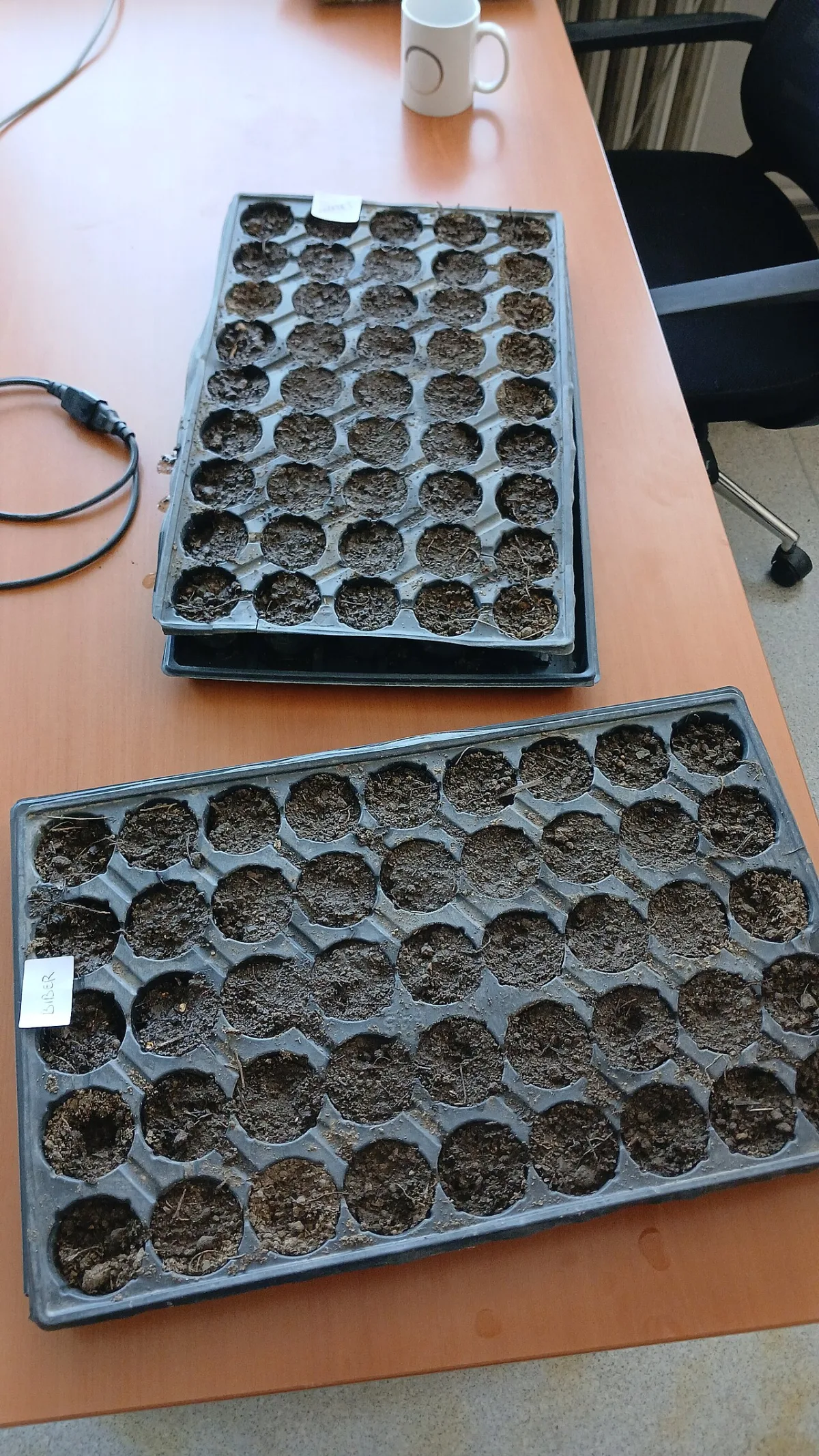
Eggplants are sensitive to any damage to the root system. To avoid traumatic transplanting, seeds can be sown directly into individual 10x10 cm pots, 3 seeds in each. After emergence, keep the single strongest seedling and carefully pinch out the others. If transplanting is planned, sow in boxes up to 10 cm high at a depth of 1.5 cm with 3 cm spacing.
Seedlings appear 7–12 days after seed soaking. Remember that at temperatures below 20 °C, eggplant seeds may not germinate at all. As soon as the first sprouts appear, move the containers to the brightest place and strictly control the temperature.
You can regulate air temperature in household conditions by simply moving the boxes closer to or further from the window frame. It is recommended to follow this temperature schedule:
| Growth period | Daytime temperature, °C | Nighttime temperature, °C |
|---|---|---|
| First 3–4 days after emergence | 17–20 | up to 10 |
| Subsequent growth of seedlings | 25–27 | 15–18 |
In the phase of the first true leaf, carry out culling: remove all small and deformed seedlings, as they will not provide a full harvest. Transplanting is performed in this same phase. Transplant the plants carefully, burying them up to the cotyledons and ensuring the root does not bend.
When growing without transplanting, do not fill the pots to the brim with soil. Leave space and gradually add soil up to the cotyledonary leaves over 2–3 weeks. Shade the transplanted seedlings for a few days, then gradually acclimate them to the sun by covering the glass with paper. Keep in mind that transplanting delays plant development, so such eggplants should be sown 10 days earlier.
Water the seedlings only with warm water, preventing the soil ball from drying out and avoiding water stagnation. Water should not get on the leaves to avoid provoking fungal diseases.
At the end of April or in May, the stems near the soil surface may crack, which causes the seedlings to wilt. At the first signs of lodging, cover the lower part of the stem with disinfected soil by 3–4 cm, water with warm water, and stake the plant.
Protection, top dressing, and shaping of seedlings
Eggplants at the seedling stage are often attacked by pests. The sowings can be affected by aphids, whiteflies, or mites — microscopic yellow or orange insects that suck sap from the leaves, causing them to acquire an ash color. To detect a threat in time, regularly inspect the leaf blades against the light: the pest leaves behind thin, spiderweb-like transparent lines.
Eggplant leaves are very delicate, so chemical agents can easily cause burns. When pests appear, do not rush to use toxic chemicals — wash the seedlings with an infusion of celandine or garlic, and in the future, strictly observe preventive measures (soil disinfection and the use of healthy seed).
- Night temperature for hardening — no lower than 7–8 °С
- Timing for pinching transplants — after the 5th true leaf
- Water temperature for irrigation during planting — no less than 20 °С
- Irrigation rate in soil — 1 bucket per 3 plants
- Loosening depth of soil after irrigation — no more than 5 cm
- Harvesting time after flowering — 26–40 days
During the growing season of transplants, two root top dressings are carried out, combining them with irrigation using warm water at a temperature of 25 °С. The first time fertilizer application is performed 15 days after pricking out: for 10 l of water, take 500–700 mg of ammonium nitrate, 1.5–2 g of superphosphate, and 1–1.5 g of potassium salt (this volume is enough for 10 plants). The second top dressing is carried out 10 days later with a solution of poultry manure (50 g per 1 l of water, infused for 5 days, then diluted in a 1:10 ratio). 7 days before planting, it is useful to carry out foliar top dressing with microelements: dissolve 0.5 g of potassium permanganate, 0.3 g of copper sulfate, and 0.3 g of boric acid in 1 l of water and spray this volume over 100 plants.
Eggplant seedlings are significantly more delicate than tomato or pepper seedlings, so they require constant monitoring. To prevent fragile stems from breaking, it is recommended to carefully tie each seedling to an individual stake. You can harden plants outdoors at night only if the temperature is guaranteed not to drop below 7–8 °С.
The results of hardening will become noticeable as early as the third or fourth day. The seedlings will grow larger, and the stems and leaves will acquire a characteristic bluish or purple tint, typical of healthy plants.
To improve the bush structure, the growing point of some plants is pinched after the fifth true leaf. After this, the transplants will stop growing for about three weeks, but active development of side buds will begin. As a result, the plants will form more compact and sturdy, they will withstand transport more easily and take root faster. Since the main harvest of eggplants is set specifically on side shoots, such pinching for many cultivars doubles the yields (it is not recommended to perform the procedure after planting in a greenhouse, as the side shoots may not have enough time to develop).
Planting transplants into the soil and subsequent care
The planting dates for eggplants coincide with those for tomatoes and peppers. For planting, choose the sunniest spot with loose soil, where solanaceous crops have not been grown for at least two years. Even with good soil quality, it is necessary to apply up to two buckets of humus or compost, as well as 1 l of wood ash, per each square meter of area.
| Fertilizer | Application rate per 1 m² |
|---|---|
| Phosphate | 40–50 g |
| Nitrogen (nitrate) | 20–30 g |
| Nitrophoska | 60–70 g |
For single-row planting, the bed is made 15–20 cm above the soil level, keeping a distance of 30–40 cm between bushes, and an irrigation furrow 10–12 cm deep is laid along the center of the bed. If a multi-row scheme is used, the inter-row spacing is made 50–60 cm wide, while the planting interval in the row is kept within 30–40 cm. The planting procedure itself requires care so as not to injure the root system of the plants.
- Two hours before planting, water the seedlings in the pots abundantly.
- Carefully extract the nursery plants, trying to preserve the soil ball completely.
- Place the plants vertically into the soil, deepening them slightly compared to their growth level in the pot.
- Water the bushes with water warmed to a temperature of no less than 20 °С. It is better to carry out planting in the evening, shading the plants with plastic cover for several days for faster establishment.
Planted eggplants do not need pruning or hilling. It is important to prevent the soil from drying out and to irrigate the plants abundantly with sun-warmed water at the root at least twice a week (a bucket of water for every three bushes). The day after irrigation or rain, the soil must be loosened to a depth of no more than 5 cm to reduce evaporation. During irrigation, water should not get on the leaf apparatus and flowers.
After planting in the soil, the plants are top-dressed according to the following scheme:
- First top dressing: in 10 l of water, dissolve 15 g of ammonium nitrate, 20 g of superphosphate, and 10 g of potassium sulfate (or a double dose of ash) calculated for 10 bushes.
- Top dressing during flowering: carry out two foliar applications with microelements (2 tablets per 10 l of water) or a daily ash infusion (2 cups per bucket of water).
- Top dressing during fruiting: use organic matter — cow manure infusion (3–4 kg per 10 l) or poultry manure (0.5 kg per 10 l), aged for several days and diluted 1:10, or ash infusion (200 g per bucket of water).
The fruits are harvested exclusively at the stage of technical maturity, 26–40 days after the end of flowering. Timely harvesting is mandatory, as over-ripening eggplants delay the formation of subsequent fruit sets on the bush. Unlike tomatoes or peppers, eggplants are not capable of post-harvest ripening and wilt quickly. To slow down moisture loss, fruits are cut along with the stalks, after which they can be stored in the refrigerator for up to two weeks.
To obtain high-quality eggplant seed, select parent bushes immediately after planting transplants into the soil. Choose the healthiest and most productive plants. For seed-bearing fruit maturation, leave only 1–2 of the best fruit sets on the second tier from the bottom, and mercilessly remove all other flowers and buds.
Carry out harvesting and seed preparation according to the following scheme:
- Every 7–10 days until the end of summer, regularly pinch off all newly appearing buds.
- At the end of the growing season, remove the seed-bearing fruits and place them in a warm place, protected from direct sunlight.
- After 2–3 weeks, when the fruits become soft, cut them open and extract the seed.
- Dry the seed in the shade, put them into paper bags, and label them with the cultivar, year of harvest, and ripening period.
Although eggplant seed retains germination capacity for several years, in practice, fresh seed from the previous year shows the best results.
Specifics of cultivation and pest protection
Eggplants grow perfectly in open soil but require attention to temperature regimes and proximity to other crops. In June, if there is a threat of cold nights, be sure to cover the plantings with film — this will protect the plants from stress and accelerate their growth.
Do not grow eggplants in the same greenhouse as tomatoes or peppers. Proximity to these solanaceous crops sharply increases the risk of mass aphid reproduction.
Disease prevention begins 10–15 days after planting transplants into the soil. During this period, carry out the first preventive treatment of plants with a Bordeaux mixture.
The main threat to young eggplants is aphids and spider mites. Start daily inspection of the underside of the leaves from an early seedling age. If a pest has just appeared, it can be removed manually with tweezers, preventing its spread throughout the greenhouse. In case of mass infestation, use working solutions of insecticides and folk remedies.
| Preparation or remedy | Application rate and preparation method | Application features |
|---|---|---|
| Karbofos | 0.3% solution | Used only as a last resort when biological methods are ineffective. |
| Celandine infusion | Pour water over 1 bucket of fresh herb, steep for 1 week. Before use, dilute with water in a 1:3 ratio. | Foliar spraying. |
| Garlic infusion | Steep 200 g of garlic scapes in 3 l of water. Dilute the resulting concentrate with water to a volume of 3 buckets. | Spraying plants in a closed greenhouse. |
| Soap solution | Soap suds | Abundant wetting of leaf blades in case of isolated pest foci. |
Read next
Greenhouses and covers For gardeners
Seed preparation and sowing rules for pepper transplants
Greenhouses and covers For gardeners
Sowing and growing technology of tomato transplants for greenhouses
Greenhouses and covers For agronomists