
Effective heating systems and thermal insulation methods for greenhouses
14 min read
Greenhouse heating organization and temperature control
To obtain high-quality seedlings in the spring period, it is important to use energy resources correctly. An effective solution is to operate electric heating during nighttime hours at a preferential unlimited tariff. The heat accumulated overnight is stored in the soil and gradually released throughout the rest of the day, which allows for a significant reduction in overall electricity costs.
In spring greenhouses, the primary heating method is air heating, while in winter ones, it is used as a supplement to water heating. Air is heated using air heaters or heat generators operating on electricity, gas, hot water, steam, or hot gases. The warmed air is supplied to the space directly or distributed through perforated film sleeves.
The operation of air heaters requires an uninterrupted power supply. If power is cut off, the fans will stop, and the air heating system will cease to function.
The temperature in the greenhouse must be regulated taking into account the time of day and cloud cover so that physiological processes in plants proceed normally. For monitoring indicators, be sure to use alcohol-based soil and air thermometers — mercury-based instruments are prohibited for use in greenhouses.
- Reduction of air temperature at night — by 3–8 °C
- Reduction of temperature in cloudy weather — by 3–5 °C
- Installation of film before transplanting seedlings — 10 days in advance
Heat conservation methods and frost protection
To reduce heat loss in winter greenhouses, sealing of enclosures with polystyrene foam and other synthetic materials is used. In block-type glazed structures, side walls are reinforced from the inside with a second layer of film. In film greenhouses, a double cover with an air gap between layers is installed, which provides a good thermal insulation effect.
| Thermal insulation method | Heat retention effect | Impact on plants and growing season conditions |
|---|---|---|
| Double layer of film with an air gap | Reduces facility heat loss by 25–30% | Reduces light levels by 10–20%, lengthens crop maturation periods |
| Transformable mechanized shading systems (closed at night) | Reduce nighttime heat losses by 30–50% | Protect plants from overheating in hot sunny weather |
| Soil mulching with light-transmitting film | Increases soil temperature during the day by 4–8 °C, at night by 2–4 °C | Promotes uniform emergence 2–4 days earlier |
| Heat-retaining polymer films (compared to standard polyethylene) | Increase temperature in the structure by 1–3 °C | Improve overall temperature regime in the greenhouse |
In the seedling cultivation zone, it is recommended to install removable heat-insulating screens on frames or frameless covers. It is important to correctly calculate the volume of the air chamber above the plants. During experiments at an extreme outdoor temperature of -27 °C in a greenhouse with soil heating at 80 W/m², raising the film screen from a height of 30 cm to 150 cm led to a drop in air temperature above the leafy crops from -1 to -5 °C (by 4 °C).
For hotbeds, straw mats remain a reliable means of protection. They can be made manually by placing a layer of straw between two sheets of old polyethylene film and sewing it with oiled twine. Also, remember that the temperature regime under the film is unstable: in sunny hours, the temperature there can exceed the outdoor temperature by 10–30 °C, while at night the difference is only 2–5 °C.
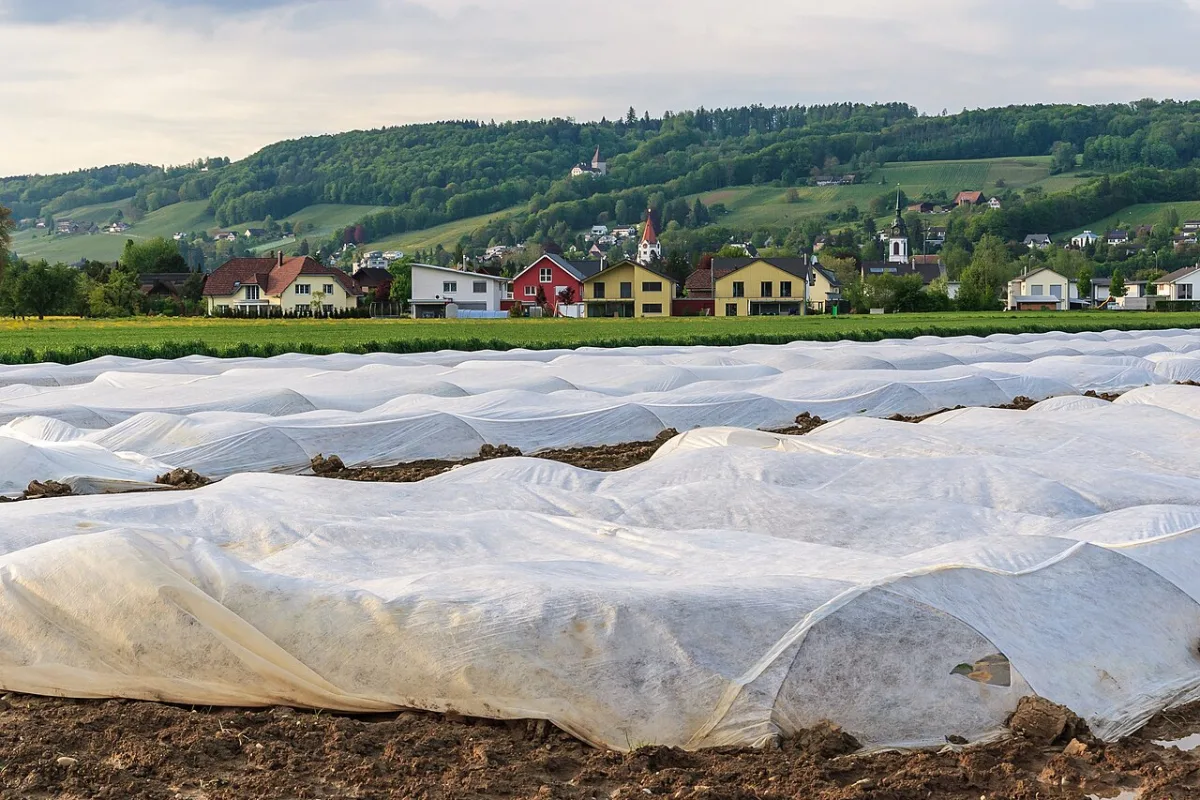
Ordinary polyethylene film will not protect against severe frosts due to its high permeability to thermal radiation. On clear nights, the temperature under it can be 1 °C lower than in open soil. Tomatoes planted the day before under such a cover will perish. The maximum capacity of film covers to protect against frost ranges from -2 °C to -3.5 °C and depends on external conditions.
An effective way to combat nighttime frost is soil irrigation. This agricultural practice significantly increases the heat capacity and thermal conductivity of the soil. Irrigation triggers several defense mechanisms simultaneously:
- Heat is transferred through moist soil from lower layers to the surface much more actively than through dry soil.
- Air humidity in the surface layer increases, which significantly reduces the long-wave radiation of the soil surface.
- During nighttime cooling, moisture condenses on plants and the inside of the film, releasing additional latent heat of condensation.
At a temperature of 0 °C, moisture begins to change into an ice state, accompanied by additional heat release.
After watering plants under polyethylene covers, a layer of condensed water forms on the inner surface of the film, which reduces the transmittance of the cover for long-wave infrared radiation. This layer of water can absorb up to 99% of infrared rays and contributes to protecting plants from frost.
Thus, the observations showed that irrigation is of great importance as a plant protection measure for tomatoes against frost under polyethylene cover.
The combined effect of irrigation and a second layer of film on tunnel covers inside greenhouses is particularly effective. For example, during an unusually cold second ten-day period of April, when prolonged frosts of -5...-6 °C were observed on the soil surface for 7 days, lasting 8—10 hours, and the daytime air temperature was 13—15 °C, the tomato transplants in our experiments were not damaged. On the night of April 14 to 15, when the outside temperature dropped to -3 °C, the air temperature in the greenhouse was 1 °C, and on the night of April 15 to 16, when a second layer of film was used on the covers along with irrigation, the temperature in the transplant growing zone was 2.5 °C at -6 °C.
Placing heating devices in the plant growing zone provides a significant economic effect. When growing transplants, soil and above-soil heating are mainly used (air heating is used only as an emergency measure).
To improve the temperature regime in greenhouses, structures should be placed in wind-protected areas and all gaps should be sealed. Fences and buildings can be located on the north side. Attached greenhouses accumulate heat well.
To accumulate solar energy heat, any water containers are used, including plastic bottles and various black surfaces. The soil itself is an excellent heat accumulator, especially when mulched with black film.
Another direction for regulating the temperature regime is combating overheating.
On a sunny day, the air temperature in greenhouse structures can rise to 40 °C, which is 10—15 °C above the biological optimum. In such cases, the temperature is regulated by opening ventilation apertures. Immediately after planting, for heat retention, it is better to close ventilation no later than 15:00—16:00, and during warmer weather — at 17:00—18:00. When constructing ventilation, it must be remembered that the cucumber prefers top ventilation to avoid drafts, while the tomato, on the contrary, requires cross-ventilation. What should you do if you only arrive at your plot on Saturday and Sunday, but want to have an early harvest? For example, I perforated the film by making small holes in it, watered the soil well, and left a wide container of water in the room.
To reduce overheating, air conditioning with additional humidification, the use of various light-shading devices, overhead irrigation of the roof, and other methods (including mulching the soil with straw) can be quite effective.
One of the effective ways to prevent plant overheating in film greenhouses is forced ventilation with air humidification (the cooling effect in this case reaches 8 °C).
Of the physical methods for reducing air and plant temperature, the most effective is external irrigation of the roof and structures. A previously used method of shading the roof, such as whitewashing, reduced the penetration of physiologically active radiation by 1.5—3 times, whereas external irrigation increases it by 5—14 %. This occurs due to the reflection of light from the droplet layer of moisture on the roof and the creation of an optical effect of a thin layer of water film on the surface. Roof irrigation reduces air and leaf temperature by 5—13 °C.
To reduce the temperature in greenhouse structures, refreshing irrigation of plants is also carried out in the form of fine mist spraying. In the conditions of Ukraine, an effective method to prevent cucumber overheating in late April — early May is to form spherical plants. In this case, in the fruit placement zone, the relative humidity of the air">relative humidity is 80—95 %, and the temperature is 8—15 °C lower than above the plant surface.
Soil and air humidity, methods of its regulation Regulation of soil and air humidity in accordance with the biological characteristics of plants, temperature and lighting
Water quality. For irrigation, water is taken from wells, as well as from rivers, free of harmful impurities. The dry residue mass in the water should not exceed 1—1.2 g/l. Bacteriological contamination is allowed within the limits established for drinking water. The water should be heated to the optimal temperature of the soil.
It is necessary to determine the amount of nitrogen in the irrigation water, including its content in the total dose of nitrogen fertilizer application.
Irrigation methods. Various irrigation methods are used in greenhouses: sprinkler irrigation, drip irrigation, and hose irrigation.
The most common irrigation method is overhead irrigation. In block greenhouses, mobile pipelines are used for overhead irrigation. They are positioned at a height of 2.2 or 0.3 m from the soil surface. Sub-irrigation for cucumber is applied once the plant has lost its leaves up to a height of 75 cm, and for tomato — after harvesting the first two clusters.
Irrigation and humidity control in the greenhouse
Irrigation at different stages of plant development requires a differentiated approach. At the beginning of growth, uniform moistening of the soil is ensured by overhead irrigation. Under-canopy irrigation is inconvenient to use at the start, as the lower leaves prevent the water from distributing across the full width of the greenhouse. With this method, irrigation pipelines are equipped with slit-type or arc-type nozzles, while hose irrigation is kept as a backup.
- Water and fertilizer consumption — 20–30% lower
- Increase in vegetable yield — 8–17%
- Sprinkler spacing for overhead irrigation — 1.6 m
When switching to automation and container growing, drip irrigation becomes the primary method. Water or a nutrient solution is supplied directly to the root zone, which optimizes the soil's water-air and nutrient status and reduces plant disease. The system includes a water source, main lines, polyethylene distribution pipes, a fertilizer doser, and micro-tube emitters.
The optimal level of soil moisture depends on the development phase of the crop. Humidity is monitored using a tensiometer or the gravimetric method.
| Crop or growing object | Period or development phase | Optimal soil moisture, % of FC |
|---|---|---|
| Cucumber | From planting to the start of fruiting | 65–75 |
| Cucumber | Fruiting period | 85–90 |
| Tomato | From planting to the start of fruiting | 65–70 |
| Tomato | Fruiting period | 75–80 |
| Vegetable transplants | From sowing to seedling emergence | 70–75 |
| Vegetable transplants | From seedling emergence to hardening | 55–65 |
During the hardening of transplants, they are not irrigated. Otherwise, water application rates are calculated based on specific growing phases and crop characteristics.
| Crop or object | Growing conditions and period | Irrigation rate |
|---|---|---|
| Vegetable transplants | Seedling emergence period | 3–4 l/m² |
| Early white cabbage transplants | In 6-cm pots | up to 10 l/m² |
| Early tomato transplants | In 10-cm pots | up to 20 l |
| Cucumber | January | 2–3 l |
| Cucumber | June | 5–6 l |
| Tomato | February | 5–8 l |
| Tomato | July | 10–12 l |
In clear weather, due to high transpiration, irrigation is carried out more frequently and with increased rates. For example, in January, cucumber is irrigated 10–12 times, while in June and July — already 27–30 times. To ensure optimal moisture distribution, follow the irrigation schedule:
- Water cucumbers during the fruiting period in the afternoon — this improves soil moisture and enhances fruit growth at night.
- Water vegetable transplants and tomatoes in the morning, followed by intensive greenhouse ventilation to reduce relative air humidity.
Relative air humidity is measured using an Assmann aspiration psychrometer. Different crops require different humidity parameters, which must be strictly maintained in the greenhouse.
| Crop | Development phase | Optimal relative air humidity, % |
|---|---|---|
| Cucumber | Before fruiting | 75–80 |
| Cucumber | During fruiting period | 80–85 |
| Tomato | Entire period | 60–70 |
| Vegetable transplants for open ground | Entire period | 60–65 |
It is especially important to reduce relative air humidity at night and prevent dew formation. This reduces plant disease and increases fruit set.
Convector heating and through-ventilation help reduce humidity. In winter block greenhouses, it is effective to simultaneously use pipe heating and open vent ventilation for this purpose. Conversely, to increase humidity or combat overheating, forced ventilation with humidification and refreshing irrigation are used. For cucumbers, "steaming" is beneficial — increasing air humidity by irrigating at a rate of 1.5–2 l/m² between main irrigations (spraying walkways and soil), after which the greenhouse is closed for 1–2 hours.
Gas regime and CO₂ top dressing
In greenhouses, plants form a massive vegetative canopy. The natural influx of carbon dioxide (CO₂) in greenhouses is insufficient, and its deficit hinders photosynthesis and reduces yield. The requirement for carbon dioxide is 10–20 g per 1 m² of greenhouse area per day. Plants need to be fed throughout the entire growing season, especially at the beginning of the year and in the spring when vents are closed. Maximum effect from gassing is achieved during the fruiting period.
| Crop | Optimal CO₂ concentration in the air, % |
|---|---|
| Short-fruited cucumber | 0.5–0.6 |
| Long-fruited cucumber | 0.2–0.3 |
| Tomato | 0.1–0.3 |
| Lettuce | 0.1–0.3 |
The air can be enriched with carbon dioxide by technical or biological means. With the biological method, CO₂ is released during the decomposition of organic greenhouse soil or biofuel. For instance, the air in a hotbed on biofuel contains 1.7% carbon dioxide in the first 30 days, which is 56 times higher than the norm for outside air. In small greenhouses, containers with fermenting manure are placed directly into the room, and the fermented mass is subsequently used for top dressing. In the initial period of straw bale decomposition, a volume of carbon dioxide is released that is comparable to technical supply.
After filling hotbeds with biofuel, the concentration of not only carbon dioxide but also ammonia rises to dangerous levels. Do not plant transplants until 4–5 days after filling and mandatory ventilation.
Selecting a carbon dioxide source for a greenhouse
The method of carbon dioxide supply directly affects the farm's economics and the microclimate in the greenhouse facility. It is important for an agronomist to choose a CO₂ source that provides plants with nutrients without undesirable temperature changes or poisoning by toxic impurities. In practice, three main sources of carbon dioxide are used: liquefied gas in cylinders, solid carbon dioxide, and boiler flue gases.
Using liquefied gas in cylinders is a simple but expensive method. This gas is chemically pure and does not affect the temperature regime in the greenhouse. The use of solid carbon dioxide (dry ice), on the contrary, lowers the air temperature, which must be taken into account when controlling the climate.
It is economically promising to use carbon dioxide from boilers running on natural gas. It is extracted from chimneys by fans and directed into a special pipeline network. However, if the boiler runs on solid fuel, the flue gases require mandatory purification.
Burning solid fuel releases gases that are harmful to humans and plants. Such carbon dioxide can only be supplied to the greenhouse after filtration and strict monitoring of the concentration of hazardous impurities.
| Harmful impurity | Maximum permissible concentration, mg/m³ |
|---|---|
| Sulfur dioxide | 0.2 |
| Ammonia | 10 |
| Nitrogen dioxide | 20 |
| Carbon monoxide | 500 |
Read next
Greenhouses and covers For gardeners
Technologies for growing vegetable transplants in protected soil
Greenhouses and covers For agronomists
Vegetable growing technology in small-sized plastic tunnels and covers
Greenhouses and covers For gardeners