
Biological characteristics of growth and regeneration of the grapevine
9 min read
How liana biology determines the recovery of vines
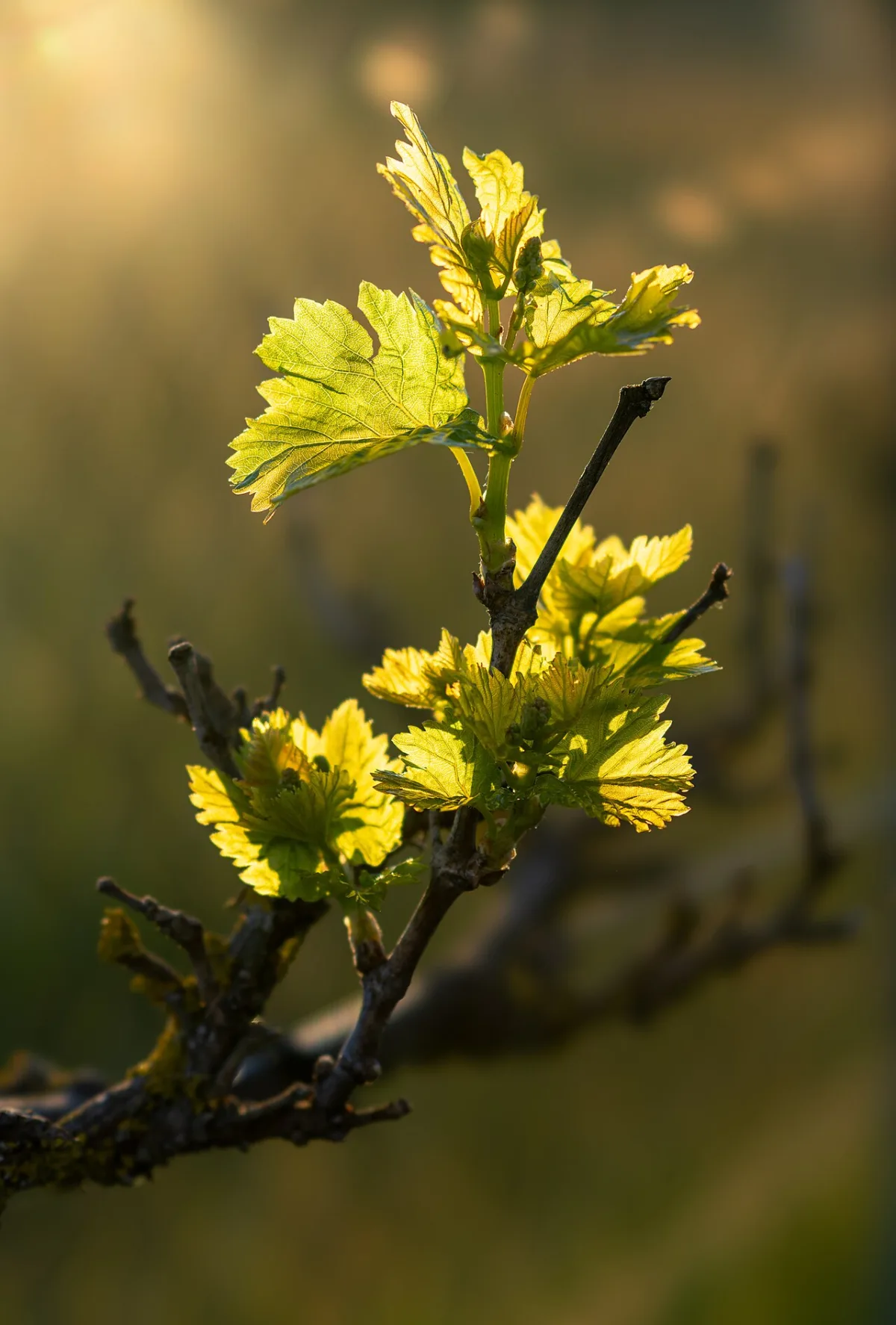
The grapevine evolved as a climbing woody liana in the shaded forests of the Tertiary period. To reach sunlight from under the forest canopy, representatives of the Vitaceae family abandoned a rigid woody skeleton and shifted from monopodial to sympodial growth. The role of support organs was taken over by tendrils, which are evolutionarily transformed shoot tips. This type of development allows the grapevine to rapidly build up vegetative mass with minimal expenditure of organic matter on skeleton construction.
| Shoot parameter | Maximum value |
|---|---|
| Shoot thickness | 15 mm |
| Shoot length | 20 m |
Due to the lack of a sturdy trunk, the above-ground part of the grapevine is easily damaged by wind, frost, or mechanical impact. In response to this, the plant has developed a powerful regeneration system. When the main stems are damaged, the vineyard quickly restores its vegetative mass through the development of buds:
- axillary prompt buds (lateral shoot buds) located on the shoot;
- central and replacement buds of the compound bud;
- latent buds.
The vine's ability to regenerate quickly is the basis for agrotechnical practices for recovering bushes after winter frosts and spring freezes, including the renewal of the planting with root system pruning.
Conductive system, nutrient reserves, and fruiting characteristics
To supply long and thin shoots with water, the grapevine utilizes powerful root pressure and intense moisture evaporation by the leaves. The suction force of the roots reaches 147 kPa (up to 1.5 atm). Rapid water transport and the outflow of organic substances are facilitated by large conductive vessels of the wood, tracheae, and sieve tubes, as well as a dense network of veins in the leaves.
The grapevine accumulates its main nutrient reserves in the roots—primarily in the libriform tissues, bast fibers, and medullary rays. Fewer nutrients are stored in the stems, where they are concentrated mainly in the diaphragm of the nodes. Accumulated reserves are consumed during the most critical periods of the plant's life:
- during the annual spring bud break;
- during the growth and development of shoots, leaves, and reproductive organs;
- for survival after harsh winters.
To reduce the weight of the above-ground part without losing structural integrity, the grapevine has developed a specific stem architecture. Shoots are divided into nodes and internodes, the tissues have a loose structure, and heavy mechanical tissue (sclerenchyma) is absent. Pith cells become suberized early, causing internodes to become hollow and filled with air. This lightens the bush structure, improves internal gas exchange, and accelerates bark drying during vine ripening.
The main difference between grapes and other berry and fruit crops lies in the combination of vegetative growth and fruiting. While raspberry shoots only grow in the first year and fruit in the second, and apple trees form special structures for the harvest—such as spurs, fruit-bearing twigs, and others—in grapes, the same shoot can be both vegetative and fruit-bearing. At the same time, assimilates for the development of bunches are actively produced by the leaves of both fruit-bearing and sterile shoots.
A grapevine growing in natural conditions is characterized by self-regulation of growth and fruiting. This consists in the fact that, out of the many buds formed on the shoots in spring, most do not develop due to external and internal factors. Some inflorescences do not develop into bunches, and only a minor portion of flowers forms berries. Thanks to this, the grapevine plant lacks fruiting periodicity.
When cultivating grapes, this is also not observed, as the application of various agrotechnical techniques allows for regulating the growth and fruiting of the vine bush, thereby obtaining high yields of good quality every year. Such techniques include:
- disbudding (thinning);
- pruning;
- regulating the load of eyes and shoots on the bushes;
- other practices.
Unlike other woody plants, grapes have a more strongly expressed polarity—both longitudinal and planar. According to M. Kh. Chailakhyan, polarity is an inherent property of organic matter and is expressed in morphophysiological differences at opposite ends of cells, tissues, organs, and the entire plant. It manifests in polar opposite abilities:
- leaf-stem—based on air and light nutrition;
- root-forming—based on water and soil nutrition.
The struggle and unity of these abilities are accepted as the driving force of individual plant development.
One of the important internal factors of plants, which determines the direction of these processes and their activity, is the activity of phytohormones (auxins, gibberellins, inhibitors), which are formed primarily in zones with high meristematic activity—in the tips of stems and roots, in young leaves, buds, and growing fruits. All of them are products of plant metabolism. By penetrating tissues with high sensitivity, phytohormones act on cell receptors, causing them to divide and expand actively.
The growth of various plant organs is determined by a specific combination of hormones:
| Root growth | action of auxins with reduced inhibitor content |
| Shoot growth | combined action of gibberellin and an inhibitor |
| Seed growth | influence of gibberellin, cytokinin, or auxin with reduced endogenous inhibitor content |
Phytohormones move first to the apical buds, and then to the lower ones. The buds farthest from the base of the shoot develop first and most intensely: they develop into the strongest shoots. Buds located lower down open later, and if the lowest ones open at all, they produce weaker shoots. The growth intensity of grapevine shoots is very high — up to 10 cm per day. It is significantly influenced by the spatial orientation of the shoot — vertical, inclined, or horizontal.
Initially, when the shoot is growing vertically, shoots of the 2nd, 3rd, and subsequent orders of branching (lateral shoots/suckers) barely develop; these contribute to leaf surface development and possess the property of restoring correlations between the roots and the assimilation surface. Here, the inhibitory (suppressing) effect of the apex on lateral buds is manifested. In the event that apical growth stops, the growth of lateral shoots is sharply stimulated. They also grow actively when the shoot assumes a horizontal or inclined position, that is, when longitudinal polarity is suppressed. This is used in viticulture if it is necessary to induce the growth of lateral shoots.
Planar polarity in grapevines is manifested in the dorsoventral, asymmetric structure of all organs: the shoot, leaf petiole, leaf blade, roots, and seeds. The asymmetry of the organ structure is due to significant differences in their physiological and biochemical properties and the diversity of their performed functions. The dorsoventrality of roots contributes to their better advancement into the soil. In growing grapevine shoots, planar polarity is expressed in an asymmetric structure. In cross-section, the shoot has the appearance of a rectangle with rounded corners and four unevenly developed sides — ventral, dorsal, furrowed, and flat.
The ventral side is wide and more developed, however, its growth rate is weaker than that of the dorsal side, which is why the tip of the growing shoot curves downward. The dorsal side is more convex and more intensely colored. The shoot creeps along the ground or attaches to a support with its ventral side. As the shoot grows, the dorsal and ventral sides maintain their position in space along its entire length. The furrowed and flat sides alternate from one node to the next. This explains the arrangement of leaves on the shoot in an alternating order, which contributes to their most complete utilization of light. Such an arrangement of the shoot sides in space contributes to better stem branching and the positioning of lateral shoots of the 1st, 2nd, and subsequent orders, which is also an adaptive biological feature characteristic of lianas.
Knowing the patterns of shoot growth and development, one can purposefully influence the manifestation of polarity properties through the following agrotechnical measures:
- appropriate tying of shoots in a specific direction and at a specific angle;
- removal of a portion of the shoots;
- performing their thinning (disbudding) at the beginning of the growing season;
- pinching, topping, and trimming of shoots.
How to manage growth and fruiting through the biology of a liana
Grapevine is one of the most plastic garden crops. Unlike most fruit trees, each bush in a vineyard requires an individual approach based on an understanding of its physiology. The main task of an agronomist is to maintain a constant balance between the development of the root system and the above-ground part, as well as between shoot growth and harvest ripening. Any disruption of this correlation shifts the development of the bush either toward vigorous shoot growth or toward exhaustion and weakening of the roots.
Practical vineyard management is based on the control of plant polarity — its natural tendency to direct nutrients to the most distant points of growth. By weakening or strengthening this property through pruning and tying, we redistribute the bush's resources in the desired direction. All key technological processes on the farm are based on the knowledge of these patterns:
- choice of the cultivation system and training of bushes;
- pruning and calculation of the optimal load of buds, shoots, and harvest;
- tying of shoots;
- the entire complex of operations with the green parts of the bush;
- application of growth regulators;
- technologies for growing nursery plants.
For fine-tuning these processes, it is necessary to clearly distinguish the organs of the bush by their functions. The vegetative organs of the grapevine include the root, stem, and leaves; the generative (reproductive) organs include flowers, clusters, berries, and seeds. Buds play a special role: they are universal and can simultaneously give rise to both vegetative shoots and new inflorescences.
The high biological plasticity of the grapevine allows for the restoration of bushes after damage and their adaptation to external conditions. However, this same feature obliges the agronomist to strictly control the balance of underground and above-ground mass during every technological operation.
Read next
Viticulture For agronomists
Biological features and types of buds of the grapevine plant
Viticulture For agronomists
Characteristics, taxonomy, and origin history of the Vitaceae family
Viticulture For agronomists