
Technology of pre-sowing soil preparation and methods of soil moisture conservation for vegetable crops
5 min read
Early Spring Tillage and Soil Moisture Conservation
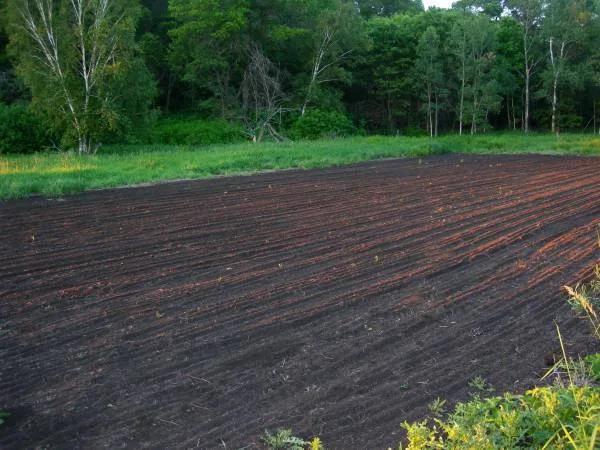
Spring soil preparation addresses the main tasks of an agronomist: conserving soil moisture, loosening the soil, breaking the crust, and destroying weed seedlings. During winter, the soil becomes highly compacted. Without spring loosening, the soil takes a long time to warm up, soil microflora activates later, nutrients become available to plants more slowly, and soil moisture evaporates very quickly.
- Daily evaporation without tillage — 40–50 m³/ha
- Evaporation after harrowing — 5–6 times less
- Cultivations for early cabbage — 1
- Cultivations for tomato and cucumber — 2
- Cultivations for pepper and eggplant — 2
| Type of tillage | Daily soil moisture evaporation (m³ per 1 ha) |
|---|---|
| No tillage | 40–50 |
| After harrowing | 5–6 times less |
The first mandatory method of spring tillage is harrowing across the direction of ploughing. It is carried out using wide-capture harrow hitches on crawler tractors. Before the optimal sowing dates for early crops (onion, carrot, beet, direct-seeded tomato), one or two such harrowings can be performed.
Pre-sowing cultivation of soil for onion, carrot, beet, and direct-seeded tomato is unacceptable. It inevitably leads to loss of soil moisture, thin stands, and uneven emergence. Place early-sown crops in weed-free areas after predecessors that are harvested early.
For transplants and the most heat-loving crops (cucumber, bean), spring cultivation of soil across the ploughing is mandatory. The number of tillage passes depends on the planting or sowing dates and the weediness of the field. In this case, the final cultivation is always carried out strictly at the seeding depth of seeds">depth of seed placement or transplant planting.
- For early cabbage, only one cultivation is recommended.
- For early tomato transplants and seeded cucumber, two cultivations are often necessary.
- For pepper and eggplant, two cultivations are often necessary.
For crops with late planting or sowing dates (late cabbage, summer-planted potato, summer-sown cucumber), the soil is managed using a semi-fallow system if weediness is high. The field is kept in a loose and clean state through systematic cultivations. In intensive crop rotation, it is advisable to first occupy such areas with early-maturing vegetable crops with a short growing season.
Soil Packing and Crop Maintenance
In the event of a prolonged absence of precipitation, pre-sowing soil packing is carried out using ring-spur or ring-toothed rollers. This method levels the field, ensures uniform seed placement, and draws moisture from the lower layers to the surface. Packing is especially effective in non-irrigated areas in arid northern and eastern regions. In cases of low soil moisture, it is repeated after sowing small-seeded crops.
- Clear the field of post-harvest residues of the early crop.
- Perform ploughing with non-moldboard implements accompanied by harrowing.
- Perform irrigation before sowing or planting the main crop.
- Perform cultivation 1–2 times.
- Perform pre-sowing packing with ring-spur or ring-toothed rollers.
The best results are achieved by combining loosening, sowing, and packing in a single pass using a combined aggregate (e.g., APO-5.4). This machine simultaneously cuts technological guide furrows for the tractor wheels that will maintain the growing plants. If a combined aggregate is not available, separate machines are used, but with a minimum time interval between operations.
Maintenance of plants during the growing season is aimed at preserving the soil structure, conserving soil moisture, and ensuring the effective use of fertilizer. The main implements here are various systems of cultivators, rotary tillers, and hillers. The working parts of these machines loosen the inter-rows, cut weeds, hill up plants, and apply top dressing in dry or liquid form. After mass emergence, weeding and inter-row loosening are repeated regularly as weed vegetation appears, as well as after every rain or irrigation.
The first inter-row treatment for onion, carrot, beet, direct-seeded tomato, pepper, and eggplant is carried out following the emergence of marker crops (radish, lettuce, spinach). The emergence of the main vegetables takes a long time after sowing, so marker crops serve as a guide for work.
During the first cultivations of seeded crops, enlarged protective zones are set, or cultivators and tillers are equipped with special attachments that prevent soil from covering the seedlings. Subsequently, as the plants grow, the need for such attachments disappears. In the case of vegetable transplants, relatively large plants are already placed in the field, however, during the first cultivation, protecting them from being covered with soil is also necessary. After the transplants have fully established, some hilling of the plants during cultivation is even beneficial.
Figure 2 — Inter-row tillage of crops using a multi-row rotary tiller
The depth of inter-row tillage does not remain constant during the growing season:
| Tillage period | Depth |
| In the beginning (small roots) | 12–15 cm |
| Later on | 8–10 cm |
The number of inter-row tillage operations depends on many conditions: the degree of weed infestation of the fields, soil type, frequency of irrigation and rainfall, etc. However, when growing early-maturing crops, the number of cultivations should not be less than two to three, and for late-maturing ones — four to five. In onion crops, inter-row tillage and loosening within rows must continue until the leaves begin to lodge, while for other crops, they cease when the rows close.
Read next
Fruit growing For agronomists
Soil management systems in orchard inter-rows
Soil and tillage For agronomists
Planning a tillage system within the crop rotation of an agricultural enterprise
Vegetable growing For students