
Morphological characteristics of seeds and toxicity of sweet clover (Melilotus officinalis)
2 min read
Family: FABACEAE
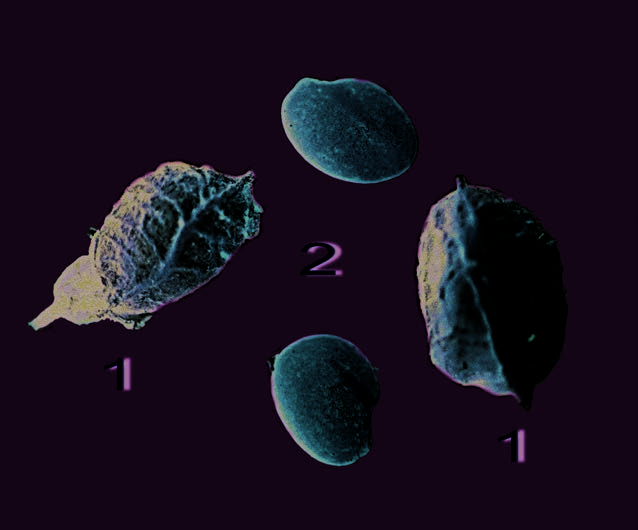
Pall. Pods are obovate, slightly compressed, single-seeded, rarely two-seeded. The apex is rounded-obtuse with a small pointed projection. The base is often enclosed in the calyx, formed by triangular-pointed leaflets. The surface is transversely wrinkled, glabrous, slightly punctate, matte. Color is brownish-yellow, light yellow, dark gray; the calyx is darker. Length 2.5–3.5 mm, width 1.75–2.25 mm, thickness 1.25–1.5 mm. Seeds are oval-elongated, slightly compressed. The radicle is tightly adjacent to the cotyledons and constitutes about 3/4 of their length, forming a faint, oblique projection. The seed scar is round, small, light-colored, located below the radicle projection. The surface is smooth, matte, sometimes slightly shiny. Color is yellow, yellowish-green, light brown. Length 1.75–2.25 mm, width 1.25–1.75 mm, thickness 1–1.25 mm. Infests crops of grains, cotton, and clover; grows in meadows and along roadsides. Distribution: European part (almost everywhere), Caucasus, Western and Eastern Siberia, Central Asia. Toxic properties. The aerial part contains an aromatic lactone of hydroxycinnamic acid — coumarin, which gives fresh hay a pleasant sweetness. When hay rots (due to the influence of mold fungi), poisonous dicoumarol is formed, which has an anticoagulant effect. Dicoumarol is an antagonist of vitamin K, which is necessary for the synthesis of blood clotting factors (prothrombin, etc.) in the liver.
Poisoning develops with a latent period of 3–5 days and is characterized by bleeding, hemorrhages, dyspeptic disorders, liver function depression, hematuria; allergic reactions are possible. By crossing the placenta, dicoumarol can cause fatal hemorrhage in the fetus. Poisoning is complicated by the accumulation of dicoumarol in the body, which is why feeding livestock animals spoiled hay or silage made from sweet clover (especially when there is a deficiency of vitamin K in the diet) is extremely dangerous. Treatment: administration of vitamin K. Other species: White sweet clover — (distributed everywhere), contains a smaller amount of coumarin (cultivated coumarin-free forms have been developed), but can also have a toxic effect if the hay spoils. Up to ten other species of sweet clover are known in the flora of the Russian Federation (having limited distribution), with similar toxic properties.
Read next
Seeds and varieties For agronomists
Morphological characteristics of seeds and toxicity of common houndstongue
Seeds and varieties For agronomists
Botanical characteristics of seeds and harmfulness of water pepper (Persicaria hydropiper)
Seeds and varieties For agronomists