
Cicuta virosa morphological features of seed and plant toxicity
2 min read
Family: APIACEAE
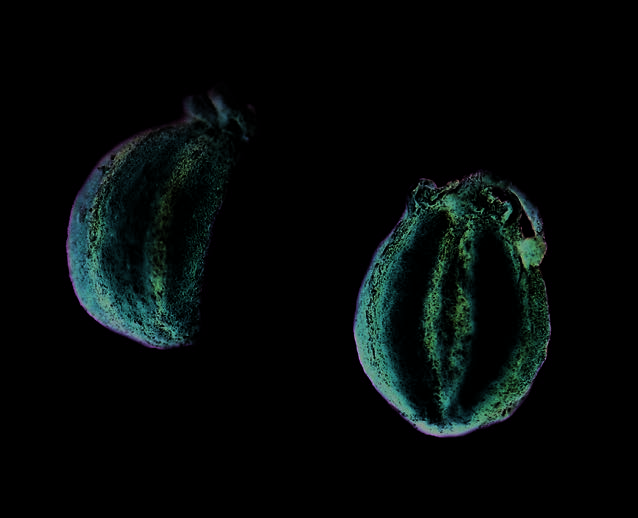
Schizocarps are spherical, compressed from above. At the apex, there is a multi-lobed remnant of the style; at the base, there is often a remnant of the pedicel. The schizocarps have ten widely inflated ribs, with clearly visible essential oil canals located between them. The surface is coarsely rough. The color is brownish-brown, yellowish-brown; the ribs are lighter, the canals are dark, sometimes almost black. Length is 1.5–2.25 mm, width 1.75–3 mm, thickness 1.5–2.5 mm. The fruitlets are broadly ovoid, the back is strongly convex, the ventral side is almost straight or weakly convex, with five ribs, between which clearly visible canals pass. The fruit scar is located below the epigynous disk. The surface is coarsely rough. The color is brownish-brown, with almost black stripes. Length is 1.5–2.25 mm, width 1.25–2.75 mm, thickness 0.75–1 mm. It infests mainly rice fields, grows in wet meadows and along ditches. Distribution: European part (everywhere, except Crimea), Caucasus, Western and Eastern Siberia, Far East, Central Asia. Toxic properties. The entire plant contains cicutoxin. Cicutoxin is rapidly absorbed from the digestive tract and has a convulsive effect on the central nervous system. In non-toxic doses, it causes a sedative effect, reduces motor activity and blood pressure. 15–20 minutes after the poison enters the digestive tract, headache, nausea, vomiting, and abdominal pain develop. A feeling of cold throughout the body, loss of balance, and decreased skin sensitivity are characteristic. As the poisoning progresses, clonic-tonic convulsions and copious secretion of thick saliva are observed. Death can occur from cessation of respiration against the background of acute cardiovascular failure. Water hemlock is toxic to livestock animals. The lethal dose for cattle is 200 g of fresh rhizome, for sheep — 60–80 g. The rhizome is easily pulled out of the swampy soil when the above-ground part is bitten off. Other species. Representatives of the related genus Oenanthe, containing oenanthotoxin, which is close to cicutoxin, possess a similar (weaker) effect.
Read next
Seeds and varieties For agronomists
Morphology and distribution of the poisonous weed fool's parsley
Seeds and varieties For agronomists
Morphological features of seed and toxic properties of tall buttercup
Seeds and varieties For agronomists