
Morphological description and identification of the fruitlets of rough chervil (Chaerophyllum temulum)
1 min read
Rough chervil (Apiaceae family) infests crops of cereal crops and vegetable gardens. The weed is widely distributed across the European part, covering its northern, central, and southern regions. The presence of plant parts and seed in the harvest poses a serious danger due to the toxicity of the weed.
The entire plant contains the alkaloid chaerophyllin, presumably produced by parasitic fungi.
Morphological features of the fruitlets
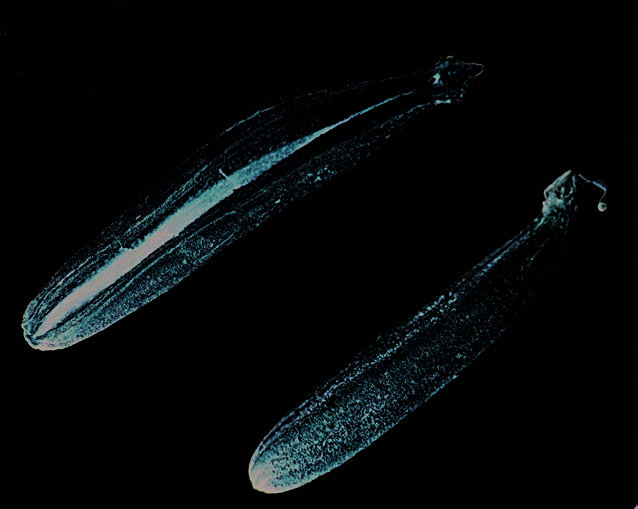
For timely detection of the contaminant during the analysis of seed material and grain cleaning, it is important to be able to identify its fruitlets. They have an obovate-cylindrical shape, narrowing towards the apex. At the apex, there is a beak-like conical remnant of the epigynous disk, and the fruit scar lies below it. The surface of the fruitlet is glabrous, smooth, or finely dotted.
- Fruitlet length — 3,58 mm
- Fruitlet width — 1,251,5 mm
- Fruitlet thickness — 0,751 mm
The dorsal side of the fruitlet is slightly convex, while the ventral side is significantly concave, with a clearly defined slit-like groove. Rough chervil fruitlets can be distinguished by the character of the ribs and contrasting coloration:
- Ribs and vittae: there are five slightly protruding ribs on the fruitlets (three run along the back, two along the edges). Between them lie oil-bearing vittae (canals), which are equal in width to the ribs or slightly wider.
- Coloration: the main surface of the fruitlets is yellowish-gray, the ribs are yellowish-brown, and the oil-bearing vittae stand out in a blackish-brown, almost black hue.
Read next
Seeds and varieties For agronomists
Cicuta virosa morphological features of seed and plant toxicity
Seeds and varieties For agronomists
Morphological features of seeds and distribution area of corn buttercup
Seeds and varieties For agronomists