
Botanical description and geographical distribution of the barnyard grass weed
2 min read
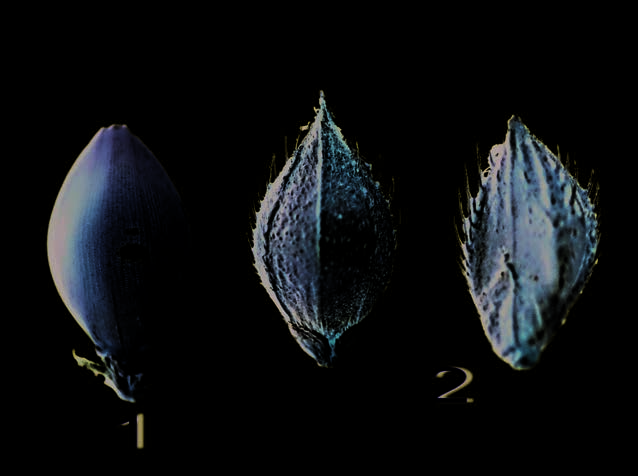
POACEAE FAMILY (GRASSES) Spikelets are single-flowered, ovoid, convex on one side, ranging from awnless to long-awned, pointed at the top, blunter towards the base; the dorsal side is strongly convex, while the inner (ventral) side is almost flat or slightly concave. There are three glumes: the lower one (on the ventral side) is short (about 1/3 the length of the spikelet), broadly ovoid, with three clearly visible veins. The second (outer) glume on the dorsal side is equal to or slightly longer than the spikelet, covers the membranous caryopsis, is five-nerved, and strongly pointed at the top. The third (inner) glume (emerging from under the lower short one) is seven-nerved. On the dorsal side of the spikelet, under the glume, there is a translucent broadly ovoid scale — a rudiment of the second flower. The awn extends from the apex of the inner glume. The surface is rough, covered with sparse prickles between the ribs, and serrated along the ribs. The color is straw-greenish, sometimes with a violet tint. Length 2.75–3.25 mm, width 1.5–2 mm, thickness 1.25–1.5 mm. The membranous caryopsis is ovoid, convex on one side, pointed at the top, blunter at the base; the outer dorsal side is strongly convex, while the inner ventral side is flat. The outer palea is shell-like, enclosing the inner one. The callus is significantly protruding. The surface is smooth, glabrous, and shiny. The color is greenish-gray, steel-colored. Length 2.25–3 mm, width 1.25–1.75 mm, thickness 1–1.25 mm. The caryopsis is oval, slightly compressed, finely dotted, light yellow. The embryo is oval, slightly depressed, and darker. Length 2 mm.
Sowing material is contaminated by spikelets. It infests grain crops, irrigated rice crops, row crops, melon fields, gardens, and orchards. Distribution: European part (almost everywhere except for northern regions, especially abundant in southern and southeastern regions), Caucasus, Western and Eastern Siberia, Far East, Central Asia. It is the most frequently encountered weed in plant production.
Read next
Seeds and varieties For agronomists
Botanical characteristics and morphology of Johnson grass spikelets
Seeds and varieties For agronomists
Morphological features and characteristics of common wild oat seed
Seeds and varieties For agronomists