
Botanical characteristics and morphology of Johnson grass spikelets
1 min read
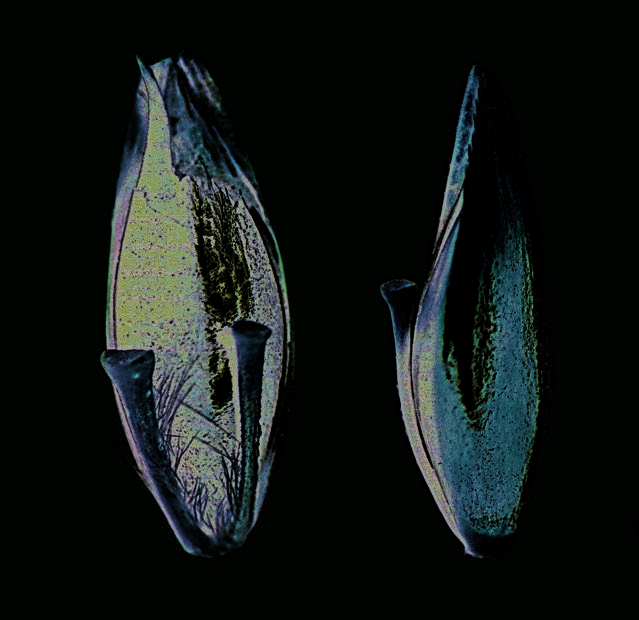
Johnsongrass (sorghum halepense) is one of the most common and harmful weeds infesting crop production. It can be found in sowings of grain, legume, and vegetable crops. The main areas of the pest's distribution are concentrated in the southern regions of the European part, the Caucasus, and Central Asia. For an agronomist, it is important to identify the weed impurity in the seed material in a timely manner to prevent it from entering the fields.
During transportation and processing of produce, the awns of Johnsongrass usually break off, and the sparse long hairs at the apex and base of the spikelets are worn away. This significantly masks the weed in the bulk and makes its identification difficult.
Morphological features of spikelet structure
The weed belongs to the grass family — Poaceae Barnhart. Its spikelets have an ovoid, geniculate-awned shape; they are slightly compressed from the ventral and dorsal sides, have a pointed apex and a blunter base. The grain is tightly protected by leathery glumes:
- The outer glume is located on the dorsal side; it is flatter, weakly ribbed, three-toothed at the apex, and covered with sparse long hairs.
- The inner glume is located on the convex side of the grain; it is convex, becomes keeled closer to the apex, and may be pubescent or completely glabrous.
Under the glumes are two membranous lemma and palea, which tightly enclose the caryopsis. Thin, rounded, and pubescent rachis internodes of the spikelet diverge from the base at an angle, reaching half or two-thirds of the glume height. At the apex, they are expanded and have a cup-shaped depression. The surface of the spikelets is shiny and glabrous, colored dark purple or dark brown with a reddish translucence, while the rachis internodes and pubescence remain white.
| Spikelet parameter | Dimensional characteristics |
|---|---|
| Spikelet length | 46 mm |
| Spikelet width | 2 mm |
| Spikelet thickness | 1.3 mm |
Read next
Seeds and varieties For agronomists
Darnel ryegrass classified as a dangerous weed in flax crops
Seeds and varieties For agronomists
Cenchrus pauciflorus is a dangerous quarantine weed of fields and pastures.
Seeds and varieties For agronomists