
Darnel ryegrass classified as a dangerous weed in flax crops
1 min read
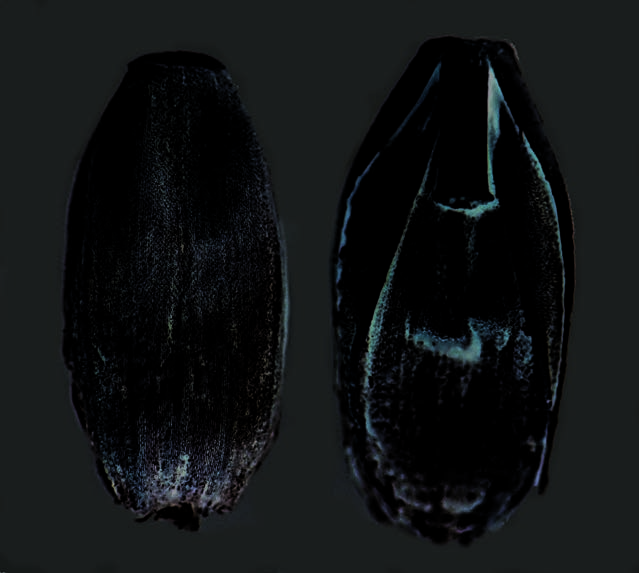
Darnel ryegrass (Lolium remotum) is a dangerous weed of spring crops, which primarily infests flax sowings. It is widespread in the European part of the Russian Federation (in flax-growing regions) and in the Far East. The main problem for an agronomist is that the caryopses of this weed are extremely difficult to separate from flax seed during cleaning of the harvested bulk.
A high admixture of flax ryegrass imparts toxic properties to the resulting oil and makes it unsafe for human consumption. The weed caryopses themselves have an excitatory effect when ingested.
Morphological features and seed dimensions
The weed belongs to the grass family — Poaceae Barnhart. The spikelets of this plant are four- to eight-flowered. The membranous caryopsis of the ryegrass is fused with the floral glumes, has an ovoid, widely open shape without an awn and a rounded-obtuse apex.
- The lemma is leathery, with faintly visible lateral veins and a clearly protruding midrib.
- The palea has two sharp keeled ribs and a transversely tubercular surface.
- An awn is in most cases absent or replaced by a small awn-like point.
- The rachilla is broad, compressed, and straight-truncate.
- The seed surface is glabrous, with slight longitudinal wrinkling.
- The color of the husk varies from straw-brown to greenish-gray.
| Seed parameter | Size, mm |
|---|---|
| Length | 3,55 |
| Width | 1,51,75 |
| Thickness | 0,751 |
Read next
Seeds and varieties For agronomists
Botanical description and geographical distribution of the barnyard grass weed
Seeds and varieties For agronomists
Morphological features and characteristics of common wild oat seed
Seeds and varieties For agronomists