
Botanical characteristics and morphological features of hairy vetch seed
1 min read
Hairy vetchling (Vicia hirsuta) from the Legume family (FABACEAE Lindl.) is one of the most common weeds contaminating crop products. Its seed often gets into the heap during harvesting of cereals and grain legumes, significantly reducing the quality of marketable grain and seed material. To timely identify the weed and correctly calibrate cleaning machines, an agronomist needs to know exactly the morphological features of the fruits and seed of this pest.
The weed is widespread almost everywhere: its seed is regularly found in harvest lots from the European part, Siberia, the Caucasus, the Far East, and Central Asia.
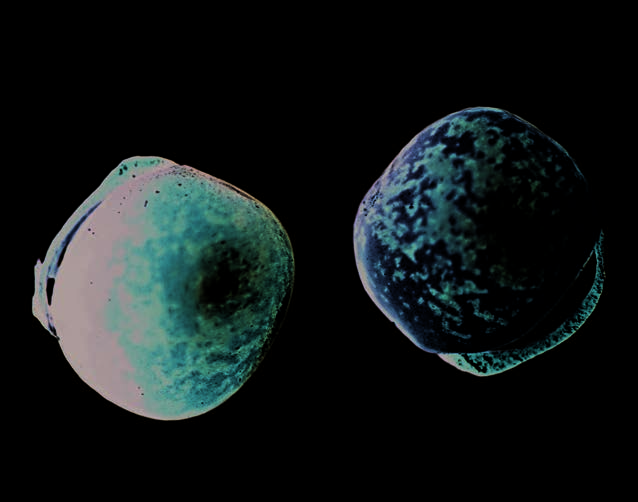
Morphological characteristics of pods and seeds
When analyzing a heap, it is important to be able to distinguish elements of hairy vetchling by characteristic external features. The pods of this plant have an oblong-rhombic or oval-elongated shape. At a young age, they are softly pubescent and pale green, and upon ripening, they become brown or intensely black. Usually, two seeds develop inside each pod, although one- and three-seeded specimens occur.
The seeds themselves have a spherical, slightly compressed shape and a smooth, shiny surface. Their color is variegated, mottled-marbled: a gray-green or grayish-brown pattern is scattered over a lighter background, although monochromatic seeds are occasionally found. A characteristic detail is a dark brown linear hilum with a longitudinally protruding ridge, occupying 1/4 of the seed circumference, below which is located a darker chalaza. The hilum is often covered by a funiculus, which frequently detaches, and at the point of attachment, it is significantly thickened and colored reddish-brown.
- Pod length — 610 mm
- Pod width — 34 mm
- Seed length and width — 1.53 mm
- Seed thickness — 1.52.5 mm
Read next
Seeds and varieties For agronomists
Morphological characteristics and geographic distribution of redroot pigweed
Seeds and varieties For agronomists
Morphological characteristics and seed dispersal features of the creeping thistle (Cirsium arvense)
Seeds and varieties For agronomists