
Specifics of pruning and forming red and white currant bushes
3 min read
- Lifespan of fruit-bearing branches — 7–8 years
- Productive period of a branch — up to 8 years
- Minimum shoot length — 20 cm
- Planting interval on a trellis — 1–1.2 m
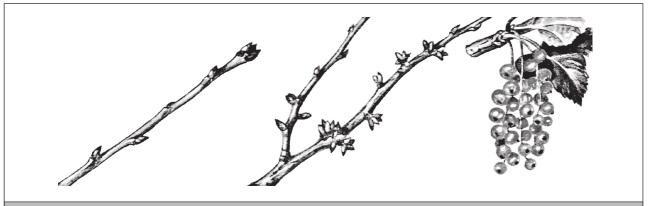
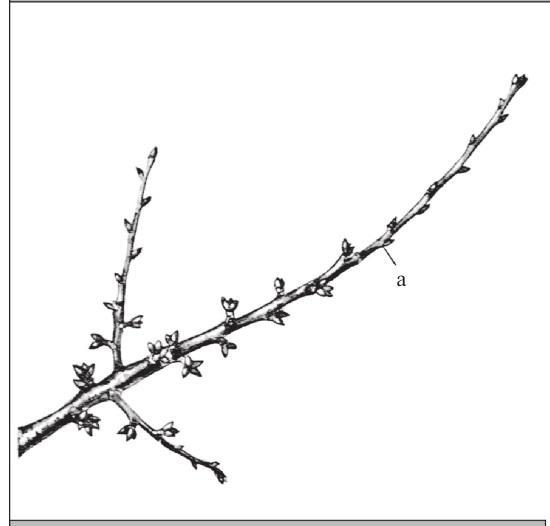
Red and white currants produce fewer basal (zero) shoots compared to black currants. They form their harvest primarily on bouquet branches and shortened annual branches. Since skeletal branches maintain high productivity for up to 8 years, the bushes become bare more slowly and provide a stable harvest. When pruning it is important to consider cultivar characteristics: the rates of bud break and shoot-forming capacity vary significantly among different cultivars.
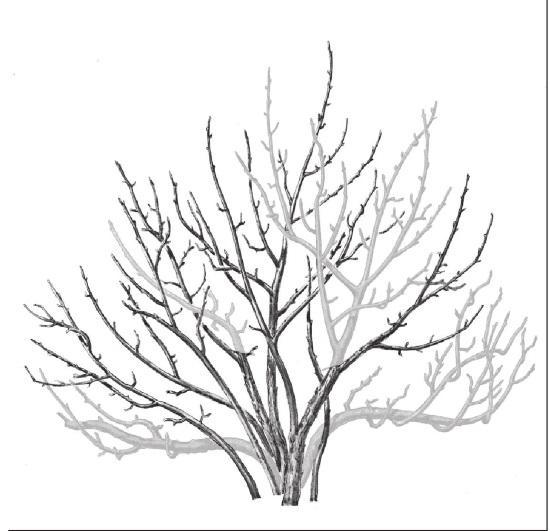
For stable annual fruiting, maintain branches of different ages within the bush. The gardener's main task is to prevent excessive canopy density. To do this, timely remove excess basal shoots, leaving only branches for the planned replacement of aging ones.
Do not shorten the branches of the first, second, or higher orders. Such pruning will lead to a sharp decrease in yield, as the bulk of flower buds are set on these parts of the branches.
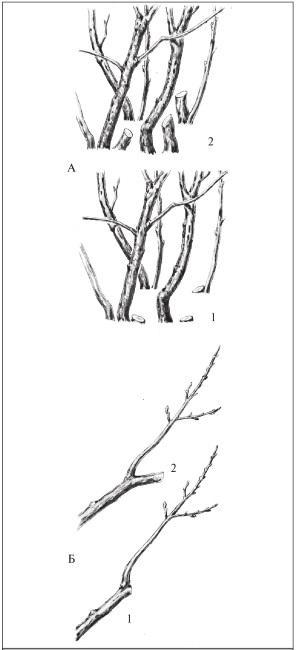
- Leave basal branches only in the quantity necessary to replace aging skeletal branches.
- Prune the unripened upper part of shoots down to a healthy bud.
- Ensure the length of remaining shoots is no less than 20 cm.
- Rejuvenate aging branches by pruning to a strong lateral branch.
Forming and pruning bushes on a trellis
Red and white currants can be grown not only as a traditional bush but also on a vertical wire trellis. This arrangement saves space in the plot and allows the plantings to be used as a hedge or screen. For trellis culture, nursery plants are placed in a row, with the main branches trained strictly along the plane of the stretched wire.
- Plant bushes at a distance of 1–1.2 m from each other, orienting the strongest branches along the trellis plane.
- Tie 4–5 main bush branches to the wires in a fan shape, leaving free space for 2–3 newly growing shoots.
- In the first 2–3 years, prune the branches very lightly so as not to provoke excessive branching.
- When branches reach the height of the third, top-most wire, prune them regularly by transferring to lower-positioned branches.
- Starting from the fifth or sixth year of growth, carry out planned branch rejuvenation.
- Each year, leave exactly as many basal shoots as are needed to replace aging branches, and cut all others off at soil level.
All strong vertical branches that do not have enough space on the trellis plane should be cut off completely at the base or used to replace aging skeletal shoots.
Dozens of currant cultivars are suitable for growing in temperate latitudes. The most reliable remain the time-tested historical cultivars, which have demonstrated stability over centuries. They form the basis of the assortment in many traditional farms.
| Cultivar | Year cultivation began |
|---|---|
| Hollandsche Rode | 1665 |
| Hollandsche Witte | 1690 |
| Versaillaise Blanche | 1850 |
| Chulkovskaya | Since time immemorial |
The domestic heirloom cultivar Chulkovskaya may be found in various regions under local names such as Kryukovskaya or Zhelninskaya. The choice of a specific cultivar depends on the production goals of the farm. Among more modern cultivars, breeders identify groups with distinct economic traits:
- High-yielding: Jonkheer van Tets, Krasny Krest, Nenaglyadnaya, Shchedraya.
- Early-ripening: Rannyaya Sladkaya.
- Dessert (excellent taste): Hollandskaya Rozovaya, Sakharnaya, Rannyaya Sladkaya, Chulkovskaya.
Read next
Pruning and training For gardeners
Features of pruning and training gooseberry bushes of different cultivars
Pruning and training For gardeners
Fundamentals of canopy formation and pruning of sweet cherry in the orchard
Pruning and training For gardeners