
Features of pruning and training gooseberry bushes of different cultivars
3 min read
The productivity of a gooseberry plantation directly depends on the biological characteristics of the cultivar being grown. All cultivars of this crop are divided into three main groups, each of which requires an individual approach to bush training:
- European large-fruited cultivars (Finik, Zeleny Butylochny, etc.) have moderate bud break and shoot formation ability. Their shoot regeneration is low, but the basal (zero) branches remain productive for up to 10–12 years. The harvest is formed mainly on fruiting spurs and annual growth.
- American small-fruited cultivars (Houghton, Primorsky, etc.) are characterized by good bud break with moderate shoot formation ability. They regenerate shoots quickly. The main part of the berries ripens on annual branches, while very few fruits set on short-lived fruiting spurs.
- Hybrids between European and American cultivars (Kolkhozny, Smena, Arlekin, Belye Nochi, Grushenka, Kamenyar, Kolobok, Malakhit, Orlenok, Rodnik, Serenada, Sirius, Moskovsky, Russky, etc.) occupy an intermediate position in their characteristics. Currently, this is the most sought-after group in commercial berry growing.
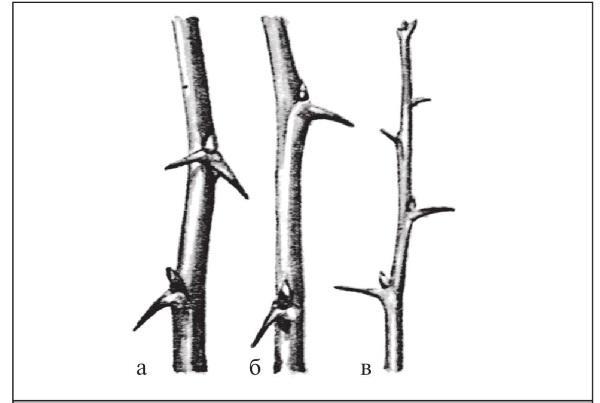
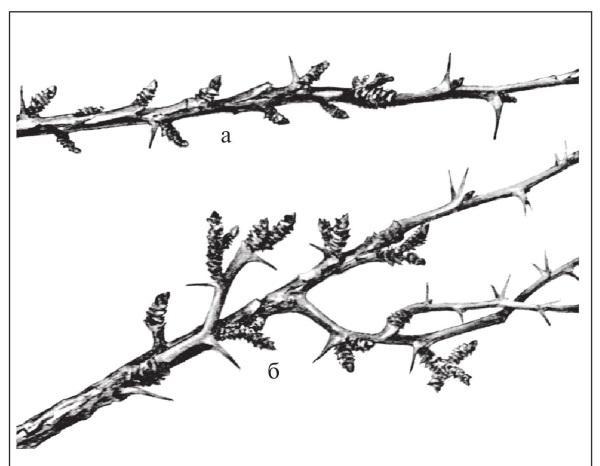
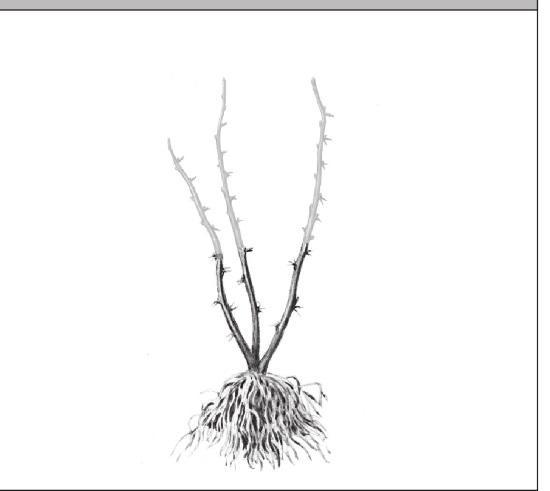
Proper bush training begins even before planting the nursery plants in the soil. Initial pruning helps balance the root system and the above-ground part of the nursery plant, stimulating the growth of strong skeletal branches.
- Before planting, perform pre-planting pruning of the nursery plant: on weak branches, shorten all ramifications to two buds; on strong ones, to four buds. Completely remove very weak ramifications ("to the collar").
- In the year following planting, select 3–5 of the strongest and best-positioned basal shoots from those that have emerged. Be sure to cut off the unripened ends of these branches.
- In subsequent years, leave new strong shoots annually, gradually increasing the total number of branches of different ages in the bush.
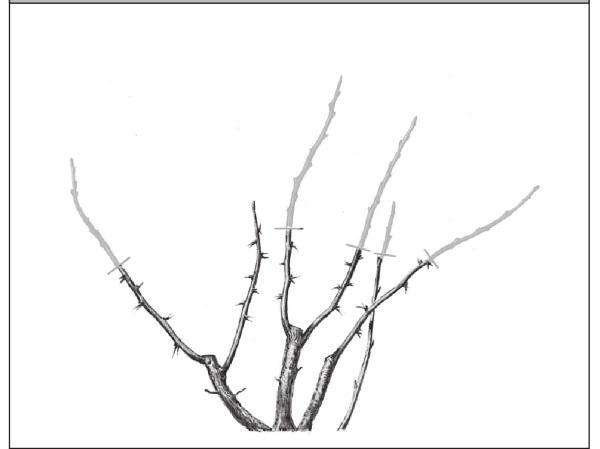
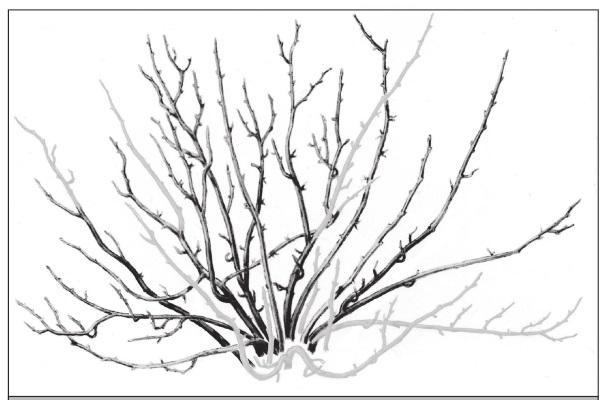
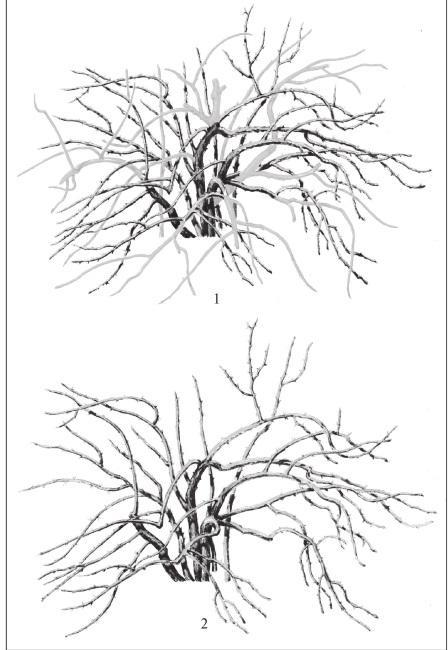
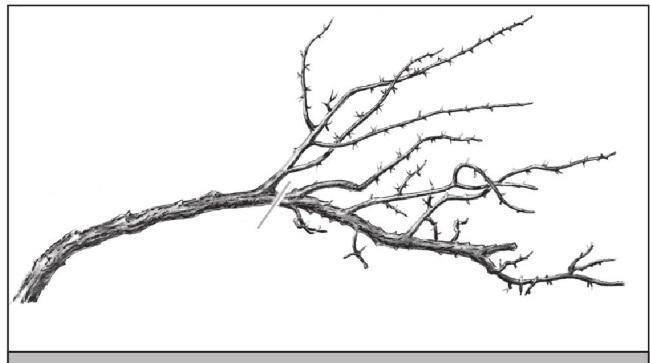
Adult, fruit-bearing bushes require annual sanitary and thinning pruning. This consists of removing excess basal shoots and cutting out broken, weak, overcrowding, and low-productivity branches. Due to the early decline in growth, gooseberry branches are periodically rejuvenated by cutting them back to a strong lateral branch. This same technique is used if the bush lacks basal shoots for replacement.
Gooseberries are extremely sensitive to a lack of light. If the bush becomes severely overcrowded, its growth ceases prematurely, the skeletal branches age quickly, and the overall productivity of the plantation drops sharply.
During annual pruning, be sure to shorten the ends of branches that have been damaged by winter frosts or affected by powdery mildew.
Features of growing and training gooseberries on a trellis
Gooseberries can be successfully grown on a wire trellis, similar to red and white currants. This method facilitates plant care and harvesting, and also ensures optimal canopy illumination. It is important to maintain proper planting density and correctly distribute the branches within the plane of the trellis.
- Productive lifespan of branches of European cultivars — up to 10–12 years
- Pruning ramifications on weak branches of the nursery plant — to 2 buds
- Pruning ramifications on strong branches of the nursery plant — to 4 buds
- Distance between bushes in a row on a trellis — 1–1.2 m
- Minimum number of branches per bush — 4 pcs.
To create a trellis culture, the bushes are planted at a certain distance from each other, directing their branches in a fan shape within the plane of the trellis. At the bottom, they can emerge from a single root. Having positioned the branches and tied them to the lower wire of the trellis, their further growth is directed vertically. Since lateral branches positioned at a wide angle to the center of the bush grow more slowly, central vertical shoots are shortened more severely to balance growth vigor.
With each shortening, ensure that a sufficient number of fruiting twigs are developing on the branches. The degree of pruning must strictly correspond to the varietal characteristics: take into account the bud break and shoot formation ability of the specific plant. Replace aging branches in a timely manner with new ones, using lower lateral offshoots at their bases or specifically kept basal shoots.
Read next
Pruning and training For gardeners
Specifics of pruning and forming red and white currant bushes
Pruning and training For gardeners
Fundamentals of canopy formation and pruning of sweet cherry in the orchard
Pruning and training For gardeners