
Peculiarities of growth and canopy formation of blackcurrant bushes
4 min read
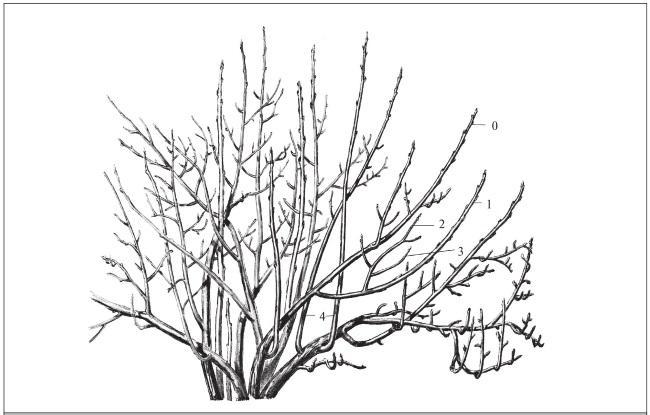
A blackcurrant bush consists of 12–15, and sometimes even 20–25, zero-order branches of different ages. In the first year, a zero-order shoot grows vigorously; in subsequent years, the growth rate slows down sharply, and by the fifth to seventh year, the branch increment is only 3–5 cm. The growth zone is located in the lower part of a zero-order branch. This is where the strongest first-order branches are formed.
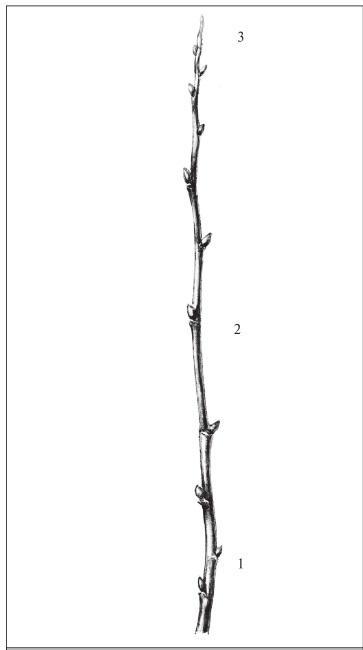
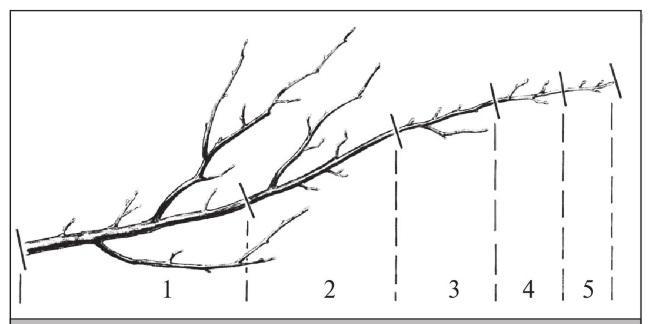
The growth vigor of branches decreases from the base to the apex across all branching orders. The growth and fruiting zone is located in the middle part; it bears vegetative buds and well-developed floral buds. The upper part of the branch is the fruiting zone. Most buds in this zone are floral. However, they are less developed than the solitary floral buds in the middle part of the branch.
The apical bud is generally vegetative. However, currants usually have a second wave of growth. The shoots that appear as a result do not ripen and are severely damaged by frost in winter. When growth at the base of zero-order branches weakens, strong water sprouts grow from dormant buds. The productive period of branches developed from water sprouts is much shorter than that of zero-order branches.
Currant cultivars differ significantly in bud burst and shoot-forming capacity. The floral buds of blackcurrant are vegetative-generative, and are located singly or in groups.
Black currant bears fruit on annual branches and spurs – generative branches of the short-shoot type. The most abundant and high-quality harvest is formed on first- and second-order branches that are 30–40 cm long. On shorter branches and those of higher branching orders, the yield is high, but berry quality is low.
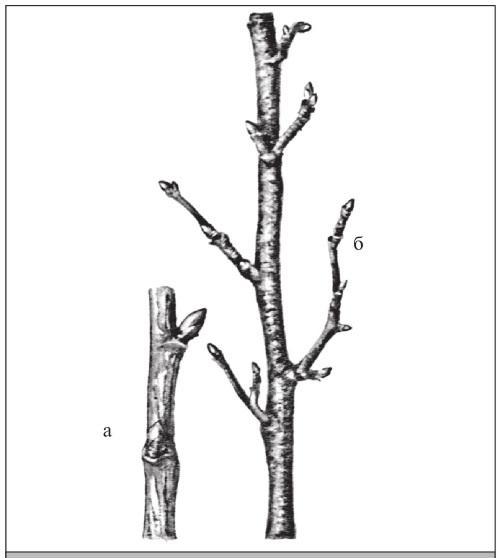
Fruit twigs of blackcurrant die off after one to three fruiting cycles. No more than 5% of the harvest is located on four-year-old spurs; five-year-old ones are practically non-existent.
Based on growth habit, blackcurrant cultivars are classified as vigorous (Pamyat Michurina, Belorusskaya sladkaya, Zelenaya dymka, Cherny zhemchug, Sozvezdie, Gulliver, Ksyusha, Bagira, Kipiana, etc.), medium-growing (Dushistaya, Nara, Bredthorpe (Karelskaya), etc.), and low-growing (Dachnitsa, Sofya, Yadrenaya). Based on branch spatial distribution: spreading (Bredthorpe (Karelskaya), Dikovinka, Pamyati Ravkina, Vologda, etc.), semi-spreading (Yadrenaya, Bagira, Vernost, Orloviya, Azhurnaya, etc.), and compact (Pamyat Michurina, Kompaktnaya, Dushistaya, Sofya, Lentyay, Selechenskaya, Nara, etc.).
Formation is aimed at creating a bush consisting of a number of different-aged branches that corresponds to the planting scheme, the care system, and the method of harvesting .
The more intensive the plantation, the fewer branches in an individual bush and the more bushes per unit area. In sparse plantings, 3–4 branches of the same age per bush are acceptable; in dense plantings, 1–2 are allowed.
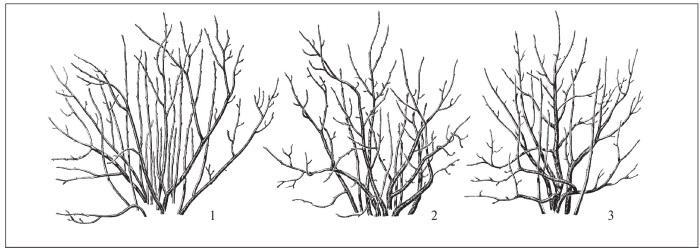
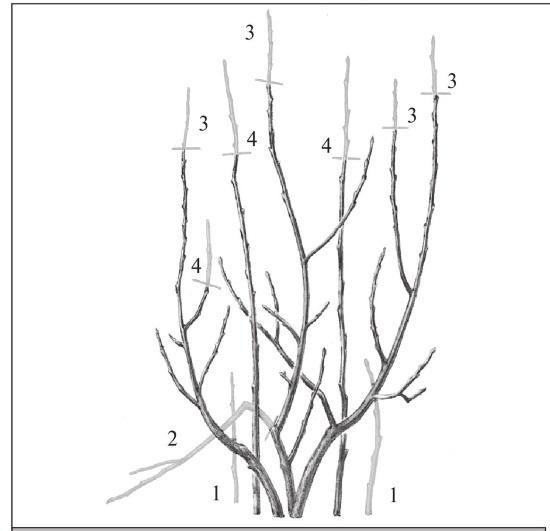
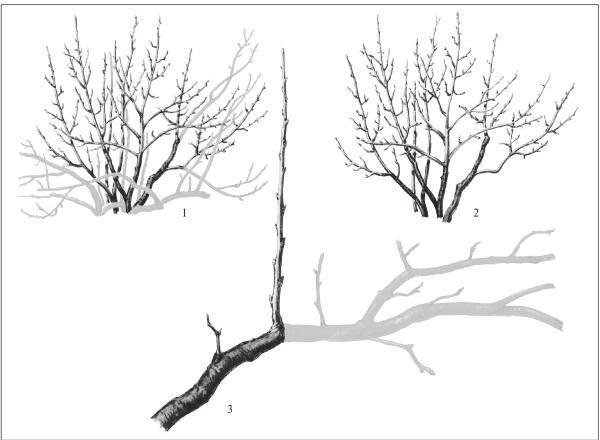
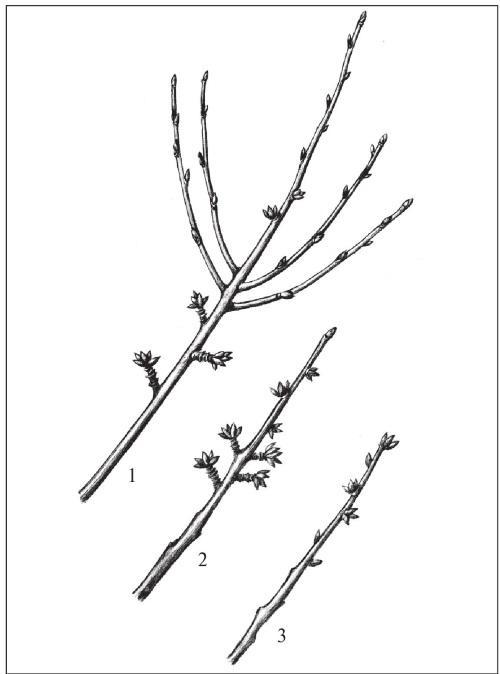
pruning of weak (1), overcrowding, and broken branches (2), unripened apices (3); pruning to stimulate branching (4).
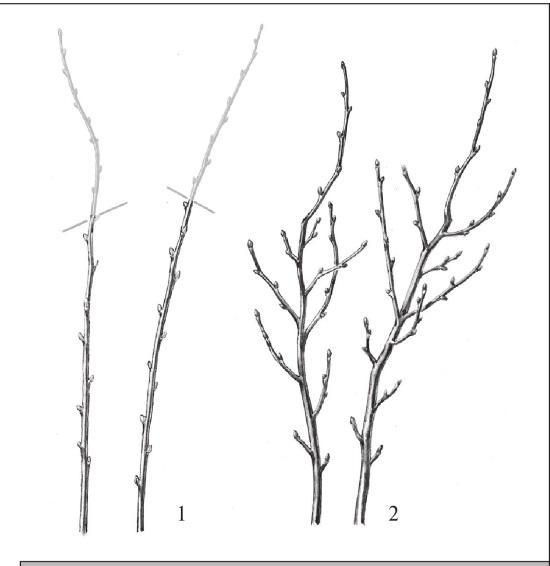
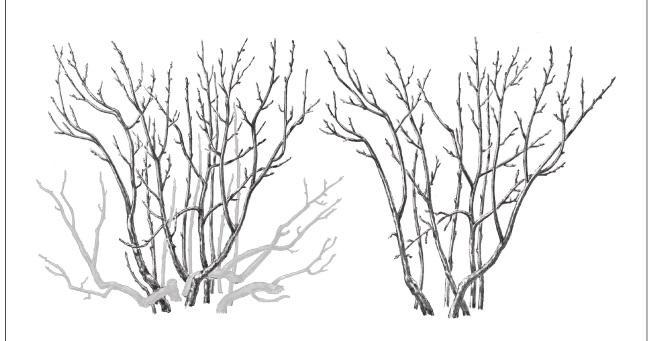
Correct pruning of blackcurrant directly determines the yield and longevity of the plantation. It stimulates the appearance of new zero-order shoots, enhances branching, increases the length of increments, and protects bushes from overcrowding. The main task of the agronomist is to timely replace aging, low-productivity branches with new shoots.
Blackcurrant does not require summer pruning. Prune branches strictly in late autumn or early spring.
Bush formation takes several years. To lay the productive foundation of the plant, carry out pruning sequentially. Correct actions at the start determine the future structure of the bush.
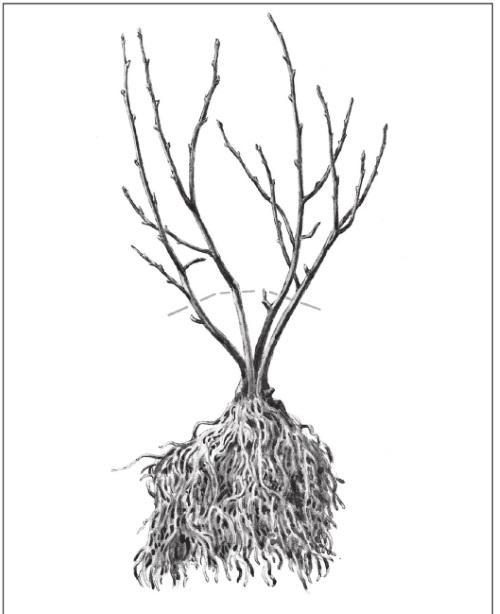
- Before planting, prune each branch of the nursery plant to well-developed buds.
- During the bush formation period (up to 4–5 years), leave the strongest and best-positioned zero-order branches annually.
- Cut out all weak, damaged, and overcrowding branches at soil level. Be sure to prune the unripened apices of the remaining branches.
- Shorten zero-order branches to stimulate branching. If a cultivar has poor shoot-forming capacity, shorten the branch by almost half.
If few zero-order shoots are formed, their emergence can be stimulated artificially. To do this, cut out one or two of the oldest branches of the bush.
Regular care and rejuvenation of bushes
On a well-formed bush, annual pruning is quick. An agronomist must timely remove old four-to-five-year-old branches, which lose their growth capacity and reduce the overall yield. During annual detailed sanitary pruning, it is also mandatory to remove all defective shoots.
- broken branches;
- diseased branches;
- withered branches;
- crowding branches;
- excess zero-order shoots.
Neglected plantings require different tactics. In such bushes, many old unproductive branches accumulate, and young shoots are predominantly of epicormic origin. Such plants need to be heavily thinned out by completely removing all old, low-productivity branches and unnecessary zero-order shoots.
On large commercial plantations, mechanized pruning shows excellent results. With this method, the entire above-ground part of the bushes is mowed at the soil level. This radical rejuvenation also allows for the effective cleaning of the plantation from accumulated pests and diseases.
- Bush formation period — 4–5 years
- Age of removed branches — 4–5 years
- Frequency of mechanical pruning — once every 5–6 years
- Yield recovery — in 2–3 years
| Pruning frequency | Yield recovery period |
|---|---|
| Once every 5–6 years | In 2–3 years |
Read next
Pruning and training For gardeners
Features of pruning and training gooseberry bushes of different cultivars
Pruning and training For gardeners
Training and pruning of plum trees considering the type of fruiting and cultivar
Pruning and training For gardeners