
Optimization of the light regime within the fruit tree canopy
3 min read
Light directly determines the canopy structure, leaf development, and photosynthetic efficiency of a fruit tree. Good illumination stimulates shoot growth, but without control, it quickly leads to overcrowding. Shaded branches inside the canopy begin to die off, causing the tree to temporarily self-thin, after which the cycle of rapid growth repeats. To break this circle, the agronomist must regulate the light regime through pruning.
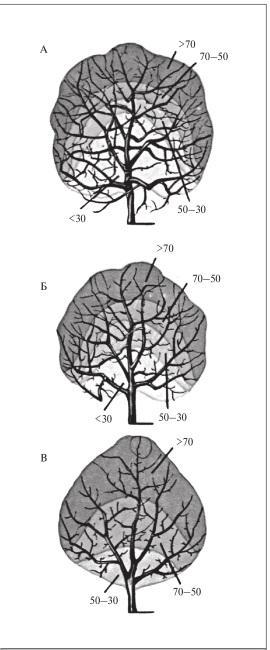
- Optimal leaf illumination — 70% of full sun
- Threshold for normal fruiting — 30% of full sun
- Minimum for shade leaf operation — 8–10% of full sun
- Thickness of the productive leaf canopy — 0.8–1.5 m
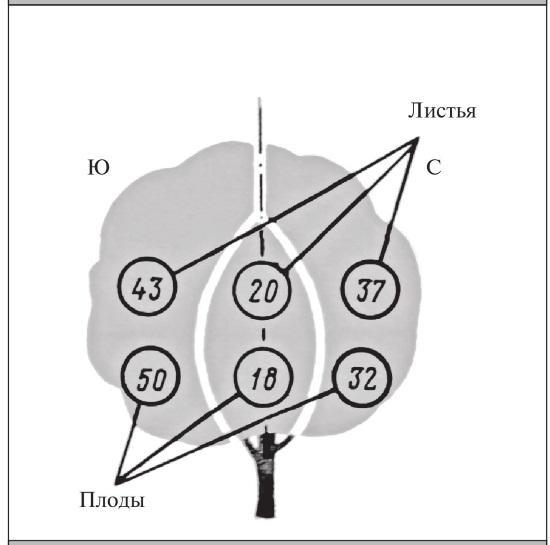
The unevenness of canopy illumination is noticeable even at a young age. The southern and eastern sides of the tree are better illuminated; therefore, by the age of 10, the length of their annual growth is almost 1.5 times that of the northern and western sides. 37% of leaves and 32% of fruits are formed on the south and east, while the center of the canopy gradually falls into shade. With age, this light regime deficit progresses: in 25–30-year-old trees, the empty, non-productive zone in the center can occupy from 20–30% to 50% of the total canopy volume.
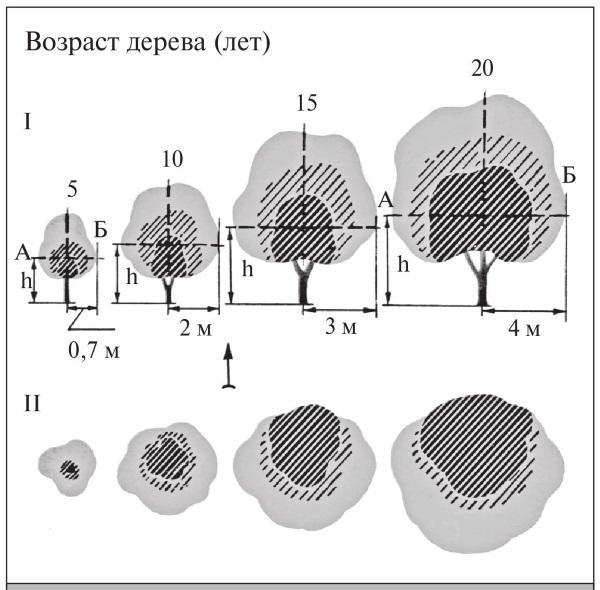
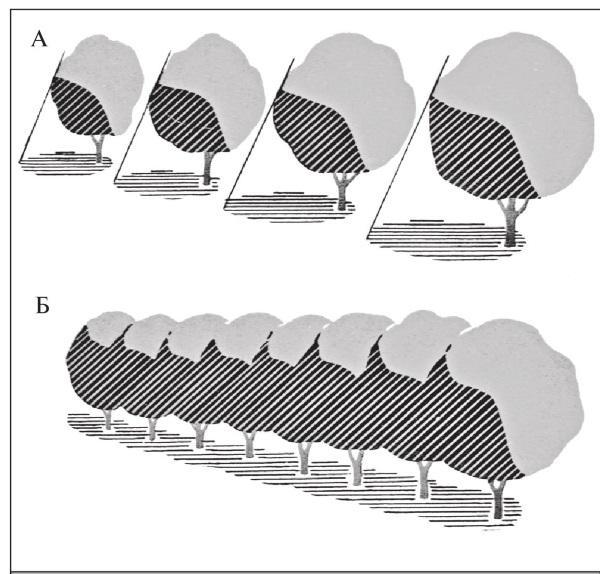
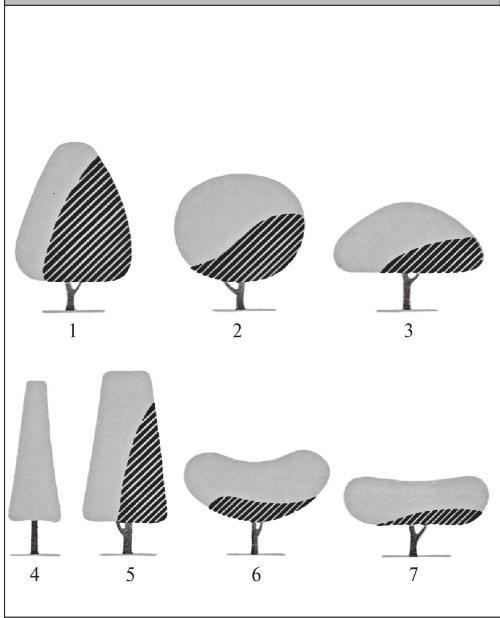
Influence of planting density and row structure on the light regime
The center of the canopy becomes bare especially quickly in overcrowded orchards without regular thinning. With planting schemes of 8 × 3 m or 8 × 2 m, the branches of adjacent trees close into a solid row. The active leaf canopy then operates only on the periphery to a depth of 1.5 m. The entire inner part of the 6–7-meter row is shaded and completely excluded from fruiting.
| Parameters of the non-productive zone in a solid row | Size, m |
|---|---|
| Width at the base | 3–4 |
| Height | from 1 to 4 |
Do not allow the illumination inside the canopy to drop below 30% of the full open area. In conditions of deep shading, photosynthesis is inhibited, and ripening fruits lose their cultivar qualities: they become smaller, deform, and fail to reach full color and sugar content.
Orienting rows from north to south ensures the most favorable illumination of the solid row canopy throughout the day and prevents excessive leaf overheating at noon.
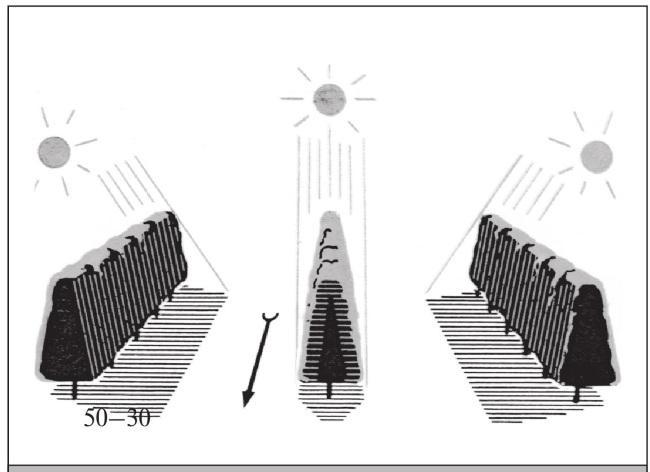
Vertically flattened canopies, such as a palmette or a living fruit wall, effectively solve the problem of sunlight shortage deep in the tree. The thinner the canopy, the more evenly light is distributed between the leaves and the ripening fruits. However, it is important to maintain a balance here. Excessive narrowing of the wall increases the area of empty inter-row spaces, which reduces the overall productivity of the orchard per hectare.
A fruit wall that is too narrow leads to a loss of yield per unit area due to inefficient use of inter-row space.
How to calculate canopy dimensions and row direction
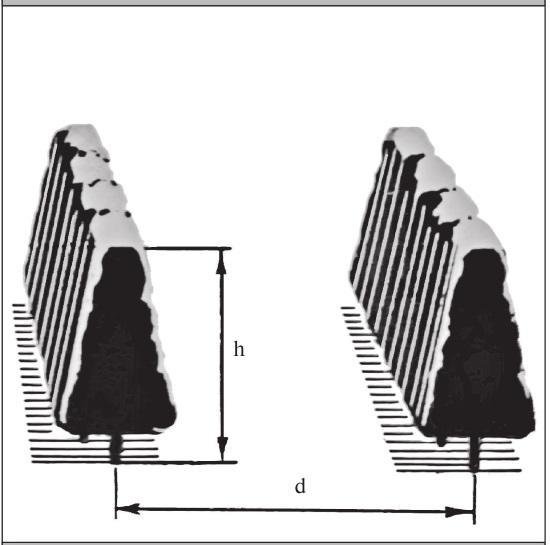
To avoid mutual shading of rows, it is necessary to strictly control tree dimensions and the width of technological passages. The leaf canopy in any projection should not exceed critical thickness, otherwise the center of the canopy will be in constant shade. When designing a planting scheme and conducting contour pruning, it is important to be guided by the calculated parameters of the light regime.
- Leaf canopy thickness — up to 1.5–2 m
- Ratio of inter-row to wall height — from 1:1 to 1.5:1
The optimal solution for uniform illumination is to orient rows from north to south. With this orientation, the canopy receives sufficient sun throughout the day. At the same time, the leaves and fruits are reliably protected from overheating during the hottest noon hours.
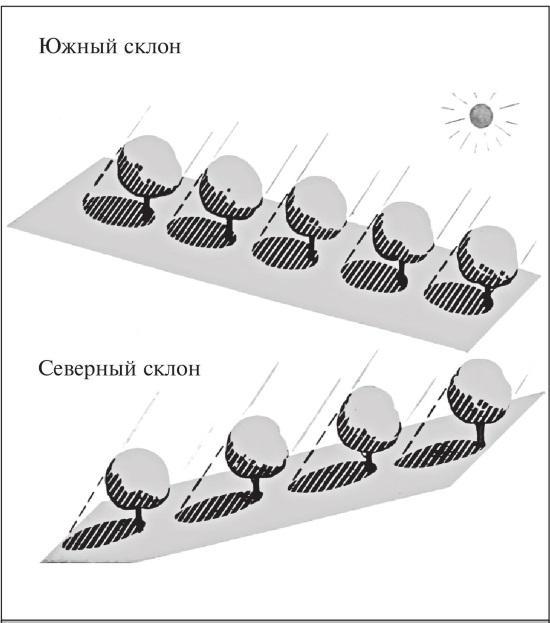
The relief of the plot also makes adjustments to standard calculations. On southern slopes, the distance between rows can be reduced without the risk of losing light. On northern slopes, row spacing must, conversely, be increased to protect neighboring trees from deep shading.
Read next
Pruning and training For gardeners
Limiting the height of fruit trees and methods for controlling water sprouts
Pruning and training For gardeners
Training and pruning of plum trees considering the type of fruiting and cultivar
Pruning and training For students