
Regulations for the application of Bordeaux mixture and the fungicide Kartotsid in plant protection
6 min read
Crop Application rate (kg/ha) Method and time of treatment Scab, anthracnose, bacterial Citrus 10-20 necrosis, fruit Spraying during the crops, mal secco rot; Downy mildew, ascochyta blight, solution. In private plots Cucumber, melon, watermelon 6-10 100 g (L) bacteriosis, olive SPOT sprayed with working Late blight, alternaria blight solution, prepared! mixture 100 g copper sulfate crops
Method of preparing the working solution. To prepare 10 L of a 1% Bordeaux mixture solution, dissolve copper sulfate in a small amount of water (temperature not exceeding 50°). Bring the solution volume to 9 L with cold water. In a separate container, slake 100 g of lime with a small amount of water and bring the lime milk to 1 L. While stirring the resulting copper sulfate solution, pour the lime milk in a thin stream. To obtain 10 L of a 3% Bordeaux mixture solution, prepare solutions of 300 g of copper sulfate and 400 g of lime in the same order. Do not prepare the solution in iron containers!
Application recommendations: ornamental and flower crops can be sprayed with a 1-3% working solution, others — with a 1% solution. Copper compounds are phytotoxic during periods of high air humidity, which must be taken into account when determining the timing of spraying.
Toxicological characteristics. Hazard class — IV. Waiting period: in greenhouses and hotbeds — three days. Side effects: after spraying with the working solution, spots remain on the leaves.
Standard packaging for private plots: 300 g bag. (100 g copper sulfate, 200 g calcium oxide). Produced by VNIICHSZR, August TPK, Technoesport
Kartotsid. SP A.i. — copper tricaprolactam dichloride monohydrate (500 g/kg). Intended, like other copper-based preparations, for controlling leaf spot diseases. TABLE 48. REGULATIONS FOR THE USE OF KARTOTSID PESTICIDES and AGROCHEMICALS List... 2001 Crop Application rate (kg/ha) Diseases Method and time of crops treatment Mal secco, anthracnose, scab, Spraying during the Citrus 18-24 (L) gray mold growing season 0.6% working solution, 1st spraying after two Tomato 40-60 g/ 10 L (L) weeks from emergence, subsequent ones at intervals of alternaria blight, 10-14 days bacterial SPOT. Cucumber 30-40 g/ 10 L (L) 1st spraying before flowering, subsequent ones!
Toxicological characteristics. Hazard class: III. Waiting period — 3-4 days. Treatment frequency: 3-4 times. Manufacturer: VNIICHSZR. Copper oxychloride (HOM). SP
A.i. — copper oxychloride (900 g/kg). Formula: [3Cu(OH)2CuCl2]. Light green powder, odorless; insoluble in water and organic solvents. Decomposes in an alkaline environment. The preparation contains an anti-evaporation agent.
Advantages. A widely used and well-proven agent for protecting crops from a complex of diseases. The preparation belongs to the group of copper compounds. It is more convenient to use due to the ease of preparing the working solution.
TABLE 49. REGULATIONS FOR THE USE OF HOM PESTICIDES and AGROCHEMICALS List... 2001 Method and time of treatment Tomatoes 2.4-3.2 40 g/10 L (L) plants 0.4% working cladosporiosis solution during the growing season and
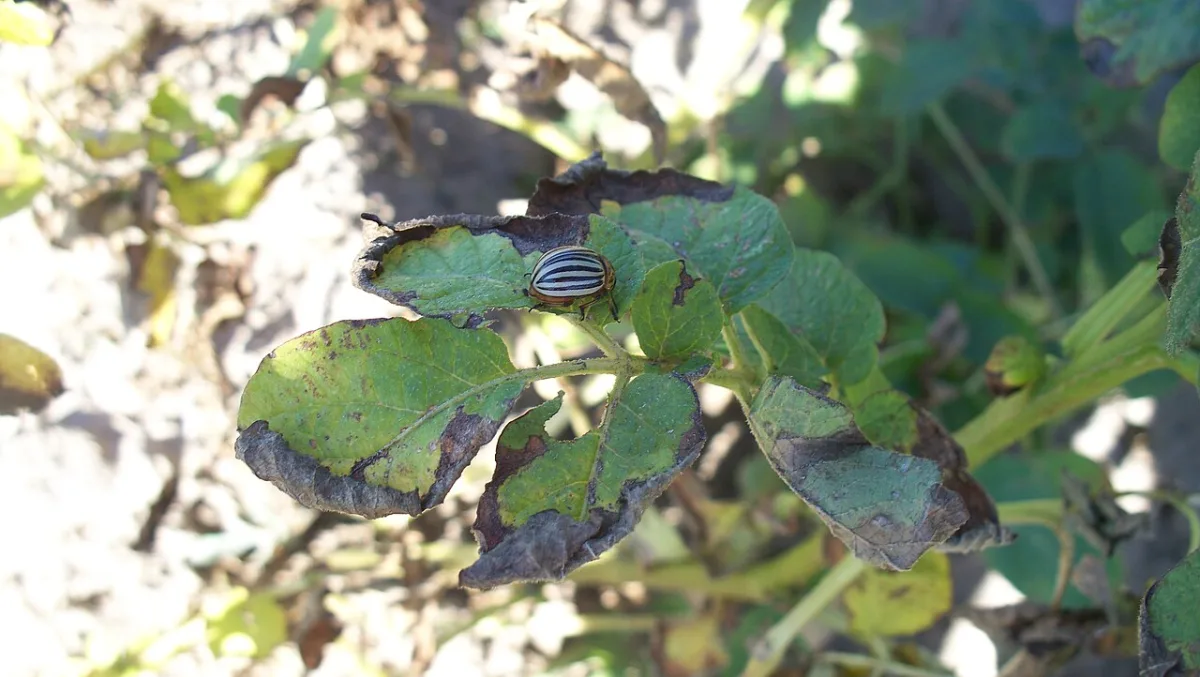
Action: contact. Being on the surface of the leaves, it protects against the penetration of disease pathogens. It is a proven agent for controlling late blight and alternaria blight of potatoes. Plants treated with copper oxychloride are less damaged by the Colorado potato beetle.
Application features: the working solution is prepared immediately before use at a rate of 40 g/10 L of water. The preparation does not adhere well to the plant surface, so treatments are repeated after rain.
Treatment frequency: tomato and cucumber 3-4 times, flower and ornamental crops — twice.
Side effects. After spraying with copper oxychloride, a net-like pattern or leaf burns may appear on the fruits of copper-sensitive cultivars.
A similar fungicide, Abiga-Peak, SC (400 g/L), is recommended for treating cucumbers and tomatoes in a 0.5% concentration. Hazard class — III. Manufacturer: VNIICHSZR.
A.i.: copper oxychloride (700 g/kg) + oxadixyl (100 g/kg).
Intended for controlling downy mildew of cucumbers, late blight, alternaria blight, septoria blight, and bacterial spot of tomatoes.
Characteristics of the active ingredient. Copper oxychloride belongs to the group of fixed copper preparations and has a contact action; oxadixyl belongs to the oxazolidinone group and is a systemic preparation. Oxadixyl is a solid crystalline substance, melting point 104-105°, non-volatile, relatively well soluble in water, stable during storage in light and in aqueous compositions, and decomposes slowly in the soil. At room temperature in solutions with pH 5, 7, and 9, the half-life is four years. Oxadixyl is compatible with other pesticides used during the growing season.
Oxyhom and oxadixyl are effective preparations for protecting crops from a complex of diseases. Oxyhom possesses preventive, curative, and eradicative contact-systemic action. Copper oxychloride in its composition suppresses enzymatic processes and destroys pathogen cells on the surface. Oxadixyl rapidly penetrates the leaves, is distributed with plant sap, and blocks the synthesis of nucleic acids in fungi.
The preparation practically does not evaporate from the leaf surface and is transported by the vascular system both upwards and downwards, penetrating into all tissues. Due to this, oxadixyl is almost completely redistributed from the treated parts into young shoots. In terms of efficacy against tomato late blight, it is equal to metalaxyl, but inferior to it in controlling cucumber damping-off. The risk of phytotoxicity for oxadixyl is minimal and manifests only at excessive application rates.
- Duration of protective action in the plant — up to 15 days
- Remains at the application site — 94% of the active ingredient
- Persistence of activity in the soil — up to 20 weeks
- Maximum number of applications — 3
- Interval between treatments — no more than 10–12 days
Application regulations and resistance prevention
Oxyhom is used for spraying crops at the initial stage of disease development. To ensure maximum effect, it is important to strictly observe the intervals between treatments. Since oxadixyl is analogous to metalaxyl in its mechanism of action, cross-resistance may occur in phytopathogens. To prevent this phenomenon, chemical treatments must be alternated.
- alternate treatments with contact fungicides;
- use combined preparations in which oxadixyl exhibits a synergistic effect.
The waiting period for cucumbers and tomatoes in greenhouse conditions is from 3 days, for grapes — up to 20 days. The preparation is hazardous to bees, therefore treatments during flowering are completely excluded. Also, prevent the working solution from entering water bodies. After spraying, spots may remain on the leaves, and the leaf blade becomes coarser.
For warm-blooded livestock animals, oxadixyl is low-toxic, does not irritate mucous membranes, and is excreted from the body naturally. It is also safe for poultry, and its degradation products are firmly bound by the soil adsorption complex.
| Indicator | Value |
|---|---|
| Hazard class | III |
| Waiting period | 3–4 days |
Read next
Plant protection For agronomists
Regulations for the application of Rovral and Kemicar fungicides in plant protection
Plant protection For agronomists
Application of biological products Baktofit and Alirin-B for plant protection of crops
Plant protection For agronomists