
Plant protection of cabbage crops against black rot and bacterial soft rot
7 min read
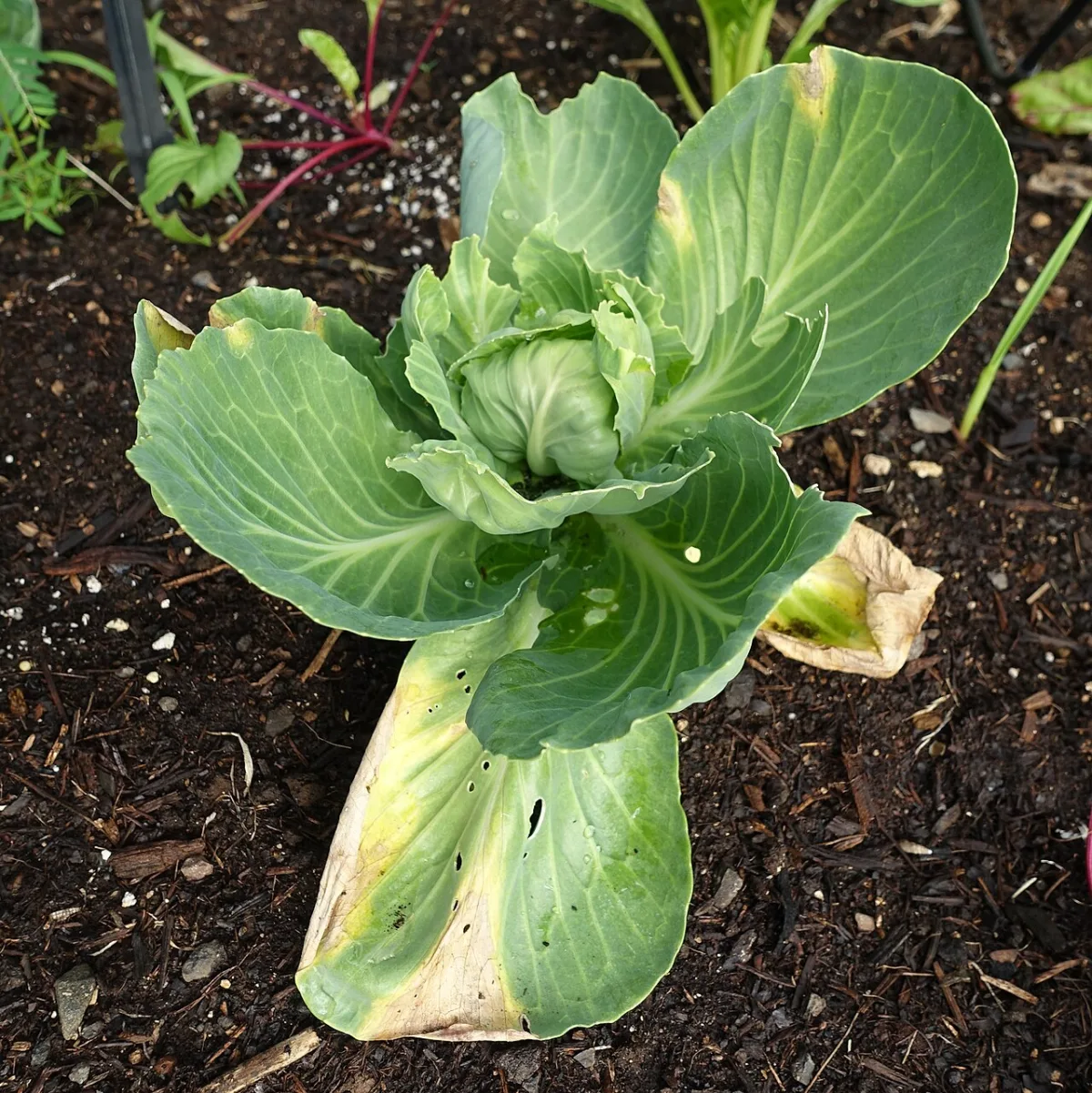
Black rot of brassicas: protection during the growing season
Black rot is insidious because in cool weather, infected plants may look perfectly healthy. The disease appears suddenly as the temperature rises. The most favorable conditions for infection occur during warm days and cool nights, when guttation droplets form on the leaf margins, through which bacteria easily penetrate the tissues.
In the field, the pathogen spreads rapidly via gusts of wind and raindrops, during irrigation, cultivation, and is also transmitted by pests and slugs. The infection persists on seeds, but its main source remains plant residues. Weeds of the cruciferous family also serve as reservoirs for bacteria:
- Virginia pepperweed;
- wild radish;
- black mustard;
- Stinkweed;
- wintercress.
The causative agent of black rot persists in plant residues for up to two years. Compliance with crop rotation excluding cruciferous crops is a mandatory condition for clearing the field of infection.
- Application rate of Phitolavin-300 for seeds — 5 g/kg
- Application rate of Planriz for seeds — 20 ml/kg
- Concentration of Phitolavin-300 for roots — 0.2%
- Application rate of Planriz for spraying — 0.3 l/ha
Protective measures are started before planting seedlings in the field and continued throughout the entire growing season. To suppress the pathogen, it is important to use clean seed material and strictly follow the technological chain of treatments with biological products. This allows for a significant reduction in the infection load on crops.
- Treat seeds with Phitolavin-300 or Planriz.
- Before planting seedlings, dip the root system in a clay-mullein slurry with the addition of 0.2% Phitolavin-300.
- Upon the appearance of the first symptoms in the field, spray the crops with a 0.1% Planriz solution with the addition of a surfactant.
- In parallel, carry out a full complex of treatments against pests and slugs that transmit the infection.
Bacterial soft rot: control of wet rot in the field and storage
Bacterial soft rot, or wet bacterial rot, affects almost all vegetable crops at all growth stages. The disease is caused by bacteria Erwinia carotovora subsp. carotovora and Pseudomonas sp., which affect over 100 plant species, including tomato and cucumber. The rot is most acute in the second half of the growing season, as well as during transport and storage of cabbage in high-temperature conditions.
Infection occurs through damaged tissues, especially after prolonged rains at a temperature of 25–30 °C. A water film on plants for several days is an ideal environment for the activity of Pseudomonas bacteria, followed by Erwinia carotovora entering the affected tissues. The risk of infection increases sharply on weakened, frost-bitten, or over-fertilized nitrogen plants, as well as during mechanical damage during cultivation, harvesting, and transport.
Excessive nitrogen nutrition makes cabbage tissues loose and susceptible to pathogens. Control nitrogen doses and prevent damage to heads during harvesting.
Pests often act as carriers of wet rot. Bacterial soft rot can also develop as a secondary infection following black rot. Sources of infection include plant residues, the rhizosphere of weeds and crops, as well as irrigation water from open reservoirs. The following play an active role in the spread of the disease:
- cabbage root fly;
- small white and large white butterflies;
- pollen beetle;
- diamondback moth;
- slugs.
At the first signs of the disease, the crops are sprayed with Planriz at an application rate of 0.3 l/ha. To prevent harvest losses in the winter period, it is necessary to pay special attention to the preparation of warehouses and the selection of cultivars. An integrated approach will preserve the quality of the heads until spring.
- Thoroughly clean storage facilities of plant residues and carry out disinfection before stocking vegetables.
- Maintain an optimal temperature regime for food cabbage at the level of 0–1 °C.
- For long-term storage, use late-maturing F1 white cabbage hybrids resistant to wet rot: Amtrak, Bartolo, Galaxi, Lennox, Albatros, Lezhkiy, Monarch.
Symptoms. White cabbage and cauliflower are susceptible to this disease. Spots can occur on both old and young leaves, including the outer leaves of the cabbage head.
At first, many small, depressed, translucent spots appear on the leaves. They grow into round or angular spots up to 5 mm in diameter, their color varies from yellowish-white to brown or black. A translucent zone is visible around the spots.
Old leaves may have tiny spots scattered over large areas of the leaf surface, which do not increase in size. In many cases, the centers of old lesions fall out, resulting in a shot-hole appearance of the leaves. Symptoms manifest mainly in the interveinal zone, although dark stripes often run along the veins and can cause the destruction of small veins. Damage at the leaf margins often leads to symptoms similar to those observed with tip burn, causing the leaves to gradually become tattered.
Biology of the pathogen. Bacteria require water droplets to penetrate leaves through stomata. Therefore, the highest level of damage is observed during periods with prolonged rains and heavy dew. The disease often manifests at low temperatures in autumn, although the pathogen can infect within a wider temperature range.
The pathogen persists on plant debris. Sources of infection can be seed.
Protection measures for this disease have not yet been developed, although it is suggested to plant in well-drained soil and ensure that foliage remains dry whenever possible. Seed treatment with thiram to prevent seed transmission of the infection. Steaming or disinfection of the soil with Basamid granules. 2.5.2.4. Bacterial leaf spot of cabbage
The pathogen is Pseudomonas syringae pv. maculicola (McCulloch) Young et al.
Harmfulness. The disease is primarily found on cauliflower.
Symptoms. Spots are visible on the leaves, appearing initially as small water-soaked dots. After some time, these dots turn into dark brown or purple spots surrounded by a translucent halo. Individual spots, usually slightly sunken, reach 3 mm in size. Merging with each other, the spots form damaged areas of irregular shape, which give the leaf a wrinkled or rough appearance. In severely affected plants, leaves turn yellow and fall off. Small grayish-brown spots form on cauliflower inflorescences. Under microscopy, it can be seen that not only epidermal but also parenchyma cells die. Accompanying pathogenic microorganisms often cause soft rot. Bacterial leaf spot also appears on stems and leaf petioles.
Biology of the pathogen. The bacteria are Gram-negative rods with lophotrichous flagella. The pathogen enters the plant through wounds and stomata. It persists in the soil and on post-harvest plant residues for at least a year and can be transmitted via seed. It spreads through the air, by heavy rains, and irrigation water. Insects can also act as vectors for the pathogen. The disease is most acute in cool, humid weather. The distribution is widespread.
Protection measures. There are three rules for controlling the disease:
- choose sites free from the pathogen for cultivation;
- correctly place crops in crop rotation, returning to the infested site no earlier than one year later.
If symptoms of the disease were noted previously during the cultivation of transplants, the soil should be sterilized before planting new crops.
To combat bacterial leaf spot, the same agents recommended for protecting the crop from black rot should be used.
2.5.3. Mycoses
2.5.3.1. Clubroot of cabbage
The pathogen is Plasmodiophora brassicae Wor.
Read next
Plant protection For agronomists
Diseases of lettuce and celery in a greenhouse and methods of control
Plant protection For agronomists
Clubroot of brassica crops: symptoms, biology of development, and harmfulness
Plant protection For agronomists