
Caring for greenhouse tomatoes in late summer and disease protection
14 min read
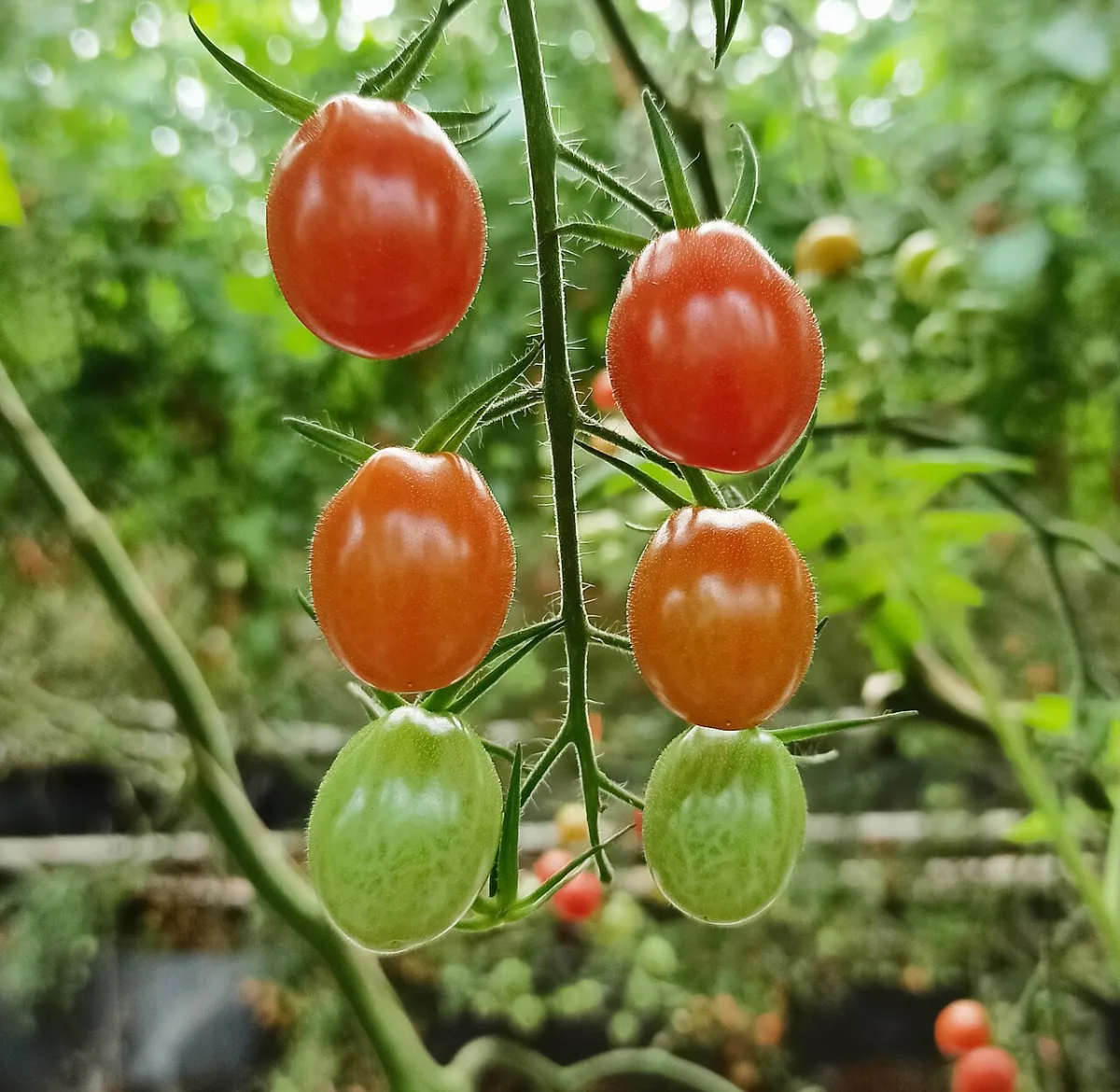
Why exactly should all the foliage be stripped in the second half of August, given that the plant seems to have plenty of time left, about a month?
A tomato fruit set grows for 40–50 days, and in theory, another batch of tomatoes could ripen during September and October, but in practice, this does not happen. The culprit is the cold nights, which cause the fruit sets to ripen slowly rather than grow. In fact, from the beginning of September, we are simply allowing what the bush has already produced to ripen and are creating better conditions for this process.
On bushes stripped of leaves, fruits are less prone to disease. Without leaves, the air becomes drier and the atmosphere healthier. Sun exposure is, one might say, ideal, which makes the fruits firmer.
At this time, plants require almost no irrigation, and they slowly transfer stored moisture and nutrients from their knotty, rigid stems into the fruits. Throughout the autumn, the fruits still continue to grow slightly.
And what should be done with the collected foliage?
- The collected foliage should be taken in a bucket to a bonfire site or to the compost heap each time.
- The idea that it is a source of disease is nonsense, so it could be used as mulch for various trees and shrubs or, along with suckers, put into the production of herbal fertilizer.
- Suckers contain a lot of nitrogen; this is a valuable raw material for summer production of "stinky" liquid fertilizer.
Aging leaves have little nitrogen or anything else, but after undergoing fermentation in a container of water along with the suckers, they increase the amount of fiber — mulch that can be used immediately.
Conclusion: note that the purpose of leaf stripping is not at all to "redistribute the plant's energy in favor of the fruits." However, there is another technique for redistributing energy in favor of ripening fruits, which is carried out in August: pinching of growing points, or the tops of shoots, along with the last inflorescences and small fruit sets.
In gardening, it is impossible to avoid the topic of pests and diseases. One could say that pests and diseases rule the roost here, and that they are the true masters, while all these self-confident "experts" are mere boasters. And only the gardener who feels easy and calm regarding this topic is worth anything. How can one gain such confidence, such amazing, seemingly miraculous abilities to protect one's plantings from devastating infestations?
Preventing a disease is more difficult than treating it because prevention requires deeper knowledge.
It is more correct to prevent plant diseases and pest infestations, or at least to try to learn how to do exactly that.
A paradox: proponents of "chemicals" in the fight against pests and plant diseases all, to a man, consider themselves the most educated part of the growers. I know from experience that people use "chemicals" only in two cases: either they don't care about anything anymore (cynics), or they lack knowledge (superficially educated).
And is it possible to acquire the necessary knowledge quickly, within the limits of a book and experience?
Let’s start with the fact that it is illegitimate to compare the human organism with a plant: yes, human diseases are treatable, but few people know that in most cases, it is already useless to treat a plant. If it has become diseased — it's the end, you won't turn it back. Plants have a different life mechanism; they were evolutionarily created differently, they are simpler, and they compensate for this with a mass of seed.
Theoretically, this can be disputed and various examples can be cited, but in practice, how many plant diseases have you actually defeated? All you could do was preserve the disease for a short time. Yet, all the toxic chemicals used have already entered you and your soil.
Industrial plant growing operates on the principle of "drenching absolutely everything with toxic chemicals and creating the appearance that there are no diseases." Do you know about this? No, you believe that after these treatments, the disease is gone. But it is simply preserved. At what a high price such vegetables are obtained! This is a wrong strategy, although the tactics look impeccable: the products are inexpensive and act quickly, in the sense that they kill microbes. It turns out that the internal structure of the plant is already destroyed, but you have killed all the microbes and, by appearances, the decay has stopped. You can temporarily preserve the fruits this way, delivering them to the consumer, but it is already impossible to make the plant itself develop normally.
People are mistaken in thinking that "a little bit" of pesticide is not dangerous, so it is fine to spray with a recommended store-bought product in case of a pest, as nothing terrible will happen. The fact is that "a little bit" of various harmful additives has already been introduced by every single manufacturer into literally everything we buy as food products. In total, this is already a lot. Leave these fairy tales about "a little bit" for the most naive. There is a reality: the last drop that separates you from your own illness (poisoning of the body). You should at least get your own vegetables and fruits completely environmentally friendly.
An outbreak of disease, a pest… It is a shock every time! I understand perfectly well. It is very difficult to maintain common sense when in shock. This is where the most acute contradictions and disputes begin, as late blight (the most dangerous and common disease of tomatoes) is looming menacingly ahead. There are countless opinions and theories about it. I would like to avoid empty disputes, because the matter boils down to nothing more than skill — whether someone knows how to grow without it or not.
What is the point of arguing for people with different skills! If one person can overcome late blight only with the help of copper-containing preparations, and another can avoid late blight without them by eliminating the causes of its appearance, then what is the point of arguing heatedly here? They have unequal interests. If the first one has enough common sense to change their habitual agrotechnics — good, and if not — then so be it. After all, it is useless to try to convince a frightened person.
What agrotechnics helps to avoid late blight? I will start the story with a list of my requirements for plantings, which I initially apply to everything, from the layout of the plot to the greenhouse:
- ease of maintenance;
- speed of maintenance;
- fruit taste (selection of cultivars with the best taste);
- above-average productivity (up to record yields);
- environmental friendliness;
- aesthetics;
- cost-effectiveness (low cost).
Note, by the way, that fruit size is not in the list. That is, there is no task to get the largest possible fruits for all crops, as in some cases size comes at the expense of taste. Although, of course, in the case of greenhouse tomatoes, melons, and watermelons, large fruits are more often tastier than small ones, which is better achieved by fruit set regulation rather than by top dressing.
For me, the listed requirements are equal in importance, regardless of their sequence in this list. The layout of all plantings is subordinated simultaneously to all these requirements. For example, when the garden is very large, then to comply with the requirement for speed of cultivation, you switch to simplification: now you sow each crop in a line, in one long row with 60–70 cm between crops. And without any raised beds, on a flat surface.
The same approach can be applied if your plot is small but located far from home and you spend many hours on the road: you need an extremely simple single-row garden. Someone will say it is primitive, but in the end, you will be able to take care of it very quickly and get select large fruits, and as a result — a record yield compared to the experts of complex agrotechnics who lose all their time on painstaking manual labor.
Aesthetics is not just a desirable interspersing of summer flowers like the amazing purslane everywhere. The garden should give the impression of perfection and neatness. And this is largely achieved by the absence of weeds on all paths, not to mention the beds and rows themselves. This is a factor of a good mood on the plot.
Weeds, on the other hand, give the impression of sloppiness and neglect; it is an invisible leakage of microelements into their seeds. Such are often the gardens of "experts" who engage in endless conversations about the "great complexity" of growing each crop. "Simplicity, cleanliness, beauty!" — this is our worthy answer.
Environmental friendliness — let us try not to end up with the following dilemma. You bought a greenhouse, let's say, for 15,000 rubles. Our cost-effectiveness has already frowned with dissatisfaction. It expects that you will get products for this amount at market value, if not in the first, then in the second season. You, of course, will cautiously note that this is unlikely for now, but the grown products will be environmentally friendly, which cannot be found anywhere in the entire trading space. No nitrates, no pesticides. And then it will immediately calm down, saying, well, that's okay, we are in the black, this is an expensive product.
However, if in the coming season the entire ripening harvest of tomatoes is hit by late blight, the cost-effectiveness will spark with a mega-discharge. And from now on, you and your family will be eating copper sulfate. And why not, most people spray their tomatoes with it, most people eat it. Bordeaux mixture consists of copper sulfate. Preparations under other names for tomato diseases also contain copper.
Here is the dilemma. So, dear "experts," there is no need to reinvent the wheel: the harmful effects of copper-containing preparations have been known for a very long time. In trace amounts, copper is necessary for our bodies, just as it is for plants, but in large quantities, it acts as a poison. Today, grapes, potatoes, tomatoes, apples, and others are mercilessly sprayed with copper. They are treated multiple times per season, and it is found in excess in all vegetables and fruits. So much for trace amounts!
In soil, whether in a rose garden or a greenhouse, copper accumulates, and soil scientists know this better than anyone. For this reason, about twenty years ago, I set myself the task of finding an eco-friendly way to grow tomatoes without late blight, and to do it reliably. I tested many methods. Both the methods suggested by gardening magazines and those I invented myself.
Some of them already yielded good results.
For example, I tried the following methods:
- planting tomato bushes "on a raft" made of elderberry branches;
- mixing the soil with an anthill of red wood ants (material was collected in autumn or early spring, before the ants emerged from the ground).
Now, however, I use a more reliable method of growing tomatoes in bags. They grow quickly and do not get sick. In my opinion, this is an excellent method for a greenhouse. So far, there hasn't been a single failure. The bags stand on dry tiles or on a concrete floor; the greenhouse creates the feeling of an orangery. I will tell you more about this method below.
Let us summarize for now. Whether or not to use pesticides for plant protection of tomatoes is everyone's personal business.
You can buy such a preparation and dilute it according to the instructions on the package without my help; there is no shortage of such guides on growing tomatoes. Every agricultural university graduate will repeat the content of these instructions for you, explaining, as if to a child, in what proportions you should dilute Bordeaux mixture. And almost every participant in tomato forums will confidently repeat the same thing to you. But here I only talk about eco-friendly ways to prevent the main tomato diseases, as well as the main pests of all our crops in the greenhouse.
I will note in passing that today I do not read any plant grower forums on the Internet. Their discussions are uninteresting. I long ago found the solutions to the issues over which they are still breaking spears. All my solutions are absolutely eco-friendly.
The use of "chemicals," pesticides, and other preparations immediately tells me that a grower's level is shallow. Do not be surprised; even an agronomy professor does not always know how to protect plants from stress, so how can some engineer achieve this, who speaks proudly about their victory over diseases using preparations, while continuously growing tomatoes without crop rotation in the same greenhouse.
So, according to my observations, late blight is most provoked in rainy weather or during frequent irrigation by the excess mucus of earth worms.
Attention. It is precisely the large worms, gathering in large numbers under the tomato bushes, that poison them with their mucus, and any poisoned organism becomes susceptible to infection — this is a law of biology. A poisoned organism will soon fall ill with something infectious; as a rule, this is a fungal disease .
Just as every plant carries its own set of various compounds, unlike any other, which are sometimes poisonous to individual plants (species incompatibility), the same applies to the animal world. It would be informative to know in detail the composition of this worm's mucus. It is known to consist of various highly active biochemicals, some of which act as an antiseptic. There are some of these substances that tomatoes simply cannot tolerate.
Why does this happen specifically with tomatoes? I can only assume that in their homeland, on islands of volcanic origin, there are no native earthworms, and the tomato, as an endemic species, is not adapted to them.
And here is what happens as a result. In summer, during heat and drought, when the surrounding soil becomes dry, earthworms begin to migrate to a damp place — to where the owner regularly irrigates something. And usually, one of these places is the greenhouse. At the very least, worms always inhabit its edge, by the gutter from the dome.
I would like to say that sooner or later, worms congregate where the plot owner waters the most; they find such places by the scent of decaying plant residues on the soil surface, which they feed on. For a worm, food consists only of plant residues softened by water. They know and catch the scent of food perfectly well and are capable of crawling many meters across the surface at night.
It turns out to be a kind of coincidence: if the greenhouse is not watered, the tomato plants laden with fruits really have less chance of catching late blight there, but this is not due to the harm of humidity in the air, but due to the absence of worm congregation.
For a long time, the opinion has been established in literature that late blight is caused by dampness and that tomatoes should be watered less, and if watered at all, then in sparse pits, at a significant distance from the plant, so that the main surface of the soil always remains dry.
Tomato plants are generally susceptible to late blight only when they have fruit. As long as there is no fruit, with the exception of the first small fruit sets, our tomatoes usually do not get sick even with abundant irrigation.
When growing in bags, tomatoes can be watered as much as you like, even with cold water straight from a hose; they do not get sick from anything.
I want to warn those who immediately perceived the message about worms negatively, remembering their usefulness: in our garden, only tomatoes are naturally vulnerable, while other crops treat them calmly.
Airtight plastic bags make it possible to cut off the soil from earthworms. At the same time, the soil warms up better in the bags. Furthermore, in them, you can create a large supply of water according to irrigation rates (up to 3–6 l per adult plant on a sunny day). Taken together, the environment for tomato roots becomes more favorable than with traditional cultivation. A threefold improvement yields results in terms of harvest and protection against all diseases.
When people immediately object to me that filling bags with soil every spring is too labor-intensive, I answer that, in my opinion, something else is labor-intensive.
Spending the entire spring caring for transplants, then spending the whole summer opening and closing greenhouse doors, watering the tomatoes, tying them up, pruning suckers, and then suddenly losing the entire harvest to late blight — that, in my opinion, is what is truly labor-intensive.
That is when it is a great pity to waste the effort and time! But filling the bags in the autumn, one bag a day — that is not so difficult. Soil from used bags goes either to composting, or as fresh bedding for poultry, or is dumped in the same greenhouse for digging with fertilizer. It is easy to restore it. Everyone chooses the technology that is convenient for them.
Preparing the bags:
- New bags with fresh soil are best prepared from autumn so that they freeze properly in the greenhouse. Earthworms cannot tolerate such overwintering.
- When filling the bags in spring, the soil should be thoroughly sorted through, mixing in fertilizers, and large worms should be removed. Small worms are not a threat; they do not impact the situation.
- It is better to use black garbage bags, which hold 5–6 buckets of soil each.
This method has been tested by the weight of a heavy harvest, high air humidity, and a small volume of soil — it withstands everything. Even ridicule.
When we talk about diseases in the greenhouse, we cannot fail to mention the topic of crop rotation. It is difficult for some gardeners to grasp that one cannot grow a single crop year after year, continuously, in the same place.
At most, one can allow a repeat planting for two years more or less without consequences, but even then — why?
After I find out that an owner is planting tomatoes here year after year, I immediately lose enthusiasm regarding their greenhouse: any advice is then like poultices for the dead to them. I feel awkward in front of them: they believe in my advice, but it knowingly cannot overcome the harm of the toxic substances accumulated in the soil, which are poisoning their plants.
Growing tomatoes in bags and protection against seasonal infections
Growing tomatoes in bags allows for effective protection of plants not only from late blight but also from most other major diseases of the crop. This technique shows excellent results when observing standard, more or less conscientious agricultural practices. An isolated root zone helps reduce the infectious load on the bushes. However, even this method of protection does not give a one hundred percent guarantee for several years ahead.
Last year's successful experience does not guarantee the protection of the harvest in the current season. If you managed to obtain tomatoes without losses using a certain technology, the same scheme may fail the following year due to changing climatic factors.
The development of pathogens largely depends on seasonal conditions. Each disease becomes active in the year whose weather is most favorable for its spread. Because of this, the vegetable grower is always at risk of a sudden outbreak of infection. To minimize risks, the agronomist must flexibly adjust the care and plant protection scheme, taking into account the current situation in the greenhouse.
Read next
Greenhouses and covers For gardeners
Classification of hotbeds and modern methods of their heating in agriculture

Greenhouses and covers For gardeners
Construction and operation of efficient greenhouses for a home garden
Greenhouses and covers For agronomists