
Classification of hotbeds and modern methods of their heating in agriculture
7 min read
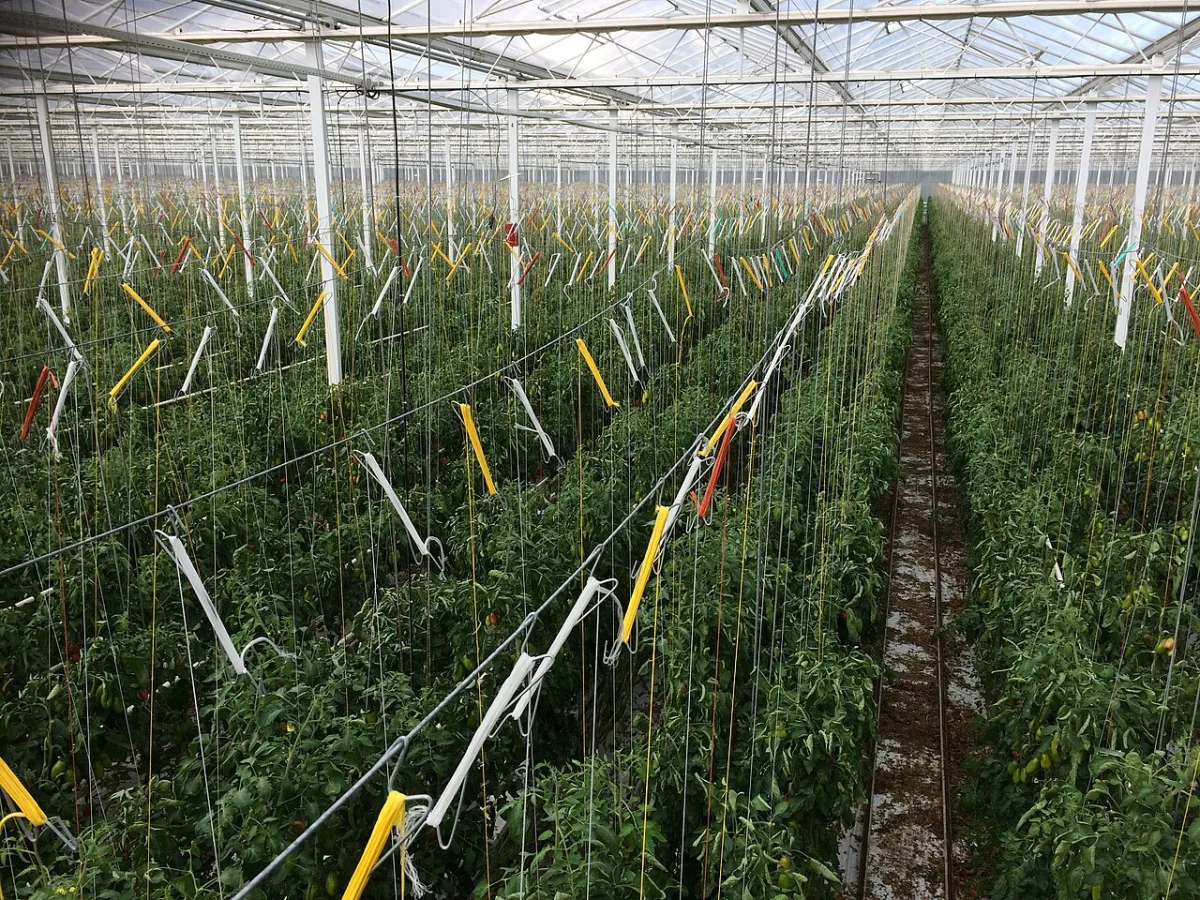
There are several types of hotbeds: Russian (sunken), Parisian (surface-level French), and Belgian (double-sloped). In recent years, mechanized hotbeds designed by Mkrtchyan have begun to be introduced in large farms.
Russian hotbeds are single-sloped with a pit dug into the ground.
Fig. 1. Cross-section of a sunken Russian hotbed. A — soil; B — manure; C — frame; D — southern side board; E — northern side board; F — cross-bar.
Parisian hotbeds are set up without a pit by layering manure on the soil surface, and a pre-prepared wooden frame (box) is placed on top of the manure.
Fig. 2. Cross-section of Parisian hotbeds.
Belgian hotbeds are double-sloped (unlike the single-sloped Russian ones).
Mechanized hotbeds are a special type of hotbed adapted for use with the hotbed combine harvester invented by comrade Mkrtchyan.
Russian hotbeds are the most convenient, inexpensive, simple, and widely used in our state and collective farms. Russian hotbeds retain heat better, require less manure, and are ultimately more convenient for organizing work and use throughout the year compared to Parisian and Belgian hotbeds.
By type of heating, hotbeds are categorized into biofuel (biological fuel), flue (stove) heating, and electric heating.
Fig. 3. Cross-section of a double-sloped Belgian hotbed, A — soil; B — manure; C — frame; D — side board; E — ridge beam.
When using biofuel to heat hotbeds, manure and other organic substances are widely used. For us, this is the main method of heating hotbeds. The use of flue heating for hotbeds is not widely spread in the USSR. Electric heating has begun to spread in our Ukrainian SSR and in Crimea. Electric heating significantly improves the ability to maintain and regulate the required thermal regime in hotbeds. In the future, with the expansion of the power grid and the availability of cheap electricity, electric heating will become widespread. Water heating for hotbeds is used when utilizing waste water from factories and plants. This type of heating is widely used abroad, but it is still little used here.
Choosing a site for hotbeds
The site intended for setting up hotbeds must meet a number of specific requirements.
The site should be elevated, dry, preferably with a sandy subsoil, and have a slope to the south, southeast, or southwest. In low-lying areas, stagnant snowmelt and rainwater may occur, and groundwater may be too close to the surface. This will cause dampness in the hotbeds, and water may appear in the pit. The level of groundwater during the spring and autumn periods should not exceed 90—120 cm. The standing groundwater level can be checked by digging a test trench up to 1.5 m deep on the site during the summer. If water does not appear in the trench within a few days, it means the groundwater level is deep enough.
Along with this, it is necessary to have a natural or artificial reservoir nearby for irrigation.
The site must be protected from northern and northeastern winds by forest plantings, fences, buildings, etc. The temperature difference in hotbeds protected and unprotected from northern winds reaches up to 6°, especially in windy weather.
It is not recommended to set up hotbeds near storage facilities (granaries, sheds) and livestock yards, as mice and rats, which severely damage crops in hotbeds, most often settle there.
On the other hand, hotbeds should not be shaded by buildings or plantings, especially from the south and southwest sides. It is recommended to place hotbeds at the following approximate distances from shading objects:
a) when shading objects are located on the eastern and western sides of the hotbed area;
Height of the shading object: up to 4 m — 15 m from hotbeds; from 4 to 8 — 30; from 8 to 12 — 45; over 12 — 60.
b) when shading objects are located on the south;
Height of the shading object: from 4 to 8 m — 12 m from hotbeds; from 8 to 12 — 16; over 12 — 20.
It is necessary to ensure that good access roads are built to the hotbed area, as a large amount of manure, waste, and water must be transported to the hotbeds.
The site must have a reserve area for potential future expansion of the hotbed facilities. When determining the required area for the hotbed facilities, it is necessary to calculate how many frames can fit per hectare, taking into account access roads, paths, and areas for auxiliary buildings: sheds for storage of equipment, shelters for frames and mats, etc. In general, considering all these conditions, 2000—2300 frames are placed per 1 ha. Auxiliary buildings are located on the north side of the site.
Hotbeds on the designated site must be arranged in such a way that it is convenient to organize work and ensure proper maintenance by transport. To this end, hotbeds are arranged in sections (blocks) of 500 frames each. A section consists of individual hotbeds, with 20 frames each. As practice shows, this is the most convenient size of a hotbed for better organization of work in the hotbed facilities: filling the hotbeds, hauling away humus and soil, transporting and carrying water, moving frames, etc. However, hotbeds may consist of 10, 30 frames, etc.
Between individual blocks, longitudinal access roads up to 5 m wide are left, and between hotbeds — paths of 70—80 cm.
хе т О КТ | И Е Е б ЕЕ еек Е =: а] | ес | [ириса еее) ре ЕК ея НЕЕ, ПР) Е: ЕЕ) ЕКА =) | реет: ЕЯ ЕЕ | ое =) [и = ЕЕ |) С) ЕЕ Е ЕЕ Ч КОИ | Е) ЕЕ ое О ЕЕ Еее еттЕтРЕЕЕЕЫ НЕТ Я |< Гоеивкиитдеятиея || 5 ЗЕ ПЕЕЕЕЕЕЕЕЕЕЕНЙ Вх ЕЕ Гоееетн | Г) Е мс ЕЕЕЕЕЕЕЕ |||» ЕТЕРЕЕТ Е — ГЕЕиЕЕ-ЕчЕт а — ЕЕ) ЕЕ, 7 =] | 2 - | —\ Г] | } й Е! ия ленес | Г - р - ЕЕ) СЕ] [= 2 |157) | 7 | [] С 3] с] Г те | А НЯ Е] Е 1 с [1 ГГ 2 93 Е Бизе с = 1 и рф к —— HOTBEDS HOTBEDS HOTBEDS с ——\ Га В а PORENAN
Fig. 4. Layout plan of sunken Russian twenty-frame hotbeds.
For the storage of soil, manure, barrels, water tanks, as well as for access, transverse roads (end roads) 9—15 m wide are arranged on each side of the hotbed block.
Paths between hotbeds wider than 80 centimeters, encountered in the practice of some farms, are impractical, as this unnecessarily increases the size of the site; furthermore, a large cooled area is formed around the hotbeds, causing the temperature of the biofuel combustion to decrease faster and the hotbeds to cool down.
In farms with a large number of hotbeds (several thousand frames), where the transport of manure, soil, water, etc., to each hotbed is organized by horse-drawn transport or motor vehicles, a strip layout of hotbeds in sections is practiced. It differs in that paths of different sizes are left between individual hotbeds. One path, narrowed, serves only for walking; its width is 50 cm. The other path is significantly wider — up to 2 m, or it is made to the width of a horse cart or a motor vehicle. The paths alternate so that one can approach all hotbeds by motor transport and horses.
In order to make more correct and economical use of the hotbed site area, the paths and roads, after being cleared of manure and soil, should be used for growing such heat-loving crops as cucumbers, tomatoes, cabbagecauliflower, squash, pumpkin, etc. Due to this, an additional quantity of valuable vegetables can be obtained from the protected ground site. To adapt and accelerate the ripening of these crops, temporary covers can be set up using frames cleared from the main hotbeds.
Read next
Greenhouses and covers For gardeners
Construction of pits and installation of the frame for classic Russian hotbeds
Greenhouses and covers For gardeners
Organization of vegetable growing in protected soil and hotbeds
Greenhouses and covers For gardeners