
Application of organic fertilizers in greenhouses and open soil
6 min read
Manure, humus and peat: application rates and rules
Organic fertilizers are the foundation of soil fertility in greenhouses and open ground. They improve soil structure, saturate it with macronutrients and stimulate the development of beneficial microflora. However, the effectiveness of each type of organic matter directly depends on following application rates and the correct timing for specific crops.
Manure contains varying amounts of nutrients depending on the animal species, feed composition and bedding. Horse and sheep manure are the richest in nitrogen, phosphorus and potassium. It is most effective to apply this fertilizer in the autumn before ploughing, especially in areas intended for early vegetables. In spring, only partially decomposed (well-rotted) manure may be used — it is used to fertilize beds for cucumbers and cabbage, and on poor soils, also for potatoes.
Humus is a highly effective fertilizer, especially when fresh. Manure humus is obtained from the complete decomposition of manure and is valued more highly than vegetable-based humus, which forms from the decay of leaves, tops and weeds. Humus is suitable for any crop, but gives the best results on beds with onions, carrots and tomatoes. It is also useful for covering seed during sowing or adding it directly into holes when planting transplants of potatoes, cabbage and tomatoes.
Peat is characterized by high water-holding capacity and low thermal conductivity; while it is rich in nitrogen, it contains little phosphorus and potassium. It is better to use it in a mixture with manure or add it to composts after preliminary drying and aeration. In its pure, aerated state, peat is excellent for mulching sowings on heavy, cold soils.
- Manure application rate — 4–6 kg/m²
- Humus application rate — 3–4 kg/m²
- Humus consumption per hole — 150–200 g
- Poultry manure solution consumption — 8–10 kg per 10 m²
- Paper share in paper compost — no more than 10%
Poultry manure and composts: preparation and application technologies
Poultry manure is a fast-acting organic fertilizer suitable for all types of soils and crops. Due to the high concentration of nutrients, it is used in the form of liquid solutions (slurry), otherwise, there is a risk of burning the root system of plants. Chicken manure can also be dried and crushed — in this form, it can be stored for a long time without loss of beneficial properties.
The high concentration of elements in poultry manure is dangerous for roots. Never apply it in a fresh, undiluted form — use only a diluted slurry or dry crushed manure.
| Nutrient | Content in poultry manure, % |
|---|---|
| Calcium | 1.2–4.0 |
| Potassium | 0.6–1.0 |
| Phosphorus and nitrogen | 0.5–1.8 |
For safe application of liquid top dressing based on poultry manure, strictly follow the preparation sequence:
- Fill a container one-third full with poultry manure, add water to the brim and stir the mixture thoroughly.
- Let the solution sit for 2–3 days, then strain the resulting mass.
- Dilute the working composition with water in a ratio of 1 L of strained solution to 3–4 L of water.
- Apply the fertilizer between the rows and water the beds abundantly to incorporate the nutrients into the soil.
Compost allows for the rational utilization of farm waste and obtaining valuable fertilizer. To set it up, choose a site 1.5 m wide and 3–4 m long. On the prepared base, lay weeds, tops, food waste and manure in 15–20 cm layers, covering each layer with 5–8 cm of soil or peat until the heap reaches a height of 1 m. To accelerate maturation, the layers are sprinkled with lime, ash, urea or phosphate fertilizer, watered regularly and turned over several times during the summer.
On sandy and loose loamy soils, be sure to lay a layer of compacted clay with a depression in the center under the compost heap. This will prevent nutrients from leaching out with rain and irrigation water.
Compost matures from 4 months to a year, turning into a dark, crumbly mass. If the heap is set up late and does not have time to rot before autumn, it is covered with straw or potato tops for the winter to prevent freezing. Paper can also be used for composting (up to 10% of the total mass) by mixing it with straw and plant waste. In paper compost, it is mandatory to add mineral fertilizers at a rate of 2–3 kg per 100 kg of raw material, and the mixture is periodically watered and turned.
To maintain the shape of the heap, wooden stakes are used, or the raw material is placed in compost pits, although decomposition proceeds faster in the open air due to good ventilation. Leaf compost is prepared separately from fallen leaves — they are tightly packed in a wire container, moistened and kept for two years. Leaf compost excellently improves the structure of sandy and clay soils, replaces peat and is applied together with lime at the same rates as regular manure. Wood sawdust is also suitable for composting, but before applying it to the soil, it must be well moistened with a solution of mineral fertilizers.
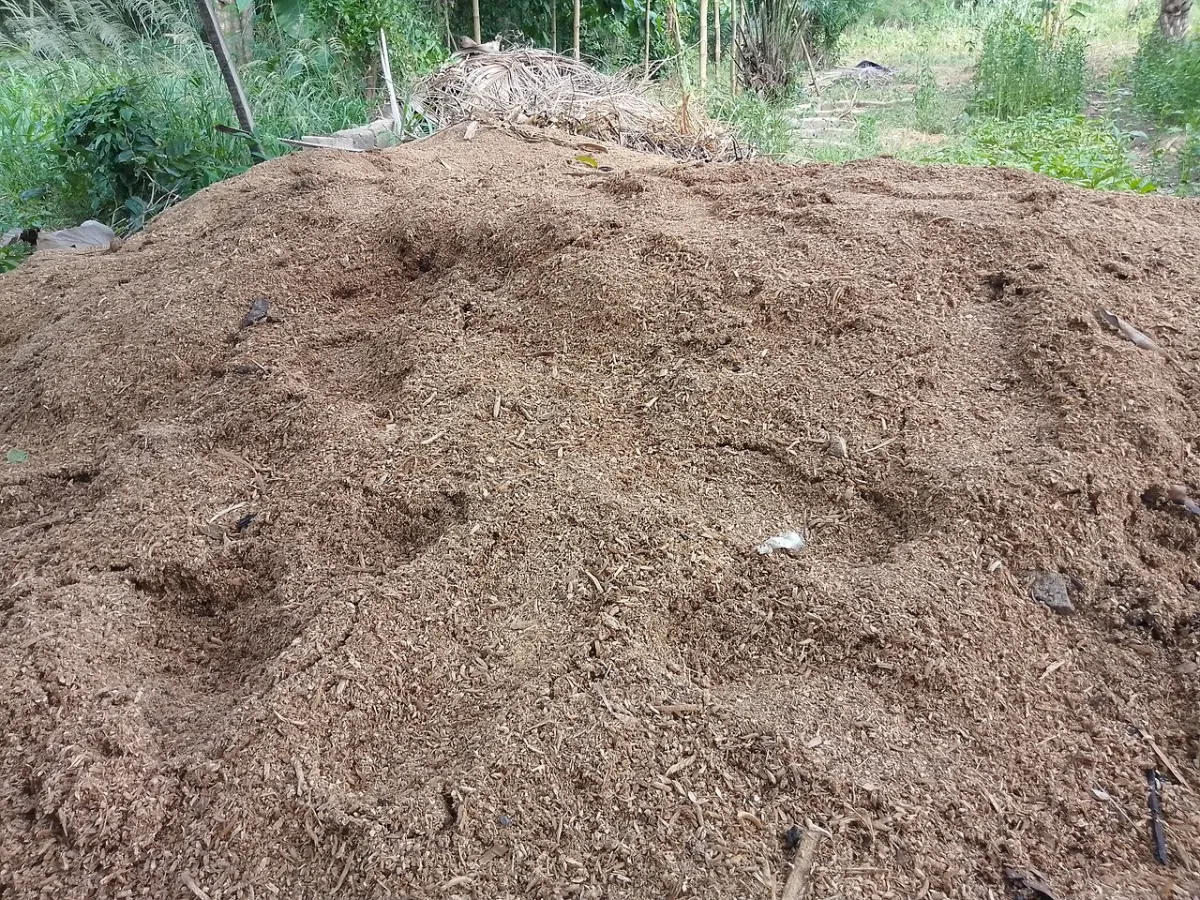
Sawdust serves as an excellent loosening material for greenhouse soil, hotbeds, and for preparing potting mixtures. In open soil, it is used to improve the physical properties of heavy, structureless soils, as well as for mulching plantings. However, it is strictly not recommended to apply sawdust in its pure form. Bacteria that decompose wood actively consume the soil nitrogen available to plants, which leads to a sharp decrease in soil fertility.
Never apply pure sawdust to the soil without treatment with nitrogen fertilizers. It is best to apply the prepared material in the autumn on previously limed plots.
To compensate for the nitrogen deficit, sawdust is pre-soaked with special solutions. One bucket of the liquid mixture is sufficient for the high-quality moistening of three buckets of sawdust. The autumn application rate for the prepared loosening agent is no more than 5 buckets per 10 m² of area.
| Component | Quantity |
|---|---|
| Urea | 220 g per 10 l of water |
| Livestock animal urine | Diluted with water 10:1 |
| Fresh cow manure | 3 l per 10 l of water |
Ash and sapropel: soil deacidification and mineral top dressing
Wood ash is a valuable complex fertilizer containing potassium, phosphorus, lime, and microelements. Wood ash is mainly applied for vegetable crops, and it must be incorporated deeply. With surface application, ash quickly forms a dense crust that blocks air access to the roots. In addition, ash acts as a liming fertilizer, reducing acidity in podzolic and heavy soils.
Ash should not be applied to carbonate and other soils with an alkaline reaction to avoid excessive alkalization.
The composition and concentration of elements in ash directly depend on the material being burned. Buckwheat and sunflower straw produce ash richest in calcium and potassium, while rye and wheat straw are richer in phosphorus. Wood ash always contains more lime than straw ash. The richest in total nutrient content is the ash from potato tops, which is why it is recommended to burn it directly on the plot after harvesting.
Sapropel, or lake silt, is a complex organic fertilizer. It is rich in nitrogen, phosphorus, potassium, and lime, and also contains microelements, vitamins, and biostimulants. Sapropel is most effective for the cultivation of acidic sod-podzolic and sandy soils, as well as a component for composting.
- Harvest the silt during the planned cleaning or lowering of pond levels.
- Thoroughly turn over the collected mass to reduce excess humidity.
- Expose the silt to air to remove compounds harmful to the plant root system.
- Apply the prepared sapropel to the soil or add it to the compost pile.
- Lime content in willow wood ash — up to 43 %
- Lime content in birch wood ash — about 37 %
- Application of ash into planting holes — 1 tablespoon each
- Application rate of sapropel to the soil — 3–4 kg per 1 m²
Read next
Vegetable growing For gardeners
Preparation and enrichment of nutrient soil mixtures for vegetable transplants
Nutrition and fertilizers For gardeners
Organic and mineral fertilizers for vegetables in a greenhouse
Nutrition and fertilizers For gardeners