
Designing and establishing an organic fruit orchard based on cultivar-rootstock combinations
5 min read
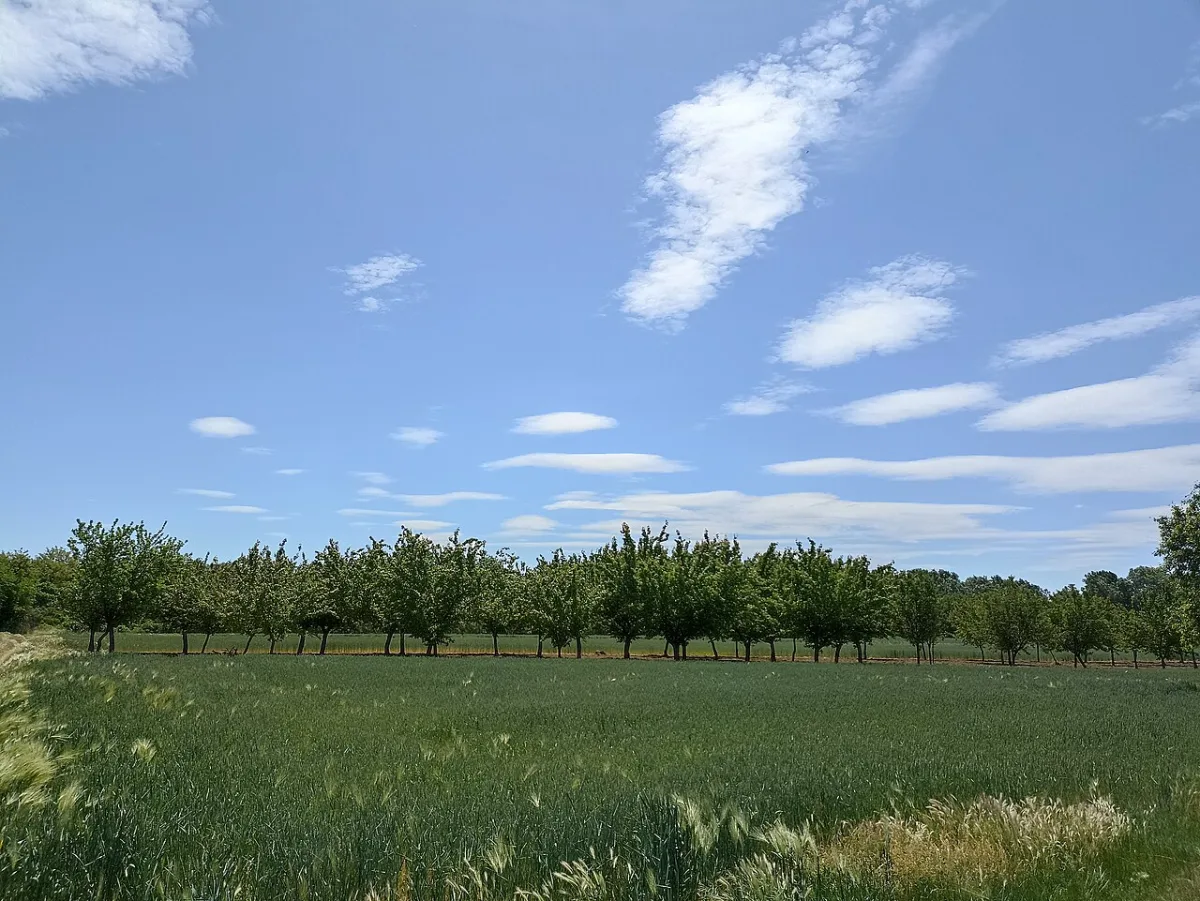
The design (type) of an orchard is determined by the combination of the following factors: the specific layout of the trees, the training and pruning of the canopy, the vigor of the cultivar and rootstock, the productivity of the cultivar-rootstock combination, the agricultural techniques employed, the system of machinery and implements, and the economic efficiency of fruit production.
Classification of modern types of fruit plantations depending on canopy shape, rootstock, and the number of trees per unit area:
– orchards with a naturally improved tree canopy shape and moderately dense placement (less dense, conventional) are close to natural (rounded), but are subject to training (regulation of the height and number of first and second-order branches);
– orchards with an artificial tree canopy shape and denser placement (medium-density). Artificial canopies that have a flat shape, extended along the axis of the row, are also subject to the regulation of the height and number of branches and shoots. In such orchards, when using a semi-dwarfing rootstock trees grow without support; with a dwarfing rootstock – with support;
– orchards with an artificial-natural tree canopy shape (highly and very highly dense). In such orchards, woody fruit plants are grown on semi-dwarfing rootstocks without support and on dwarfing rootstocks with support.
The first subgroup with an artificial-natural canopy shape includes trees with a spindle-shaped canopy grown on semi-dwarfing rootstocks (spindle bush, free-growing spindle).
In the second subgroup, canopies are formed without strong first-order branches, creating only drooping, significantly weaker first-order branches of limited length on the trunk (slender spindle, French axe, spindle, "Solaxe", column).
Obviously, in organic orchards, trees grafted onto semi-dwarfing (semi-dwarfing) rootstocks are preferred. It is precisely these rootstocks that are characterized by low sorption capabilities regarding heavy metals and a reaction to increased doses of mineral fertilizers (Doroshenko, Kondratenko, 1998).
The use of artificial canopy shapes in organic orchards is not promising due to the high labor intensity of their creation.
The planting density of trees in an orchard largely depends on the biological characteristics of the cultivar. In turn, the productivity of the plantations is determined by the number of trees per unit area.
Studies to determine the optimal tree planting scheme for apple cultivars of different vigor were carried out in the orchard of OJSC "Agronom", planted in 1998. The tree canopy shape was "Russian spindle". The experimental objects were apple trees of the Florina (vigorous) and Liberty (medium-vigorous) cultivars, grafted onto the MM106 rootstock. The experiment studied five variants of tree placement in a row: 1.5; 2.0; 2.5; 3.0 and 4.0 m apart. The distance between rows was 5 m. The soil was chernozem (leached). The apple cultivation techniques corresponded to those recommended for the specified natural conditions.
As the analysis of the data obtained in the study showed, the apple trees of the studied cultivars were characterized by different growth activity, determined by their planting scheme.
Thus, regardless of the cultivar, when trees were placed 1.5 m apart in a row, they showed weak growth, whereas when the distance was increased to 4.0 m, an increase in the average growth of shoots by 15–18% and trunk diameter by 40% was noted.
At the same time, the tree planting scheme in a row has a significant impact on the harvest volume, although in this case, varietal differences are also observed. Table 25 – Influence of the planting scheme on the economic productivity of apple cultivars* (orchard of OJSC "Agronom", planted in 1998, average for 2008–2009)
Planting Number of Harvest of fruit scheme, trees per m×m 1 ha, pcs kg/tree t/ha
5×1.5 1333 8.6 11.4
5×2.0 1000 12.4 12.4
5×2.5 800 21.1 16.8
5×3.0 666 34.3 22.9
5×4.0 500 27.4 18.3
LSD05 3.1 2.5
5×1.5 1333 7.2 9.6
5×2.0 1000 10.0 10.0
5×2.5 800 21.2 18.7
5×3.0 666 25.0 17.0
5×4.0 500 29.3 14.9
LSD05 2.0 5.2
It should be noted that the fruit harvest when trees are placed 4.0 m apart in a row is on average 37% higher than with dense placement. A close inverse relationship was established between the planting density of trees and the fruit harvest per tree (correlation coefficient r = –0.93±0.01), expressed by the regression equation:
Y = 45.67– 0.029x, where x is the number of trees per 1 ha, pcs.
At the same time, it was determined that the optimal planting density depends on the biological characteristics of the cultivar. Thus, for the vigorous Florina cultivar, the optimal distance between trees in a row is 3.0 m, and for the medium-vigorous Liberty cultivar – 2.5 m. It was found that by using these distances, the studied apple cultivars ensure the highest harvest of fruit per unit of orchard area.
However, if we consider the results obtained from the point of view of increasing the weight and market quality of the fruits, we come to a different conclusion (Figure 25, Table 26). weight, g
5x1.5 5x2 5x2.5 5x3 5x4 planting schemes, m x m
Florina Liberty Figure 25 – Influence of the planting scheme (m×m) on the weight (g) of apple fruits (average for 2008–2009) Table 26 – Influence of the planting scheme on the market qualities of apple fruits (orchard of OJSC "Agronom" planted
1998, on average for 2008–2009)
Number of trees per 1 ha, pcs Planting scheme, m×m Marketable cultivar grade, % superior I II III 5×1.5 1333 13 31 47 9 5×2.0 1000 27 44 21 8 5×2.5 800 18 53 20 9 5×3.0 666 21 50 22 7 5×4.0 500 23 55 20 2 5×1.5 1333 22 32 40 6 5×2.0 1000 25 40 28 7 5×2.5 800 23 42 31 4 5×3.0 666 27 48 23 2 5×4.0 500 27 42 25 6
Influence of planting scheme on apple marketability
To obtain fruits of superior and first marketable grades, it is necessary to increase the nutrient area of the trees within the recommended standards. Sparse planting improves the illumination of the canopy, which directly affects the size and marketable appearance of the apples. In practice, this technique allows for obtaining the maximum yield of high-quality products, which is confirmed by the results of field trials.
| Apple cultivar | Planting scheme, m | Yield of superior and I grade fruits, % |
|---|---|---|
| Florina | 5 × 4 | 75–78 |
| Liberty | 5 × 3 | 75–78 |
When increasing the distance between trees to improve the marketable qualities of the fruits, some reduction in the total yield of the orchard is possible.
Read next
Fruit growing For agronomists
Canopy formation technology of the "Russian spindle" for apple and pear trees
Fruit growing For agronomists
Influence of clonal rootstocks on the productivity of apple cultivars in southern regions
Fruit growing For agronomists