
Canopy formation technology of the "Russian spindle" for apple and pear trees
5 min read
Rootstock selection, planting scheme and the advantages of the "Russian spindle"
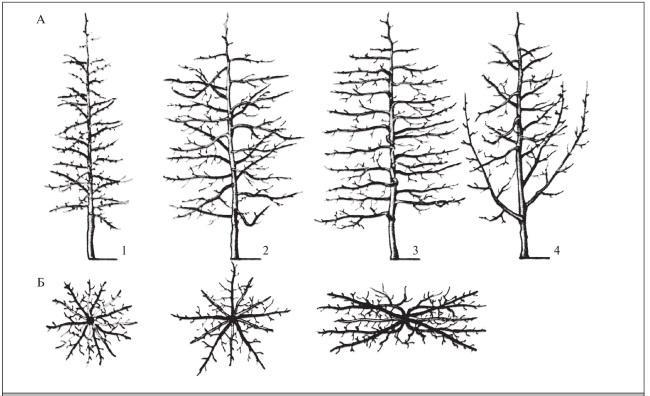
Spindle-shaped canopies of apple and pear trees have undergone a long evolution in Western European orchards: from decorative vertical cordons on dwarfs to industrial spindle-bushes on semi-dwarfing clonal rootstocks. Later, more compact spindles, slender spindles, and the French axe (pillar) with cyclical wood renewal appeared. However, in organic orchards, the free-growing or "Russian spindle" has become the most practical solution for apple trees.
This canopy type is designed specifically for cultivars with spreading tree habits. The structure consists of a central leader and first-order branches 1–1.5 m long. Unlike the classic spindle-bush, the "Russian spindle" eliminates the main drawback — branch sagging. The lower tier of branches is established in a raised position, which significantly simplifies the maintenance of tree strips.
- Cultivars — Mantuanskoe, Rennet Simirenko, Golden Delicious, Slava Pobeditelyam
- Recommended rootstocks — MM106, M4, M7
- Planting scheme — 4.5–5.0 × 2.0–2.5 m
- Tree height — 2.0–2.5 m
- Maximum canopy diameter — 1.6 m
First-order branches in the "Russian spindle" canopy are positioned strictly at specific angles. The lower tier of branches must be raised at an angle of 55–60° (by the fourth year of the growing season, the angle should be 60–65°), while upper branches are oriented horizontally at an angle of 80–90°.
Step-by-step canopy formation technology
The formation of a free-growing spindle is carried out in stages during the first five years of the orchard's growing season. Each operation is aimed at creating a strong tree skeleton and regulating its fruiting.
- First year of the growing season (spring). Cut back unbranched nursery plants to a height of 75–90 cm from the ground surface.
- First year of the growing season (summer). Once shoots reach a length of 10–15 cm, establish a trunk 45–50 cm high by completely removing competitors of the central leader. When shoots in the canopy zone grow to 20–25 cm, select 3–4 shoots with an emergence angle of 60–65° to form an open tier, distributing them evenly in a circle. Remove or pinch the remaining shoots above the 2nd–3rd leaf.
-
Second year of the growing season (spring). Subordinate the side branches to the central leader: cut the leader's extension branch 20–25 cm above the shortened side branches. Determine the degree of leader pruning based on the biological characteristics of the cultivar.
Shoot formation ability Apple cultivars Leader pruning method High Melba, Jonathan, Golden Delicious, Goldspur, Rennet Simirenko, Champion Do not shorten the extension branch of the central leader Low Wagner, Mantuanskoe, Starkrimson Shorten the extension branch of the central leader - Second year of the growing season (summer). If vertical first-order shoots overcrowd the canopy, perform green operations to remove them. Deflect shoots in the upper part of the canopy to a horizontal position.
- Third year of the growing season (spring). Transfer the central leader to an upward-directed lateral branch. This thickens the leader, stimulates the formation of fruiting spurs, and blocks the growth of vertical competitors. Simultaneously, limit the growth of lower branches at the base of the canopy by pruning them 50–60 cm from the trunk with a cut to an outward-facing branch. If vertical growth was not removed last summer, cut it out now.
- Third year of the growing season (summer). It is mandatory to perform a double green operation to remove vigorous vertical growth.
- Fourth year of the growing season and onwards (early spring). Carry out formative pruning. Limit the tree height to 2–2.5 m by transferring the leader to a side branch. Shorten overgrown branches by cutting back to a weaker lateral branch. Ensure that upper first-order side growth has an inclination angle of 80–90°, and thin out heavily branching cultivars in a timely manner.
-
Fifth year of the growing season (early spring). Begin pruning fruiting branches with a 3-year replacement cycle:
- Shorten 3-year-old branches that have already borne fruit back to 3-year-old wood, cutting to a shortened branch with 2–3 buds, a replacement stub, or fruit-bearing structures.
- Shorten 2-year-old fruiting branches if necessary to regulate the crop load and prevent fruit size reduction (especially important for Golden Delicious, Starkrimson, and Mantuanskoe cultivars).
Remove vigorous vertical growth in a timely manner. Violation of the green operations protocol during the summer of the second and third year leads to severe canopy overcrowding, degradation of the light regime, and the need for harsh spring pruning, which reduces the orchard's productivity.
Read next
Pruning and training For agronomists
Methods for forming columnar and spindle-shaped canopies of fruit trees
Fruit growing For agronomists
Features of canopy formation in modern intensive fruit growing
Fruit growing For agronomists