
Influence of canopy formation on the productivity of immune apple cultivars
6 min read
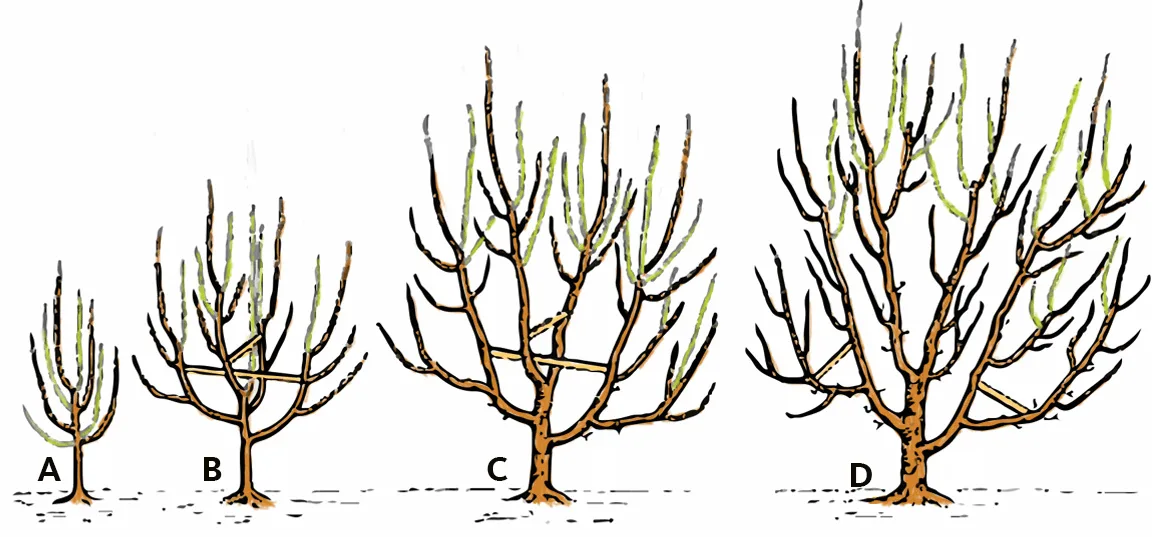
For an intensive apple orchard, it is crucial to choose the right canopy shape. It determines how much solar energy the leaves will absorb, how nutrients will be distributed, and what nutritional area each tree will require. Long-term trials (2001–2008) on trees planted in 1997 helped determine the optimal canopy formation system for the scab-immune apple cultivars Liberty (early-winter) and Florina (winter). The indicators were evaluated in six replicates, with one tree considered as a single plot.
- Rootstock — M9
- Planting pattern — 4×2 m
- Soil — leached chernozem
- Climate — moderately continental
Light regime and photosynthesis: how the canopy affects leaf performance
Apple productivity is directly related to leaf surface area. The Florina cultivar features the largest leaf area across all training systems — from 10.6 to 14.9 thousand m²/ha. At the same time, for both studied cultivars, the leaf surface reaches its maximum with the classic central leader (modified leader) system of canopy formation. However, for high productivity, not only leaf area is important, but also their illumination.
The best light regime occurs in the canopy of the Liberty apple cultivar. The "Russian spindle" training system allows for an increased influx of solar energy to the leaves inside the canopy for both cultivars. In August 2007, the illumination of the central zone under the "Russian spindle" system proved to be significantly higher, which was especially pronounced in the Florina cultivar — 30.2% of full open-field illumination against 20.5% in the central leader canopy.
Good illumination of the central parts of the canopy not only increases yield but also improves fruit quality and stimulates the setting of generative buds.
Light intensity determines the net productivity of photosynthesis. The Florina cultivar shows high photosynthetic activity (up to 0.5 g/m² per day in June 2007) if the trees are trained in the "Russian spindle" style. With such a system, nutrients are distributed more balanced between tree growth and fruiting.
| Cultivar | Central leader canopy, % of open field | Russian spindle, % of open field | ||
|---|---|---|---|---|
| Periphery | Center | Periphery | Center | |
| Liberty | 48.7 | 30.0 | 51.0 | 31.0 |
| Florina | 39.6 | 20.5 | 43.1 | 30.2 |
Tree dimensions and vigor: planning the nutritional area
The canopy shape directly influences the vigor of growth processes and the final size of the trees. The central leader system stimulates active vegetative growth. Trees with this training grow taller, with a maximum trunk diameter and a wide canopy both along and across the row. The maximum annual growth was recorded here: long branches provide the tree with productive wood (spurs, fruit-bearing wood) and large active leaves.
The "Russian spindle" training limits excessive growth, making trees more compact. Regardless of the chosen canopy, the Florina cultivar outperforms Liberty in all dimensions. Taking these varietal and training characteristics into account helps to correctly calculate the planting pattern and avoid orchard overcrowding.
Trees with a central leader canopy are characterized by increased growth intensity and require a larger nutritional area. Ignoring this fact during high-density planting will lead to mutual shading of the trees.
| Cultivar and training (data as of October 2007) | Trunk circumference, cm | Canopy width N-S, cm | Canopy width E-W, cm | Tree height, cm |
|---|---|---|---|---|
| Liberty | ||||
| Central leader (control) | 39.0 | 345 | 323 | 253 |
| Russian spindle | 32.0 | 322 | 231 | 237 |
| LSD05 | 1.0 | 2.8 | — | — |
| Florina | ||||
| Central leader (control) | 43.0 | 417 | 377 | 290 |
| Russian spindle | 40.0 | 390 | 314 | 279 |
| LSD05 | 1.0 | 3.6 | — | — |
Increased yields of fruit trees from the application of a particular canopy formation system can be caused by a number of factors. The most important of these is creating conditions for better setting and development of flower buds. Research data indicate that abundant flowering was observed on Liberty apple trees. When comparing the flowering intensity of trees with different canopy shapes, it can be noted that for both cultivars, it was more abundant on trees trained in the "Russian spindle" style. Trees with a central leader canopy were characterized by low flowering intensity. Thus, an increase in the growth activity of apple trees is associated with a weakening of their generative function and vice versa.
Orchard yield is one of the main indicators used to determine the profitability of using a cultivar and individual cultivation practices. It is noteworthy that in the experimental variants (Russian spindle) that stood out in terms of canopy illumination and photosynthetic productivity, a faster (compared to the control) build-up of apple fruit yield is ensured. t/ha
2001 2002 2003 2004 2005 2006 2007 2008 years central leader Russian spindle t/ha
2001 2002 2003 2004 2005 2006 2008 central leader Russian spindle
Figure 37 – Dynamics of apple yield on M9 rootstock depending on canopy shape (orchard of "Kuban" educational farm, planted in 1997, planting pattern 4×2 m, rootstock M9, cultivars: a – Florina; b – Liberty)
It should be noted that the low fruit yield in 2006 was associated with the negative effect of low sub-zero temperatures on plants, which are critical for the "apple" species.
However, if we consider the obtained data from the perspective of a rational balance between the two main functions of the plant: growth and fruiting, the preferred option is the one in which trees of both apple cultivars are trained using the "Russian spindle" type. Only in this case can the desired results be achieved: restrained plant growth and, simultaneously, moderate but regular fruiting, ensuring the production of high-quality market produce.
| Yield of fruits of the highest and first market grades | 67–72 % |
What are the advantages and disadvantages of different canopy shapes?
What are the types of spherical (rounded) canopies, and what are their differences?
How to establish the framework of a spherical canopy?
How to form an improved vase-shaped canopy?
How to form a spaced-tier canopy?
Evolution of spindle-shaped canopies
What factors determine the increase in yield when using different canopy training systems?
Read next
Fruit growing For agronomists
Evaluation of drought and heat tolerance of apple cultivars in the south of Russia
Fruit growing For agronomists
Characteristics of immune and scab-resistant apple cultivars
Fruit growing For agronomists