
The use of boron fertilizers in modern crop production and application techniques.
5 min read
Plants experience a lack of boron primarily in soils with a light particle-size distribution, as well as in carbonate and limed soils. There is a significant need for boron fertilizers in irrigated agriculture and rice cultivation, which is explained by the depletion of the arable soil layer of water-soluble forms of boron due to their constant removal by filtration and drainage waters.
Boron is not remobilized in plants, so its supply from the soil is necessary throughout the entire growing season. The following crops are particularly sensitive to boron deficiency:
- sunflower, rice, corn;
- tuber and root crops, flax;
- perennial forage legumes, buckwheat;
- grapes, fruit crops, and vegetable crops.
The application of boron fertilizers is advisable if the content of mobile forms of boron in the soil corresponds to these indicators:
| Soil type | Boron content, mg/kg |
| Non-chernozem zone | 0.2–0.5 |
| Chernozem zone | 0.3–0.65 |
| Serozems and chestnut soils | 0.45–2.0 |
| Flooded soils of rice fields | less than 1.0 |
Currently, the following main boron fertilizers are produced: simple boron superphosphate, double boron superphosphate, boron-magnesium fertilizer, calcium-ammonium nitrate, boric acid, and borax. The agrochemical properties of the main, most frequently used boron fertilizers in agriculture are shown in Table 78.
The application of boron fertilizers to the soil is most advisable when there is a low supply of water-soluble forms. In this case, boron is applied at a rate of 2–3 kg/ha. On soils with a medium supply of boron, this rate is reduced by 50%. A favorable agricultural background is a prerequisite for achieving high efficiency of boron fertilizers.
Boron fertilizers are applied to the soil before sowing simultaneously with the main mineral fertilizers. If boric acid is used for pre-sowing soil application, it must be prepared immediately before use by:
- Mixing thoroughly with phosphorus-potassium fertilizers for uniform distribution over the sowing area.
- Applying separately in the form of an aqueous solution using ground equipment.
When applying boron fertilizers separately, attention should be paid to the uniformity of their distribution over the fertilized surface. An excessive amount of boron fertilizers can have a negative effect on plants. Cucumber, pea, strawberry, cherry, lemon, grape, and lupine are particularly sensitive to high rates of this element. Boron fertilizers applied to the soil have an aftereffect in the 2nd and 3rd years.
In addition to pre-sowing soil application, which is the main method of their use, water-soluble forms can also be applied for root and foliar top dressing of plants and pre-sowing treatment of seed. Root top dressing of plants can have a significant positive effect when visual signs of boron starvation appear, as well as on light sandy soils and flooded soils of rice fields, where boron can be leached from the arable layer.
An effective technique for using boron fertilizers is also foliar top dressing">top dressing of plants. It is carried out with a 0.1% aqueous solution of the microelement at a rate of 300 l/ha using ground equipment. For treating large areas, it is advisable to use aviation. In this case, the concentration of the working solution is increased, as aerial spraying achieves very fine atomization, resulting in a significant reduction in the consumption of the working solution, while maintaining the application rate of the microelement. Spraying of plants should be carried out in the evening or early morning hours; spraying in rainy weather is not recommended, as precipitation shortly after treatment leads to the washing off of the boron fertilizer from the plant surface, which reduces the efficiency of this agricultural practice. Foliar top dressing with boron microfertilizers significantly reduces the consumption of the microelement. Seed crops of perennial forage legumes, cereals, and vegetable crops are sprayed with boron fertilizers during the flowering stage. The spraying solution is prepared in advance, preferably 24 hours before application, as they dissolve slowly in cold water. After 24 hours of infusion, with periodic stirring of the undissolved part, the solution is allowed to settle, and the supernatant liquid is used for spraying. Excessive rates of boron fertilizers should not be used, as they can have a toxic effect. Excess boron is detected primarily on the lower leaves, which turn brown and fall off prematurely. Deficiency, optimum, and excess of boron in plant leaves are 3–30, 31–50, and 51–200 mg/kg of dry matter, respectively.
Seed treatment with boron before sowing is an effective and economical way to provide plants with the microelement at the start. This agricultural practice yields the best results on soils with a medium supply of mobile boron. Seed treatment of cereal crops is carried out using a semi-dry method simultaneously with seed treatment, which saves time and resources. To protect personnel and firmly fix the preparation on the seed, a film-forming agent is added to the working mixture — a 2% aqueous solution of sodium carboxymethyl cellulose (NaCMC polymer).
- Boron solution concentration — 0.5 %
- Solution application rate per 1 t of seed — 10 l
- NaCMC polymer concentration — 2 %
- Storage period for treated seed — up to 2 months
Preparation technology of the mixture and sowing specifics
Before starting work, it is necessary to calculate the dose of microfertilizer for one tank filling. For this, the recommended solution concentration (C, %), the content of active ingredient in the fertilizer (A), and the capacity of the seed treater reservoir (V) are taken into account. The tank volume depends on the make of the equipment used.
| Seed treater model | Working fluid reservoir capacity, l |
|---|---|
| PSSH-3 | 31 |
| "Mobitox" | 190 |
| PS-10 | 250 |
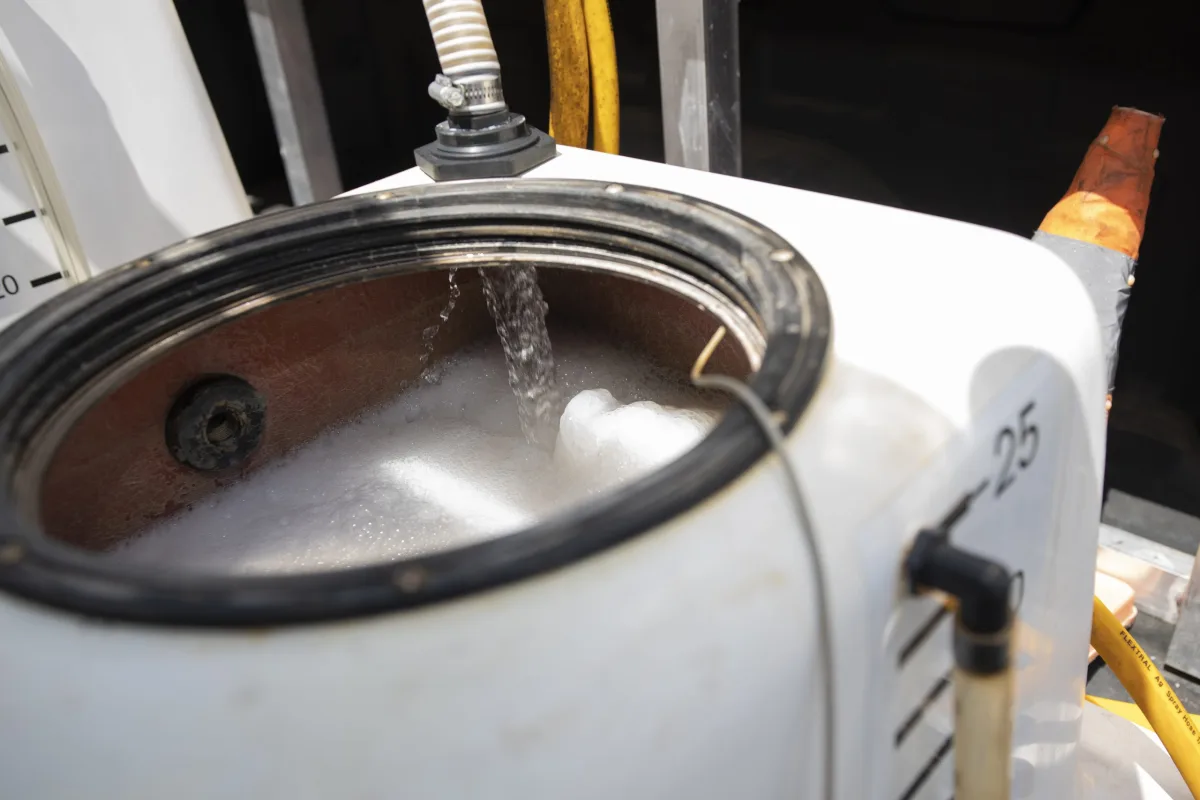
The mixing of components and filling of equipment are carried out strictly according to the regulations. It is important to follow the sequence of operations so that the solution is homogeneous. The prepared mixture is fed into the mixing chamber of the seed treater for uniform distribution over the seed material.
- Dissolve the calculated application rate of the microelement in a small volume of water.
- Pour the resulting solution into the seed treater reservoir.
- Bring the volume of the working fluid in the reservoir to the specified level with water.
- Mix the components for 2–3 minutes until completely homogeneous.
Boron-treated seed material can be stored for up to two months without loss of effectiveness of the agricultural practice. It is important to ensure that the seed moisture does not exceed the standard rate for conditioned seed material.
If sowing seeds immediately after treatment, undersowing is possible due to a temporary decrease in flowability. In this case, the agronomist and machine operators must monitor the operation of the sowing units in the field with particular care.
Read next
Agrochemistry For students
Application of copper micronutrient fertilizers to increase crop productivity

Agrochemistry For students
The use of micro-fertilizers to increase the productivity of crops in intensive farming
Agrochemistry For students