
Technology and rules for the mixing of mineral fertilizers in agricultural production
10 min read
Mixing fertilizers is a simple and cost-effective way to provide plants with all essential nutrients in a single pass of machinery. In practice, both a dry method (mixing ready-made granulated or powdered fertilizers) and a wet method (producing complex mixed fertilizers) are used. With the wet method, the mixture can be enriched with liquid micronutrients, spraying them directly before loading or during loading into truck bodies and trailers.
Dry fertilizer blends are prepared directly on farms, which allows for flexible adjustment of the nutrient ratio to meet the needs of a specific field. Ammonium nitrate, urea, simple and double superphosphates, ammophos, and potassium chloride are used for this purpose. The suitability of components is determined by their chemical composition, humidity, hygroscopicity, and tendency to cake.
Rules for component compatibility in dry mixing
To ensure the prepared fertilizer blend maintains its physical properties and is easily applied by machinery, follow technological rules. Improper combination of components leads to chemical reactions that reduce fertilizer quality. As a result, active ingredients are lost or the physical form of the mixture is degraded.
- Do not mix fertilizers if, as a result, they lose nutrients or turn into a sticky mass unsuitable for mechanized application.
- Do not combine ammonium nitrate and urea due to the extreme hygroscopicity of the resulting mixture.
- Do not mix ammonium forms of nitrogen (nitrate, ammonium sulfate, ammophos, and diammonphos) with alkaline fertilizers (phosphate slag, thermophosphates, calcium cyanamide, potash, cement dust) to avoid nitrogen loss in the form of ammonia.
The highest quality fertilizer blends are obtained from granulated fertilizers. To avoid deterioration of physical properties, the vast majority of mixtures must be prepared immediately before application to the soil.
Effect of humidity and temperature on mixture quality
The flowability and uniformity of fertilizer application depend directly on their humidity. At high humidity, granules quickly lose strength and break down. To prevent caking, it is important to monitor the initial parameters of raw materials before mixing.
| Fertilizer | Permissible humidity, % |
|---|---|
| Ammonium nitrate | 0,2–0,3 |
| Urea | 0,2–0,25 |
| Superphosphates (simple and double) | no more than 3,5 |
Exceeding the critical humidity threshold leads to the destruction of granules and the loss of their commercial properties. Wet granules clump together and clog the working parts of machines. As a result, the uniformity of fertilizer distribution across the field is disrupted.
- Critical humidity threshold for ammonium nitrate — 1,7–2,0 %
- Critical humidity threshold for urea — about 1 %
- Critical humidity threshold for potassium chloride — over 3 %
The moisture content in fertilizers increases sharply with rising storage temperature. In tests, a triple mixture of urea, double superphosphate, and potassium chloride with an initial humidity of 0,2 % contained 6,6 % moisture after one month of storage at 4 °C. At a temperature of 20 °C, this figure rose to 8,3 %, and at 40 °C, it reached 24,9 %.
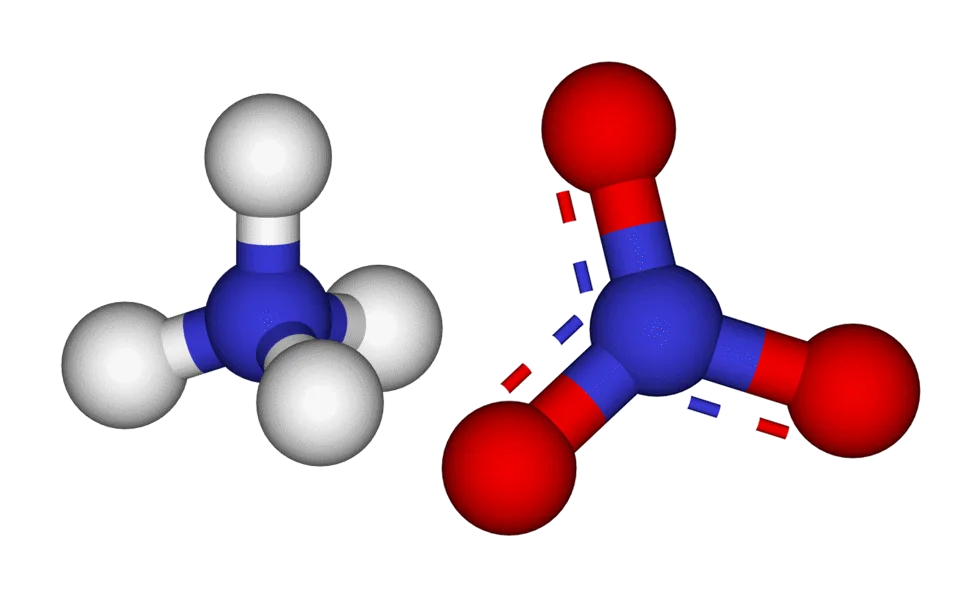
Do not mix superphosphate with ammonium nitrate, ammonium sulfate, or potassium chloride in advance. Free phosphoric acid in superphosphate reacts with nitrate, releasing gases and forming highly hygroscopic calcium nitrate. Adding potassium chloride results in the formation of hygroscopic calcium chloride. Such mixtures should be prepared strictly on the day of application, otherwise, they will quickly turn into a sticky mass.
Below are the chemical equations of reactions that occur during incompatible mixing of components. They clearly show the reasons for the formation of aggressive gases and hygroscopic salts. Due to these processes, the mixture quickly loses its flowability.
H3PO4 + NH4NO3 = NH4H2PO4 + HNO3
4HNO3 = 4NO2 + 2H2O + O2
2NH4NO3 + Ca(H2PO4)2·H2O + mH2O = 2NH4H2PO4 + Ca(NO3)2·nH2O
2KCl + Ca(H2PO4)2 = 2KH2PO4 + CaCl2
(NH4)2SO4 + Са(H2PO4)2·H2O + H2 4·2H2O + 2NH4H2PO4.
Since monocalcium phosphate has only one molecule of water, and the formation of gypsum requires two molecules of water of crystallization, the second molecule is absorbed at the expense of the mixture's free moisture. This process of absorbing free moisture has a major influence on the caking of fertilizer blends.
Do not mix fertilizers containing ammonium with alkaline fertilizers, as this will result in the loss of nitrogen in the form of ammonia. For example, when mixing potash (K2CO3) with ammonium nitrate, ammonium carbonate is formed, which will decompose into ammonia:
K2CO3+2NH4NO3 = 2KNO3+ NH4CO3;
(NH4)2CO3 → 2NH3 + H2O+CO2.
For the same reason, ammonium salts should not be mixed with alkaline fertilizers such as Thomas slag or phosphate slag.
It is not recommended to mix superphosphate with large amounts of lime fertilizers, as the soluble form of phosphorus Ca(H2PO4)2 will convert into less soluble forms CaHPO4 and Ca3(PO4)2, resulting in phosphate retrogradation:
Ca(H2PO4)2+2CaCO3 = Ca3(PO)2 + 2H2O+2CO2
An exception is adding a small amount (not more than 5%) of limestone flour to superphosphate to neutralize free phosphoric acid:
2H3PO4 + 3CaCO3 = Ca3(PO4)2+3H2O+3CO2.
Calcium carbonate and bicarbonate, which have an alkaline reaction, as well as metallurgical slags containing free calcium oxide, must not be mixed with ammonium fertilizers due to potential losses of ammonia:
CaO + (NH4)2SO4 = 2NH3 + CaSO4 + H2O.
Mixing ammonium nitrate with superphosphate in advance results in a smeary mixture that is unsuitable for spreading. Therefore, these fertilizers should be mixed immediately on the day of application. In most cases, mixing is permissible shortly before applying the fertilizer to the soil (Fig. 90; Yagodin B.A., Zhukov Yu.P., Kobzarenko V.I., 2002).
Ammonium nitrate 1 Urea 2 0 Ammonium sulfate 3 1 1 Superphosphate 4 1 1 2 Precipitate 5 1 1 2 2 Phosphate rock 6 1 1 2 2 2 Metallurgical slags 7 0 1 0 0 0 2 Ammophos 8 1 1 2 2 2 2 0 Potassium chloride 9 1 1 1 1 1 1 1 1 Potassium sulfate 10 1 1 2 2 2 2 2 2 2
1 2 3 4 5 6 7 8 9 10
Fig. 90. Chart of limitations for mixing fertilizers 0 – mixture properties deteriorate significantly; 1 – long-term storage of mixtures is not allowed; 2 – advance mixing is permissible.
To improve the physical properties of mixed and complex-mixed fertilizers, various neutralizing additives (lime, dolomite or phosphate rock, kaolin), as well as resins and organosilicon liquids, are used.
The possibility of preparing such mixtures is evident from the following reactions:
H3PO4+ Ca3(PO4)2 + 3H2O = 3Ca(H2PO4)2·H2O (1)
CaHPO4·2H2O+ H3PO4 = Ca(H2PO4)2·H2O + H2O (2)
2H3PO4 + CaCO3= Ca(H2PO4)2·H2O + CO2 (3a)
Ca(H2PO4)2·H2O + CaCO3+2H2O = = 2CaHPO4·2H2O + CO2 (3b)
H3PO4 + MgCO3+H2O = Mg(H2PO4)2·2H2O+CO2 (4a)
Mg(H2PO4)2·2H2O + MgCO3 + 3H2O = 2MgHPO4·3H2O + CO2 (4b)
These reactions indicate, firstly, the neutralization of the free acidity of superphosphate and, consequently, the absence of the possibility of free nitric acid formation in the mixture, which causes nitrogen losses; secondly, the formation of dicalcium and dimagnesium phosphates (reactions 3b and 4b), which have a positive effect on improving physical properties due to the conversion of hygroscopic water into water of crystallization.
Advance preparation of mineral fertilizer mixtures is possible only at specialized mixing stations using neutralizing additives. In this process, the additives are first mixed with the superphosphate and then with other components; only in this case will the fertilizer be more fully neutralized. Then, the mixture is combined with ammonium nitrate or ammonium sulfate and potassium chloride. It should be noted that ammonium nitrate and ammonium sulfate are physiologically acidic fertilizers, and if the mixture is intended for acidic soil, then for every centner of ammonium sulfate, 1.25 c of limestone flour is added; for 1 c of ammonium nitrate – 0.8 c; and for 1 c of urea – 1 c.
It is necessary to remember that for any method of producing mixtures containing ammonium nitrate and superphosphate, the latter must first be mixed with the neutralizing additive, and only then with the other fertilizers.
When mixing superphosphate with a neutralizing additive (limestone flour), the free phosphoric acid of the superphosphate is neutralized, the appearance of unstable nitric acid (which can form when adding ammonium nitrate) is excluded, and thus nitrogen losses are prevented. The hygroscopicity of the mixture is also reduced (due to the conversion of hygroscopic water into water of crystallization – the formation of CaHPO4·2H2O).
The required quantity of each type of single-nutrient fertilizer (for preparing the mixture) is calculated by the formula:
M = a/b, where: M – quantity of single-nutrient fertilizer, c per 1 ha; a – quantity of nutrient, kg per 1 ha; b – nutrient content in 1 c of fertilizer.
The quality of the resulting mixtures depends on the reactivity of the constituent components, as well as on moisture conditions and ambient temperature. As the air temperature rises and the degree of atmospheric saturation with water vapor increases, the rate of chemical reactions between the components forming the mixture rises, and the mixture quality deteriorates. These trends primarily relate to mixtures based on urea with NK or NPK composition involving potassium chloride.
The main condition for the correct preparation of mixtures is the thorough blending of individual fertilizers with each other. This is best achieved by using mechanized equipment in special mixers.
Example of fertilizer mixture formulation. To fertilize corn, a fertilizer mixture with a ratio of N, P2O5, K2O = 2:1:1.5 is required. If the farm has powdered superphosphate of the 1st grade, flaky ammonium nitrate, potassium chloride, and ground limestone, the fertilizer mixture is prepared as follows:
Ammonium nitrate 287 kg (100 kg of nitrogen) ╳2 = 574 kg
Superphosphate 526 kg (100 kg P2O5) = 526 kg
Potassium chloride 171 kg (100 kg K2O) ╳1.5 = 256.5 kg
To improve physical properties, 10% of ground limestone is added to the fertilizer mixture, which will amount to 135.6 kg. Thus, the total mass of the fertilizer mixture will be 1492 kg. Each centner of such a mixture will contain 13.4 kg of N, 6.7 kg of P2O5, and 10.1 kg of K2O. Fertilizers intended for mixing must be pulverized. For this purpose, hammer mills, ring, ball, and rod mills, concrete mixers, granulators, and other auxiliary devices are used. After pulverization, the fertilizers are sieved through a screen with 3–5 mm holes. When mixing, transporting, storing, and applying fertilizer mixtures, the heterogeneity of their chemical composition, caused by segregation, should be minimized.
The main reason for the heterogeneity of fertilizer mixtures is segregation in the cones of repose. In a thoroughly mixed fertilizer mixture, when loading it into vehicles and unloading it, the formation of cones of repose is possible, and as a result, the components are redistributed. Large particles are distributed predominantly in the lower part, at the base of the pile, medium-sized ones in its middle part, and the smallest ones in the upper part.
Segregation of fertilizer mixtures also occurs when they are applied using centrifugal spreaders. The uneven distribution of fertilizer mixtures is caused by the following factors:
- design features of these machines;
- physicomechanical properties of the components;
- different flight radii of particles of different size and mass.
To improve the distribution of fertilizer particles over the fertilized area, it is necessary to ensure their strictly central feed onto the disk of the spreading device. All other things being equal, as the disk rotation speed increases, the flight distance of fertilizer particles increases, but at the same time, the concentration decreases, and consequently, the uniformity of their distribution. To ensure the uniform distribution of fertilizer granules, it is necessary to maintain precise intervals between adjacent passes of the spreader in order to compensate in the overlap zone for the shortage of fertilizers spread during the spreader's pass in one direction.
The greatest uniformity of fertilizer distribution is achieved by observing the following operating parameters:
| Application rate | Machine speed |
| 2–2.5 centner/ha | 7–8 km/h |
Read next
Agrochemistry For students
Production technology and application features of ammophos in agriculture
Greenhouses and covers For gardeners
Specifics of fertilizer application in greenhouse operations
Agrochemistry For students