
Classification and application of industrial organic waste in agriculture
10 min read
Industrial organic waste: classification and application rules
Using organic waste from industry as fertilizer solves two tasks at once. First, you obtain an additional source of nutrients to increase yield. Second, it reduces the costs of disposal and neutralization of organic masses accumulating at production facilities. All available organic waste is divided into three groups based on application technology.
- Requiring mandatory composting. This includes waste that is hazardous in sanitary-helminthological, entomological, and phytosanitary terms. These are feathers, down, husks of oilseed crops, cranberry and apple pomace, grape pomace, and wine lees.
- Requiring early application to soil. This includes pulp and pomace, grape seed meal, waste from bristle factories, sweepings from wool workshops, trimmings from felt products, wool waste, and wool dust.
- Suitable for fertilization without restrictions. This group includes pork and beef hide shavings, raw fish waste, rawhide scraps, waste from glue production, horn and galalith shavings, silkworm pupae, silk down, and silkworm excrement. Tobacco and makhorka dust, tobacco leaves after nicotine extraction, castor bean meal, as well as castor, cotton, camelina, rapeseed, and mustard oil cakes can also be applied without restrictions.
Waste of the second group (wool, felt, hide scraps, and meal) has a wide carbon-to-ammonium nitrogen ratio (C:N–NH4). If applied directly before sowing, microorganisms temporarily immobilize available soil nitrogen. This leads to nitrogen starvation of plants and a decrease in yield; therefore, apply them long before sowing under primary tillage, and use nitrogen fertilizers before sowing.
- Maximum total nitrogen content during application — 80–100 kg
- Maximum application rate — up to 6 t/ha
- Potassium content in tree bark — 5.3–12 mg/100 g
Industrial waste can be applied either in pure form or as part of mixtures. With a volume of up to 6 t/ha, standard manure spreaders are used for field distribution. These materials are also excellent as nutrient additives when preparing traditional manure and composts.
Tree bark and sawdust: preparation and use
Tree bark makes up 10 to 20 % of a tree's volume and accumulates in huge quantities at woodworking enterprises. Out of 20 million tons of wood greenery generated annually in Russia, no more than 10 % is utilized. Bark and sawdust are used for mulching, improving soil structure, preparing greenhouse soils, and as bedding in poultry farms.
Bark is rich in cellulose and lignin. During mineralization, it releases carbon dioxide, improving carbon plant nutrition. The slowly decomposing part of the bark enriches the soil with tannins and lignin, which are necessary for humus formation. However, this raw material contains practically no nitrogen available to plants, and the phosphorus content is insignificant.
The carbon-to-nitrogen ratio in tree bark is very wide — 140:1. When using uncomposted bark, be sure to apply nitrogen fertilizers; otherwise, microorganisms will lack nitrogen for its decomposition and will begin to consume it from the soil to the detriment of plants.
| Physicochemical properties of tree bark | Indicator |
|---|---|
| Ash content of pine bark | 2.8 % |
| Ash content of spruce bark | from 3.1 to 5.85 % |
| Acidity (pH) | 4.8–5.7 |
Bark is biologically active; a significant amount of bacteria and molds can be found in it. To improve the hydro-physical properties of the soil, it is ploughed in to a shallow depth. When coniferous bark is ground to a 5 cm fraction, its complete decomposition period in the soil is about 2 years.
- Application rate for soil structure improvement — 125 m³/ha
- Decomposition period of ground coniferous bark — about 2 years
- Humidity of bark before composting — 65–75 %
- Wood impurity content in raw material — not more than 15 % by weight
- Proportion of particles sized 10–40 mm in raw material — not more than 40 % by weight
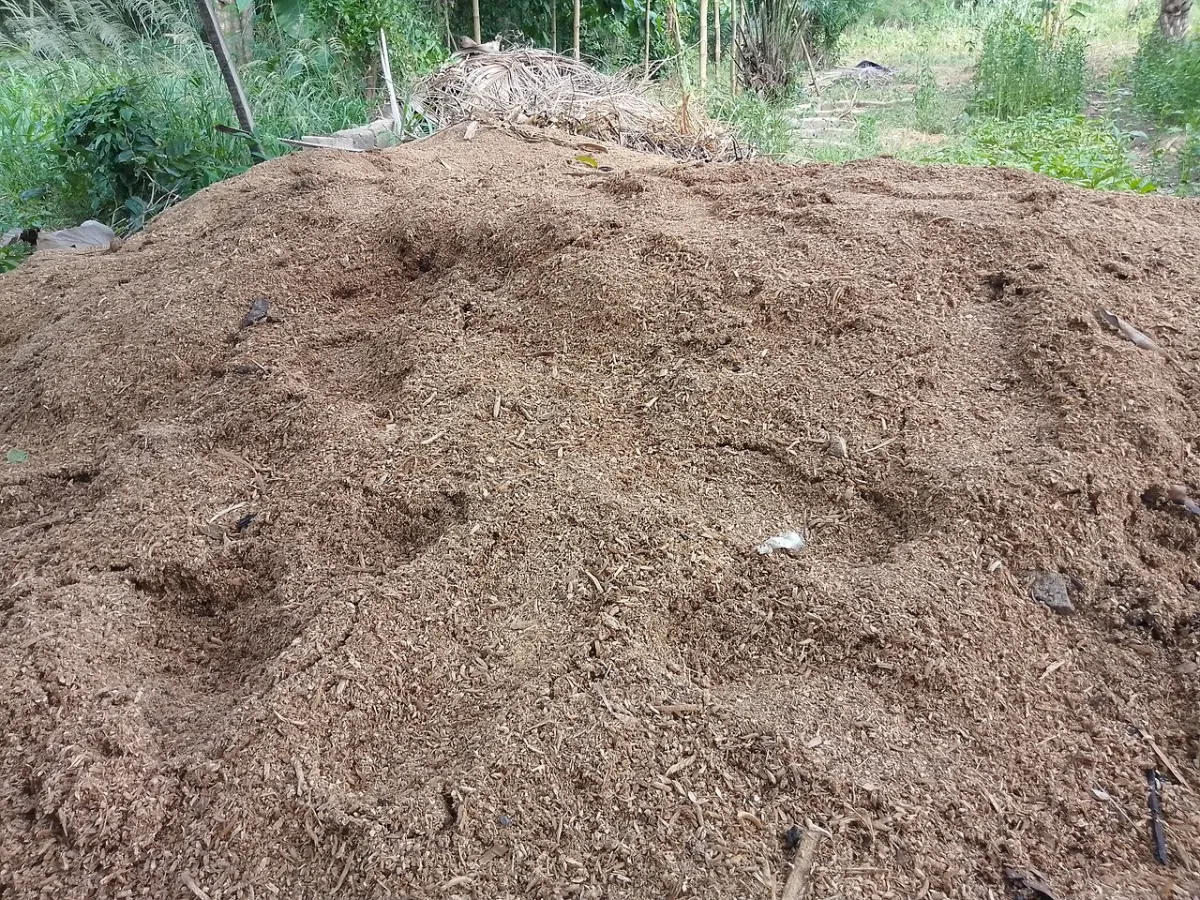
Composting is one of the best ways to utilize tree bark. For preparing composts, bark is mixed with manure or poultry litter in a 1:1, 2:1, or 3:2 ratio. To enrich the mixture with nutrients and accelerate maturation, rock phosphate and potassium chloride are added. In practice, layered, focal, or area-based stacking methods are used.
The production of bark-based composts is carried out in a strictly defined sequence, starting with the preparation of raw materials. First, the material is ground, then mixed with active components and sent for maturation. This entire process is divided into several main stages.
- Shredding the bark into 5–10 mm particles.
- Adding substances to stimulate its decomposition.
- Transporting the resulting mixture to the site.
- Piling the mixture into heaps.
- Compost maturation.
Strict requirements are imposed on raw materials for composting. The content of the 10–40 mm fraction must not exceed 40% by mass. Particles larger than 40 mm are not allowed, nor is the presence of metallic impurities or contamination by mineral oils, fuel oil, or impregnating compounds.
Favorable conditions for bark composting are created by forming piles with a base width of 3.0–4.0 m, a height of 1.5–2 m, and a length of at least 4.0 m. When composting in winter, to avoid freezing, the stack height can be increased to 2–5 m, and the length to at least 10 m. The optimal mass of the stack is 100–120 tons (a stack with a mass of less than 60 tons will freeze); the temperature during the composting period is 40–60 °C.
Finished compost must contain at least 80% organic matter on a dry weight basis at a humidity of no more than 60%, 10–15% of the total organic matter as humic substances, an aqueous extract pH of at least 5.5, a C:N ratio of no more than 30, and nitrogen, phosphorus, and potassium at 3.0%, 0.1%, and 0.1% of dry mass, respectively. Compost has a density of 0.18–0.3 g/cm3, a cloddy structure, and a water-holding capacity of 250–350 g of water per 100 g of dry matter. Due to its high content of calcium, it is a valuable soil amendment for acidic soils. Wood bark compost not only improves plant growth but also reduces the incidence of root rot and almost completely suppresses the development of nematodes.
The use of wood bark-based composts can significantly solve the problem of supplying greenhouses and hotbeds with high-quality soil.
Sawdust is used in agriculture in a similar way. All types of sawdust improve the physical properties of soils, increase their porosity and water-holding capacity, and reduce the density of heavy clay soils. Like wood bark, sawdust contains little nitrogen, so it is most efficient to compost it with nitrogen fertilizer.
Hydrolysis lignin is the main waste product of the hydrolysis industry, accounting for up to 40% of the raw material mass. When discharged from the hydrolysis apparatus, it largely retains the shape of the original raw material particles but has a dark brown color. In terms of chemical composition, hydrolysis lignin is a complex of substances, the bulk of which consists of condensation and polymerization products of natural lignin. It also contains non-hydrolyzable polysaccharides, unwashed sugars, humic substances, organic acids, sulfuric acid, and ash elements. Of these, the first two—lignin itself and polysaccharides—make up 84–91% of the total mass of hydrolysis lignin. Polysaccharides account for 24–45%, and lignin as such for 39–70%. Lignin has an acidic reaction, and its humidity is 63–75% (Table 146; Tsurkan M.A., Russu A.P., 1980).
Table 146 – Agrochemical indicators of hydrolysis lignin (calculated on dry matter) Indicator Hydrolysis lignin Hydrolysis sludge
Humidity, % 63.1–75.1 61.9–89.6 Ash content, % 3.5–14.7 4.2–72.5 Total carbon, % 42.9–50.8 12.5–53.0 Humic acid carbon, % 3.4–6.4 5.2–18.4 Fulvic acid carbon, % 3.7–7.7 3.0–6.4 Total nitrogen, % 0.34–0.54 0.62–2.32 Nitrate nitrogen, mg/100 g 0.1–0.7 0.5–2.5 Ammonium nitrogen, mg/100 g 2.2–7.6 133–389 Easily hydrolyzable nitrogen, mg/100 g 40–79 183–1470 Total phosphorus, % P2О5 0.01–0.16 0.39–2.46 Total potassium, % К2О 0.01–0.22 0.14–0.33 Total calcium, % СаО 0.20–1.19 0.16–4.07 Total sulfur, % SO4 0.41–2.23 0.64–9.28 pHH2O 1.9–4.7 3.0–4.6
Among the elements of plant mineral nutrition, sulfur and calcium occupy a large share in hydrolysis lignin. Phosphorus and potassium are contained in the amount of 0.06% and 0.09% of dry matter, respectively, on average. The total nitrogen content in hydrolysis lignin is low – 0.34–0.39%, and only 14% of its total amount is the easily hydrolyzable fraction. The C:N ratio is very wide (75–117).
Returning the organic matter of lignin to the biological cycle, combating environmental pollution, and increasing the production of local fertilizers all make it necessary and expedient to process lignin into fertilizer.
The difficulty of using lignin as a fertilizer is associated with its acidity and low nitrogen, phosphorus, and potassium content. At the same time, it possesses positive qualities: it improves air permeability, porosity, structure, and other physicochemical properties of the soil. Particularly noteworthy is its ability to adsorb nitrogen from highly mobile nitrogen fertilizers and form a chemical bond with it; therefore, nitrogen leaching from the topsoil is reduced, and its utilization rate by plants is increased.
An industrial method for preparing fertilizers has been developed by composting lignin with mineral fertilizers and treating the compost with an aqueous solution of ammonia before application to the soil. To prepare the compost, the lignin is pre-neutralized with dolomite flour at a rate of 30–35 kg per ton of fertilizer.
Lignin-manure composts are most effective at a ratio of manure to lignin of 1:1. To prepare 100 t of such compost, 48.2–48.5 t of lignin with 60% humidity, 1.5–1.75 t of dolomite flour, and 50 t of manure are required. To accelerate compost maturation, piles are made no more than 1.5 m high, and the composts are mixed thoroughly.
| Component | Content |
| N | 0.36 % |
| Р2О5 | 0.32 % |
| К2О | 0.34 % |
| pH | 5.7 |
Well-prepared lignin-manure compost is equal in effectiveness to peat-manure compost. Biologically active growth substances are also obtained from lignin, which are used in their pure form as growth stimulants for plants or serve for the preparation of fertilizers.
Household waste is an accessible source of organic matter for fields. One resident of Russia produces from 0.15 to 0.25 t of such waste per year. Its composition contains 30–40% food scraps and 20–30% paper. The dry matter of the source waste contains 40–70% organic matter, 28–30% ash, 23–37% carbon, 0.75–1.15% nitrogen, and 2.0–5.5% calcium. However, high biological contamination makes untreated waste dangerous, therefore, it requires mandatory disinfection.
Simply leaving waste in landfills is considered unpromising by sanitary services due to odors and the risk of infection. Such compost is heavily contaminated with glass, metal, and plastic, which precludes its use on arable land. Field composting also cannot process the entire volume of waste from large cities. Industrial biothermal processing remains the most effective solution.
- Waste is brought to the plant and unloaded into two storage bunkers with a depth of 10 m and a capacity of 900 m³ each.
- A grab crane with a lifting capacity of 5 t delivers the raw material to conveyors, where electromagnetic separators extract ferrous metal.
- The mass is directed into biothermal drums rotating at a speed of 0.1–1.14 rpm.
- Air and water with a temperature of at least +40 °С are fed into the drums. Due to the vital activity of microorganisms, the mixture self-heats to 60–70 °С, and complete disinfection occurs within three days.
The finished industrial compost obtained at the output has a humidity of 30–40% and a neutral-alkaline reaction (pH 7.8). According to current standards, it may contain no more than 4% foreign impurities and no more than 3% glass with a particle size of up to 15 mm. In its influence on yield, this fertilizer is close to bedding manure.
- Organic matter — 40–52% of dry mass
- Nitrogen — 1.0–1.3%
- Phosphorus — 0.8–0.7%
- Potassium — 0.4–0.6%
Application of MSW compost in practice
Field trials have proven that the yield increase from the application of industrial compost is 10–50% depending on the soil type and the crop being grown. The fertilizer is applied during tillage">primary tillage of the soil. In this case, autumn application of compost is more effective than spring application. Application rates depend on the cultivated crop.
Industrial compost is completely safe in sanitary-hygienic, helminthological, and entomological terms. High-temperature treatment destroys pathogens and parasite eggs.
| Crop | Compost application rate, t/ha |
|---|---|
| Grapes | 20 |
| Grain crops | 20–50 |
| Sunflower, corn | 30–100 |
| Fruit crops | 50–150 |
Due to the increased content of lead and zinc, the use of composts from solid household waste for vegetable crops is strictly prohibited.
Read next
Agrochemistry For students
Classification and physicochemical characteristics of slurry manure
Greenhouses and covers For gardeners
Application of organic fertilizers in greenhouses and open soil
Agrochemistry For students